
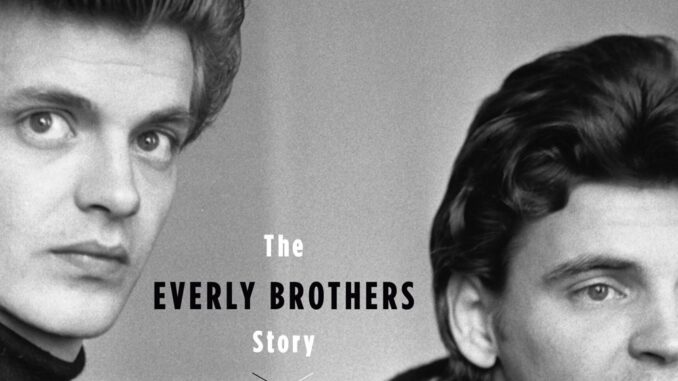
 Though they’ve always been known for those sublime, spine-tingling vocal harmonies, it can be hard to understand just how important the Everly Brothers are in modern music. They weren’t the first to use close harmony singing; there are plenty of earlier country music duos that the Everlys sought to emulate, such as the Delmore Brothers and the Milo Twins, as mentioned in this excellent book. But the Everlys were probably the first to use those close harmonies in a pop/rock and roll setting, and they set the bar when it comes to close harmony work in twentieth-century popular music. Their approach to harmony singing was the template for many prominent bands in their early development, including The Beatles, The Hollies, Crosby, Stills & Nash, and so many more. Without the music of the Everly Brothers, it’s reasonable to suggest we would not have popular music, and americana music, as we know it.
In writing “Blood Harmony”, Barry Mazor, who has previously written books on Ralph Peer and Jimmie Rodgers, sets out to show just how important the Everly Brothers have been in modern music, and to document their many contributions to music over the years, but also to try to remove some of the myth and mystery that has surrounded the brothers throughout their careers. This book is important because it seeks to establish Don and Phil as individuals – a particularly difficult task. After all, they had been treated as a combined unit from early childhood. It is almost impossible to mention one without mentioning the other, and this was both a blessing and a curse throughout their lives.
Many on the European side of the Atlantic will be surprised to discover that the Everly Brothers began their careers in entertainment when Don was seven and Phil was just five years old (“Little Donnie and Baby Phil”). It was reasonably common practice back then in the U.S, especially in rural areas, to build radio programmes around a family and Ike Everly, the brothers’ father, was a well-established entertainer with a reputation as a “guitar wizard”, and their mother, Margaret, played a mean slap bass. What this meant was that the family had a regular radio show but were also expected to promote the show and its sponsors, via regular live performances. It’s this sort of detail on the brothers’ early life, and their lengthy immersion in the business of show business, that makes this book such a compelling read.
Mazor’s research has been extensive, and he documents all the major aspects of the brothers’ lives, starting with their early hand-to-mouth existence and the family’s near-itinerant lifestyle, and following them through their successes and failures as they build their careers, both together and apart. There’s a whole chapter given over to their relationship with the songwriters Felice and Boudleaux Bryant, rightly so, given how important their songs were to the brothers, as they were emerging as teen idols. In particular, the song ‘Bye Bye Love’, which gave them their first big crossover hit. The Bryants were one of the few songwriting teams around who were writing with harmonies in mind, and it’s a fascinating insight into how the artists and the writers became so important to each other.
Perhaps the most interesting part of the book is the two chapters on the ‘lost’ years. We have ‘Don 1973 – 1982’ and ‘Phil 1973 – 1982’. These are the years they spent trying to build solo careers, and they offer some interesting insights into the differences between the two brothers. Don moved to California, hanging out at The Sundance Saloon in Calabasas, with the likes of Jackson Browne and fledgling Eagles Glenn Frey and Don Felder, reinventing himself as a country-rock singer-songwriter, before returning to Nashville and getting back to a closer relationship with country music again. Phil goes through long periods of inactivity and disinterest in performing, claiming that “When we finally split, I did basically nothing for ten years“, though he did find time to record five solo albums (3 more than brother Don in the same period), finding significant songs like ‘The Air That I Breathe‘ along the way (Phil Everly’s interpretation being the inspiration for The Hollies hit version). He’s also credited with coming up with the basic idea for Warren Zevon’s breakthrough song, ‘Werewolves of London‘ (Zevon was playing in his band at the time). Not entirely inactive then!
It’s in this period that we also see the involvement of Albert Lee, who starts out being known as “Phil’s friend” but also joins Don’s band, working with both brothers, and is the first person the brothers turn to when their reunion finally comes around and they need a guitarist and musical director.
These chapters help to lay to rest the speculation of what happened between the brothers that caused the rift. It makes for very interesting reading, but it all comes down to far too much time spent together growing up, and some of the paranoia that creeps into fraternal relations when your life is lived in the spotlight, something we’ve seen from other brothers in bands over the years. There’s a good quote from Don, at the end of his chapter, that seems to sum up the situation: “When you grow up together, working together day in and day out… you don’t know any other way, any other life. You tend to blame each other for all the things that go wrong in your personal life – divorces, whatever.” Given that Don (4) and Phil (3) had seven marriages between them, it suggests there was a lot of angst to blame each other for!
This is a terrific book, full of fascinating details and with a stellar cast of characters, as you might expect from a duo that started out on country radio, were there at the birth of rock and roll, were a founding force in country rock, and stayed musically relevant throughout their long career and beyond. In full disclosure, I was their UK tour manager for a couple of tours in the mid-80s, post the reunion; they were one of the best bands I ever worked with, and two genuinely great and very different people, whose singing was always an absolute joy to hear. This biography is important because it finally looks beyond the public image of the brothers to focus on Don and Phil, the individuals. It celebrates the great music they created together, while highlighting the differences that drove them apart and the changes they underwent in their solo years, which ultimately enabled them to reunite as a duo.
Without a doubt, Don and Phil Everly are two of the most important musicians in americana and roots music. “Blood Harmony” is the book their lives deserve.



This is a stellar review. I will be buying a copy of the book. Well done and thankyou.
Thanks Laurence, glad you found it useful.