
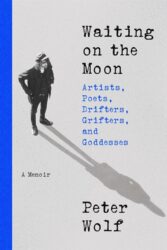
 It’s hard to imagine a rock ‘n’ roller’s memoir that is as easy to read as Peter Wolf’s Waiting on the Moon: Artists, Poets, Drifters, Grifters, and Goddesses. Readers will find raspy, rambling, raucous vignettes of the musician from early childhood in the Bronx through moving to Boston, Chicago and time spent in Hollywood. Tales are told in detail, assuredly, but this memoir is refreshingly not gossipy, mean-spirited, or sordid, at least not more than the truth or Wolf’s perspective on it demands. Wolf is as comfortable in his bones as a worn pair of boots, and he captures the rhythm of his life so effortlessly that reading his memoirs with all the fascinating characters is like meeting an old friend for coffee (or something stronger) to catch up with one who happens to be an iconic rocker.
As famous for his unrestrained lifestyle as for his blues-rock voice, Wolf presents his sprawling narrative with a deep and abiding commitment to good times and good friends. If you like living vicariously through the actions of others, there are few lives that offer more roller-coaster-ride thrills than his. The language is colourful to say the least, but it is prodigiously descriptive, entertaining and eloquent. The book is written in a confident, nuanced manner, in a conversational first-person, the anecdotes all regaled in a witty, good humour about amazing events, coincidences and chance meetings.
You might be shocked to find out who Peter Wolf has not known or met in person. There is an A-list of celebrities, artists and musicians circling through his orbit. Besides numerous big-name musicians, he details encounters with Alfred Hitchcock, Andy Warhol, Tennessee Williams, Julia Child, and Martin Scorsese, to name a few. He appears to have experienced a sort of Zelig-like life.
From the beginning, we can intuit how the book is going to continue by the title of the first chapter, “I Slept with Marilyn Monroe.” As it turns out, his parents took 10-year-old Peter to a movie theatre to distract him from visiting his sister Nancy, who was being treated for rheumatic fever in a hospital. A woman in a fur coat, accompanied by a tall man, took the seat next to the young lad. Bored by the subtitled movie, the woman rested her head on his shoulder and fell asleep. Intoxicated by her perfume and agonising over trying not to move, Peter also slept until the man jostled the lady, saying it was time to go. As the lights came up, Peter could hear people in the audience exclaiming, “Look… It’s them!”
Another time, his father got two “front-row” tickets from a ventriloquist, one of his uncle’s clients, for a sold-out Louie Armstrong show at the Roxy Theater. As Armstrong greeted the audience and the band started to play, the stage began to rise up, “higher and higher like Jack’s beanstalk,” until they could barely see the front of Armstrong’s horn. Ruefully, Wolf writes, “My dad and I learned a valuable lesson. Never trust a man with a dummy.”
His father wasn’t necessarily unproductive as a breadwinner, but he tended to earn money haphazardly: as a singing waiter contestant on the Merv Griffin show, or a summer spent in Lee, Massachusetts, singing with a chorale at Tanglewood. This is where teenage Peter was dropped off at an artist’s studio while dad rehearsed. The artist kept him supplied with paints, pencils and paper, sparking his enduring love of painting. The artist’s name… Norman Rockwell.
Bob Dylan was among the new arrivals to Greenwich Village when Wolf first saw him in a record shop. The next gasp-worthy sighting was the Monday hootenanny night at Gerde’s Folk City. Dylan was rambling on to a group of people about a record John Hammond had given him by Robert Johnson. “I can look into people’s eyes and see truth in them,” Dylan said. “Robert Johnson had a truth only a few singers are capable of capturing.” Meanwhile, unobserved Peter kept emptying Dylan’s wine glass every time he put it on a table. Rebuffed in repeated efforts to meet and converse with Dylan, he finally succeeded one afternoon while teetering down 6th Avenue in New York after having a few too many rum colas. Dylan was seated outside a steakhouse, reading the newspaper. Though initially hesitant, Wolf saw this as the perfect opportunity to show off his paintings, despite Dylan raising the newspaper to hide his face. He sits down and asks Dylan to tell him what is truth. Dylan goes into this long, loud rant about Aristotle, the pyramids, the Book of Revelation and winds it up with, “I just want to drink my coffee, read this newspaper and be left alone.” Years later, Dylan sent him a pair of black leather pants Wolf had once admired. Go figure.
Wolf got accepted at an art school in Boston and showed up a couple of days early with only enough money to stay one night at the YMCA. The next morning, he went to the school message board, hoping to find someone looking for a roommate, when another student named David tapped him on the shoulder and said he had a room. Wolf was always late with his share of the rent, which led to him being locked out of the apartment. David Lynch went on to film school in Pennsylvania and made a movie called Blue Velvet. Peter sent him a note of congratulations along with a book he thought Lynch would like. A note came back saying thank you for the book. “Good hearing from you, but I must remind you that you still owe me $33.40.”
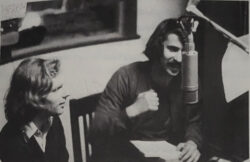
Deep down, Peter Wolf was a kid from the Bronx who loved the blues. He met and hung out with several legendary OG blues artists: James Cotton, Don Covay, John Lee Hooker, Aretha Franklin, Howlin’ Wolf. When Peter was living in Chicago, Muddy Waters used to rest up at his apartment when in town, napping on his futon. Covay stayed at his apartment in Cambridge during the time Wolf was the “Woofa-Goofa” R&B-spinning, late-night deejay on WBCN-Boston. One listener would regularly call in asking him to play a song from Van Morrison’s Astral Weeks album. Of course, that listener turned out to be Morrison himself, and the two insomniacs became friends, talking music all night long at the radio station.
Both personally and professionally, Wolf’s life’s ambition comes across strongly as a passionate dedication to his art. Though he has many faults and a penchant for recreational drinking and drugging, he strikes you as genuine, kindhearted and honest. The section on his first girlfriend in the Bronx, Edie, who lived with him through the formation of the J. Geils Band, is exceptionally poignant. There is plenty written about meeting a girl named Dorothy Faye through a publicist from his label. What followed was a sexy, stormy romance between the still-struggling rocker and the actress, Faye Dunaway, who had already starred in movies like Bonnie and Clyde and The Thomas Crown Affair.
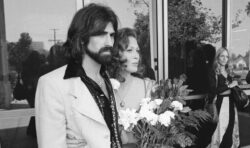
During the filming of Chinatown, Wolf and Dunaway were invited to the home of Jack Nicholson. “As the evening wore on, the other guests seemed to drift away until it was just Jack, Faye and me,” Wolf wrote. “They discuss (Roman) Polanski and the best way to deal with his temperament. Jack invited Faye upstairs to work on the script, and Faye asked if I would mind waiting. I answered, ‘Of course not.’ ” Alas, after a few hours, Nicholson and Dunaway had yet to come down. Wolf called out for Dunaway and got no response.
“I continued to wait in the living room,” Wolf continues. “Finally, as I saw the sun coming up, it occurred to me that what I thought might be happening was definitely happening. I call out her name again, louder and more forcefully, but still no response.” He ended up calling a taxi, but before leaving, picked up the expensive coffee table and a couple chairs and dumped them in the swimming pool. A year later, Peter and Faye made up and got married.
While other reviews have complained that Wolf was merely name-dropping his interactions with celebrities, it appears he was painting pictures of each of these individuals in that moment. A little more reflecting on the Geils band would have been welcomed, but I understand it’s complicated. He took the high road and told it without throwing any of his bandmates under the bus, except for a little shade on Seth Justman. Peter Wolf is obviously a guy who was in many right places at many right times, and the book is a low-keyed and fascinating celebration of being there when so much was happening.

