
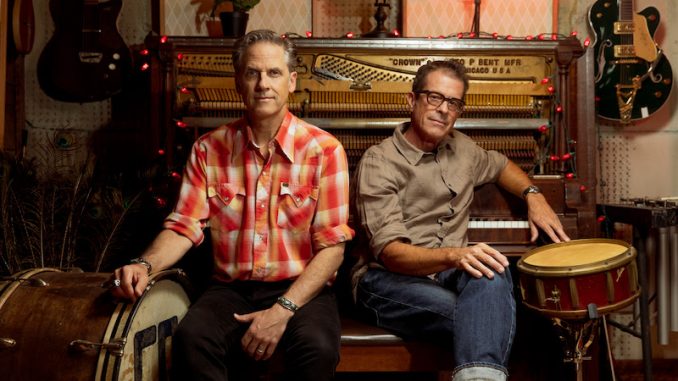
Next year, Calexico will have been around for 30 years, which I find hard to believe. Core members John Convertino and Joey Burns first met in 1990 through their mutual friend Howe Gelb, when Convertino was searching for a double-bass player. They have been playing music, often labelled as “desert noir”, as part of Calexico since 1996.
John Convertino started playing the drums at the age of nine. He studied jazz drumming under Stanley Spector, who was based in New York and died in 1987. Spector’s methods were seen by many to be unconventional, and a website, from which recordings of his lessons can be purchased, describes his methods as “having divided the drumming community”. Spector placed an emphasis on feel and being in the moment rather than the rudiments of playing the drums. There was a point when Convertino didn’t have any cymbals in his kit, concentrating on playing the snare, saying that “You can stay on the snare and hug it, you can play notes that can’t be heard but felt”. His sublime, jazz-influenced, and fluid playing underpins everything that Calexico does. An enthusiast of small vintage kits, his drumming is anything but simple. His use of brushes, not just on the slower numbers but also the upbeat songs, is something to behold. It’s worth seeing Calexico live just to watch Convertino.
Joey Burns, like Convertino, can also play a vast array of instruments. He studied music at the University of California. He initially gravitated towards the bass, acting on the advice of his older brothers, who told him that “There’s enough guitarists in the world. Why don’t you just play bass? You’ll probably get to be in more bands or have more opportunities.” As a result, he studied electric bass and joined the high school jazz band, where his love of Latin American-influenced sounds, including samba and Afro-Cuban music, developed. When fronting Calexico in concert, Burns usually plays a nylon-string acoustic or a white vintage 1962 Airline 3P Res-O-Glas guitar, with bass duties currently being undertaken by Scott Colberg.
The genesis of Calexico was when Burns and Convertino gelled during a Giant Sand tour of Europe. It was the birth of what could well be considered the finest blend of americana, mariachi, folk, country, and jazz music, which has resulted in 12 studio albums of material. So, which of their LPs would I take with me if I were to be shipwrecked on a desert island, and which one would be left to sink to the ocean floor?
Can’t Live With It: “Spoke” (1996)

Maybe it’s unfair to include “Spoke” amongst Calexico’s discography, given that the band had not officially adopted that name when the record was originally released in 1996 and still referred to themselves as Spoke. However, the founding pair of Burns and Convertino wrote and play on every track. It’s certainly a smaller and more compact version of the band than appears on future releases. The main duo are accompanied by Tasha Bundy (drums), Bridget Keating (violin) and David Coffman (guitar). It really is an embryonic Calexico sound, which is on display here. It’s more lo-fi and gritty than things to come. Burns’s vocals sound slightly washed out to these ears, but that may be a product of the recording process, which took place on an eight-track recording machine at the band’s homes. And yet many of the songs still manage to convey the feel of the desert, but they don’t quite capture the expanse of the landscape as well as many of their later works do.
The album opens with the fittingly named ‘Low Expectations’, which features somewhat soporific singing from Burns. It sets the tone of the album. The second track ‘Mind the Gap’ is a 52-second field recording of a train rolling into a Prague underground station and an announcement, in Czech, which it’s presumed translates as the title. Things pick up a little with the Slavic-influenced waltz ‘Mazurra’, later on in the album, there’s another instrumental in the same time signature entitled ‘Mazurka.’
It’s not until the fourth song, ‘Sanchez’, that a more recognisable Calexico sound and themes emerge, with lyrics such as “Going on their lands for sale to stake my claim, Burn my name in the soil, Out past the borders beyond the hill, Through seasons of nothing.” ‘Slag’, featuring just Burns and Convertino, continues the underwhelming vocals. It’s a song that is still performed live by the band, but with a more fully formed sound.
‘Scout’ is a perfunctory piece of surf rock which nods in the direction of Duane Eddy; however, it’s good enough to punch through the listlessness of the proceedings induced by the first nine songs. As Calexico wrote of the track ‘Ice Cream Jeep’, “the title says it all”. It’s another field recording, this time of an ice cream van. I feel that I am missing the joke somewhere. Proceedings come to a close with ‘Stinging Nettle’. It’s the last of the eight instrumentals and probably the best piece of music on the album. It was co-written by Burns and Coffman. It includes some beautiful finger-picked guitar, as well as marimba and vibes. There’s something captivating about it, as a mournful cello plays over the top of the other instruments.
Overall, this feels like a very bitty album with seven of the 19 tracks clocking in at two minutes or less. It’s a body of work produced by a band which still had not quite found their feet. However, this might say more about my taste as a listener and my inability to appreciate the artistic and slightly experimental nature of the oeuvre. “Spoke” is certainly a slow burner of a record, not without its charms; however, with a back catalogue as bountiful and as good as Calexico’s, it’s not one of their albums that I return to often.
Can’t Live Without It: ‘Feast of Wire’ (2003)
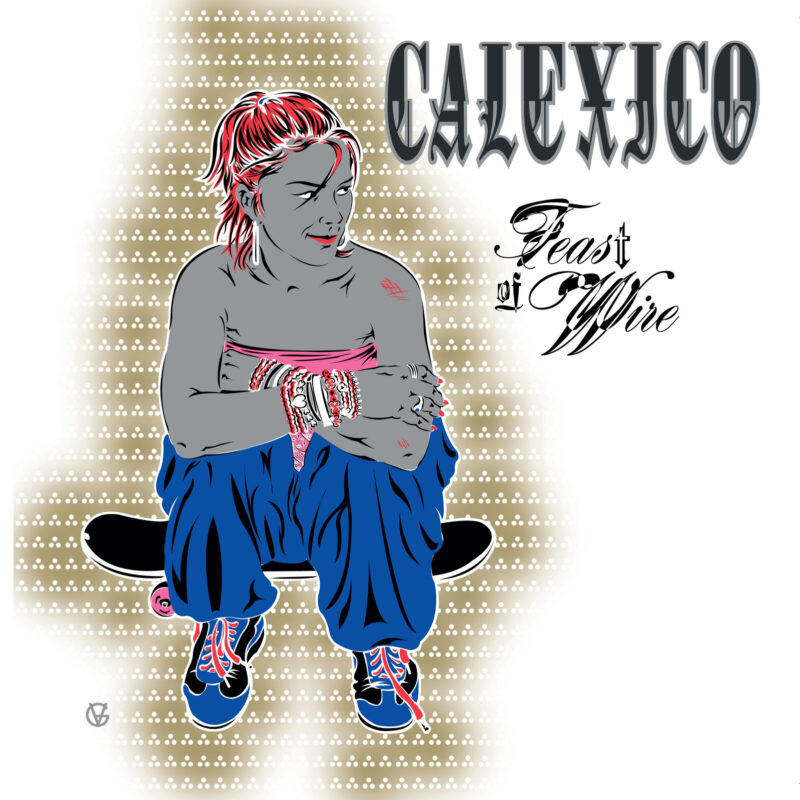 Released seven years after “Spoke”, “Feast of Wire”, Calexico’s fourth record, is by any measure a classic album. The album first came to my attention via Nick Stewart, who broadcast an americana-themed show on Virgin Radio, under the Captain America moniker, on Sunday evenings in the early 2000s.
The range of genres and styles on display on the record makes for an eclectic mix that somehow manages to be at the same time coherent and cohesive. The record’s influences are too many to mention, but include: Gram Parsons, Townes Van Zandt, Ennio Morricone, Miles Davis, Link Wray and possibly even Kraftwerk.
The artwork for the album was supplied by Victor Gastelum, who Burns described as “The fifth Beatle, he is the silent one that no one really ever sees.” The pair met when they were both working at SST Records. Gastelum not only produced the album cover but also came up with the record’s title. Burns was contemplating using “Feast of Snakes” taken from a Harry Crews book title. However, as Gastelum explains, “He was also thinking about the idea of communications telephone wires. We just started going back and forth, saying feast of this and that, and at one point, I think I said: How about Feast of Wire?” It’s an appropriate title for what’s contained within the songs, tales of borders, fences, twisted communications and intertwined relationships.
The accordion-driven opener, ‘Sunken Waltz’, has a parable-like quality to it. The song references “Carpenter Mike”, who was someone Burns knew and lived in a treehouse on the outskirts of town. It’s a tale of escaping creeping urbanisation and the corporate world to sleep “neath the stars” and to take “flight at first light of new morning”.
The album not only brings together a range of musical styles but also highlights Burns and Convertino’s musical versatility and virtuosity. Burns is credited with playing 13 different instruments, in addition to providing lead vocals on most of the songs. The cornerstone of the album is surely ‘Across the Wire’. It was inspired by Luis Alberto Urrea’s prize-winning book entitled “Across the Wire: Life and Hard Times on the Mexican Border”, a non-fiction account of the life and day-to-day struggles of refugees living on the Mexican side of the border a mere 20 miles from San Diego. It provides an explanation as to why so many people undertake the perilous journey “across the wire” from Mexico into the USA. Calexico manage to distil the whole book into a two-and-a-half-minute song in which Alberto and his brother are “dodging the shadows of the border patrol, out in the wastelands wandering for days”. There’s a superlative live version recorded at the Barbican in London in 2004 featuring the Tucson-based band Mariachi Luz de Luna.
There are songs on the album which have obviously been inspired by Spaghetti Western soundtracks, with the influence of Ennio Morricone having seeped into the pores of the musicians’ skin. The Tucson Symphony Orchestra provide a depth and beauty to ‘Black Heart’. ‘Attack! El Robot! Attack!‘ sees the band delve into electronica and dish up one of their many idiosyncratic instrumentals, and ‘Crumble’ spotlights Convertino’s jazz drumming training. There’s a limited edition CD version of the album which concludes with three cover versions: The Minutemen’s ‘Corona’, Françoiz Breut’s ‘Si Tu Disais’ and Link Wray’s ‘Fallin’ Rain’. These add rather than detract from the preceding Calexico originals, so it’s no surprise that this LP is rightly regarded as the band’s masterpiece.

