

Mention the name of Jeffrey Foucault to the ordinary music listener and you will almost certainly be met with a blank look, such that I almost feel as if Jeffrey Foucault ought to be a subject of our Feature ‘More people really should know about….’ However I put my trust in AUK readers that they have not only heard of him, but have also heard an album or two although maybe not his whole catalogue – for he is an AUK favourite. It may be a surprise to learn that Foucault has released 15 albums, which include two as part of the trio Redbird (with his wife Kris Delmhorst, who is as equally under the radar as her husband, and the very talented Peter Mulvey, ditto), two as part of a collaboration with the poet Lisa Olstein called Cold Satellite, an album of murder ballads with Mark Erelli (well worth the entrance price) and an album of acoustic outtakes from one of his own albums, “Horse Latitudes“. He has also produced a number of albums, including the brilliant Caitlin Canty’s 2015 offering, “Reckless Skyline”.
Foucault comes from Wisconsin, though he now lives with Delmhorst, in New England. The Midwest state has been a fertile ground for his songs of vivid imagery and cinematic landscape, which often are used in conjunction with his songs of love, loss, mortality, disenfranchisement – all sung in a rich baritone, often weathered when he occasionally tends to slur words. Tracks vary from country folk in the style of John Prine to country blues similar to Chris Smither.
His first album came out in 2001, the promising but rather spartan “Miles from the Lightning“, and his latest was in 2024, the often brilliant “The Universal Fire” which equates the fire at Universal Studios which destroyed many of the master recordings of a number of very famous and influential artists with the death of his drummer and best friend Billy Conway, from cancer in 2021. In the middle of his output is a quite outstanding album of covers of Prine songs, “Shoot the Moon Right Between the Eyes“, taken from a lyric in Prine’s song ‘Clocks and Spoons’.
Can’t Live With it: “Deadstock: Uncollected Recording 2005 – 2020″ (2020)
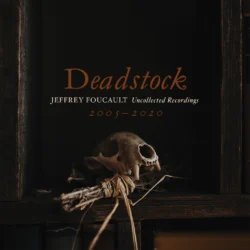 There is no such thing as a poor Foucault album, not even an average one. The album that I would play least is “Cavalcade” with Cold Satellite, but as the lyrics are largely those of Lisa Olstein, I have disregarded that album. So that leaves this really rather good album where there are seven new writes and new arrangements of other songs that appeared on earlier albums. It is played by most of the band that Foucault has used for many of his later albums with David Goodrich, Billy Conway, Eric Hayward and Jeremy Moses Curtis, plus his favourite vocalists, Kris Delmhorst, Pieta Brown and Caitlin Canty – a formidable group. And as I write this, I find it very difficult to explain why it is an album that does not get the airplay with me that other Foucault albums get. As he himself stated, “Here’s a bunch of songs so good I never put them out, but these are as good as anything I ever wrote, and we’ve played some of them on the road for years”. I think maybe it doesn’t hang together as a cohesive work in the way that his other albums seem to (take “The Universal Fire“, “Salt as Wolves“, or the album featured below). There is a little weakness in the original songs, and, to these ears, the re-recorded versions of earlier tracks are no match for the originals. Still, his writing is still great with wonderful images such as in ‘Cold Late Spring Bark River‘ – “High water in the tall grass / And I’m listening / To the cars roll by /Out on the overpass”, or “The quiet fury of our dreaming / The starry horsemen gone careening / In the blue teeth of the gas stove / In the soft unnumbered falling / Of the moon” from ‘ Shadows Tumble‘. And the opener is a very fine version of Rev Gary Davis’ ‘There is a Destruction on this Land’. But there you have it, I’ve had my say; not an album that gets as much airplay as it perhaps should.
Whereas…
Can’t Live Without it: “Ghost Repeater” (2006)
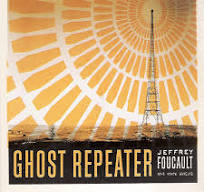 An album that gets regular repetition (no mean feat given the number of CDs it competes against) and a bona fide challenger for best album of its year.
After a couple of albums with modest instrumental support, Foucault upped the ante, brought in the incredible Bo Ramsey as producer as well as main guitarist, and created a much more expansive sound, which made people sit up and listen to him on what was a rather more accessible album without any diminution of his writing skills (which, to be fair, have been consistently high throughout his recorded career). Ramsey was well known for his country blues styling in his work with Greg and Pieta Brown and Lucinda Williams, and frontman for the Mother Blues Band. The rhythm section of Steve Hayes (drums) and Rick Cicalo (bass) were also largely in the Mother Blues Band; Dave Moore was a renowned accordion player, Eric Heywood an exceptional steel player, and Kris Delmhorst a better-than-average harmony singer. The album kicks off with one of Foucault’s most accessible tunes, though rather cerebral lyrics, the title track, which refers to a network of radio stations broadcasting religious programmes from a centralised platform without any local presence, in this case a metaphor for feelings of alienation. Acoustic guitar, accordion and harmony vocal are the main accompaniment. And thereafter, you get the impact of the extraordinary Bo Ramsey on proceedings. His contribution to ‘Americans in Corduroys‘, a reflection on the excitement of marriage to, and honeymoon in an unnamed country with, Kris Delmhorst (a constant theme throughout the album), is spellbinding; his two guitars seem to spar with each other in short solo bursts. The love songs on the album are just beautiful, melodically and lyrically. ‘One Part Love‘ is such a thoughtful love song that you probably need a listen or two to pick up on the interconnection between love and grief, as exemplified by an absence from a loved one due to travelling. ‘One for Sorrow‘ swings along with a country vibe – “And we’ll have a hundred babies / And a little house outside of town / With a wood-stove and a claw-foot tub / When we′re all done traveling around”.
These songs also touch on the other main theme of the album, travelling and various places are featured in this musical landscape – ‘Train to Jackson‘, a prodigal son story, has haunting guitar work from Ramsey, ‘Tall Grass in old Virginny’ and ‘Mesa, Arizona’, a more gently rocking country song, ponder living as a touring musician. The latter comes full circle lyrically to the title track – “ The country rolls / And the towns slide by / Like ghost repeaters / Of faded billboards & big-box stores / Like a movie of an empty theatre”
‘Wild Waste and Welter‘ is an acoustic blues which highlights Foucault’s own guitar playing, and the final track, ‘Appeline’, a really slow, somewhat simpler-than-usual love song that really highlights Heywood’s steel, Ramsey’s resonator playing and Delmhorst’s exquisite harmonies. One could continue to show examples of Foucault’s extraordinarily rich imagery, which might place him above even Greg Brown or Chris Smither or Darrell Scott as a lyricist throughout his catalogue; but the best way to experience his talent is by listening to his albums, perhaps starting with the one I can’t live without. It seems that critics have noted that “he writes like a novelist and sings like a man who has been through it“. Sums him up to a tee.



Big fan here. Met Jeff a few times, and interviewed him a few years ago:
https://twoholedraw.blogspot.com/2017/05/blog-post.html
Love Ghost Repeater. My favourite song at Christmas. Great memories. Cheers Fred.