
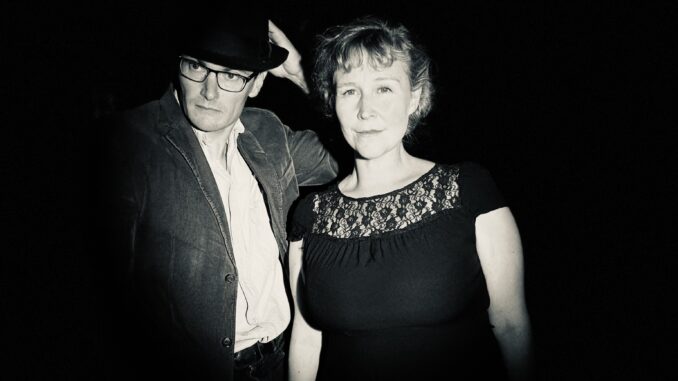
With influences in blues, jazz and country, Ma Polaine’s Great Decline is actually thriving on their fifth album, Monster Swan (2025). Based in Somerset, England, Beth Packer’s distinctive, emotive vocals, coupled with her evocative lyrics, create a compelling mix of abstract tales, dark humour and raw beauty, while Clinton Hough’s understated guitar style supports with rich chords and tasty riffs. The comparisons are there to a band like Cowboy Junkies, or, as they propose, “a moody Margaret O’Hara,” yet their sound is very much their own concoction.
In line with this, it is fascinating to hear artists whose body of work you can look at and see a blueprint of everything that bothers them, or sometimes delights the couple. Their daughter would be one example of the latter. “Once she’s asleep, then we can actually play,” Hough notes, “then that is kind of our downtime, and we’ll be able to reset our brains a bit.”
Monster Swan, in particular, is reminiscent of Over the Rhine’s The Long Surrender. Even though they both were recorded with a band, the albums come across as stripped-down and spacious at times, echoing into laments even on songs with more tempo. They spin tales of terror and tenderness, a collection of moving vignettes that would not surprise anyone familiar with their body of work. They tell stories that, no matter the level of detail, can stir even the sternest heart.
Small Town and Numb are back-to-back on the album, and both have that feeling of loneliness and despair. “I’m from a very small town in Cornwall,” Packer explained, “and the first is about somebody that leaves for long extended periods and the loneliness of returning, not quite feeling as though you completely belong. ‘Numb’ I wrote after a breakup, and it was basically that time where you almost don’t feel anything anymore. It’s such a strange feeling to love somebody and then all of a sudden there’s nothing but an emptiness.”
That’s how we sift through memory, of course — looking for significance in the things that stick with us, and sometimes coming up empty. Without loss, however, you don’t appreciate finding what makes living as a couple work. Two other songs slated one after the other are Told You Lately and Nights Like This. “The first is about the people who matter most,” Packer said, “and making sure they actually know it.” The second is a tender lockdown love song about biscuits, frustration, and endurance. “Clinton forgot the biscuits, and somehow it turned into this song. It’s really about love in the small moments, how companionship carries us through the strangest times.”
The tales told never buckle under their own emotional weight. Packer is the primary songwriter, and her characters or situations don’t exist just to suffer as they might in the hands of a less caring and considerate artist. Thanks to her pleasingly or a tender moment gritty vocal tone and Hough’s selection of such stark but beautiful instrumentation, they achieve the perfect balance. Listening to some of these songs is like having a friend hold your hand during a scary movie or a tender moment. Gasoline Can, the opening track, for example, is reminiscent of the television miniseries Little Fires Everywhere, with the exception that the children burn down the house instead of Packer’s arsonist. It’s a blues-fuelled take on a traditional murder ballad that turns the old trope on its head, where women are usually the victims, but here she takes the story back. “A friend of mine lived with her boyfriend,” Packer replied. “She’d come home one day, and he packed all of his stuff up and left, writing this goodbye message on the back of a Tesco receipt. Obviously, it was not a great time for her. And it just led onto this whole thing in my mind about how we actually have quite a lot of murder ballads, which are about men killing women. I just flipped it around so it was actually the woman seeking her revenge.”
Lyrically, Packer’s approach is from a different place than other bands. And her smoky vocals are another aspect that makes Ma Polaine’s Great Decline so enticing. “Beth’s voice is unique,” Hough said. “But she does it does it all. Occasionally, I’ll chip in with a different chord, a variation or middle eight.” Beth has a retort. “You always say this, but I think of our band as a little more than that because you can have the bare bones of a song with the chords and the melody and such, but it doesn’t really become what the song is until we come together and then that sound is created for both of us, if that makes sense.”
Hough joined Packer’s soul and blues band Beth and the Black Cat Bones in August 2010, and it was February 2011 when a failed attempt at re-working the blues classic My Babe stumbled into the first Ma Polaine song, Pigfoot Blues. It was clear this new song wouldn’t fit into the Black Cat Bones set, so it had to be for a new project. This propelled the pair into writing song after song, which led to the November 2011 release of the first Ma Polaine’s Great Decline EP.
“Music has always been a part of my life,” Packer noted. “I had piano lessons very young and singing, and then as soon as I hit the early teens, I started writing songs. Then we’d have a band, and the band would come and rehearse in the living room every Sunday and annoy all the neighbours. My mom would make us all a roast. And every weekend there’d be a band coming through my little town in Cornwall, and I’d go to watch them even if some were good, some were not, but you’d just always be there regardless.”
Hough always played and started by going to the local jam sessions. Then he met Beth. “We liked similar music, but when I was a teen, I liked the guitar bands like Supergrass and Oasis, but then I got into blues and jazz and carried on from there. In Beth’s band, the guitarist was leaving the country, and I auditioned and joined the band.”

Playing live as a duo, the songs become sparse versions of themselves, but the sound is a full one. Packer’s electric and double basses anchor the band, with additional accordion and harmonica, leaving Clinton to play with the space in between. She has a dark humour that gives the audience the chance to laugh at themselves by the songs’ human connection, love, and the complex facets of pain, with an understanding life can go a bit wonky sometimes. The band seeks to offer a raw, authentic portrayal of real-life experiences that will resonate with audiences from all walks of life. There’s a cathartic nature to her lyrics, songwriting and sound that hugs the listener and draws them in. “We don’t always get it right,” she commented. “We’re not perfect, and our imperfections are part of what make us human, alive, and connected.”
They enjoy playing the smaller rooms where people can pick up on the tenor of the songs. “I really love intimate gigs where you’re all squashed in a little room,” she said slyly. “There’s been a few where Clinton’s had to slightly bend down, isn’t there? Because in the UK we have very old pubs. Sometimes they’ll have music rooms downstairs in the basement. You all squeeze in and are squashed up next to each other. But there’s something really magical about those gigs because it feels so intimate. It’s like you’re having a conversation with the audience.”

Hough had never been in a band that was a listening band. “It was always dancing or just very loud, so it didn’t matter if people were talking because we would just be louder than them. At our first gig, that was a bit of a shock because we only had eight songs, but everybody listened throughout the whole thing, no one talking, no noise, not even from the bar. It felt strange at the time.”
One they still play from early days is The Poison Sits, where Packer is accompanied by sombre acoustic guitar. “The poison sits Just a little bit too close to you Do I make you uncomfortable? Does it suck the air out of you?” Yet this is a love song, though Hough remarked, “God, that’s horrible, but we still always play that live. There was a spell when we left it out and then people were asking for it back.”
Returning to the new material, The Grind is particularly intriguing by the David and Goliath reference. It would have been a wonderful sync in the current Prime television series, House of David. It’s a surreal reflection on city working life and identity, exploring the tension of navigating a world that’s sexist, money-driven, and obsessed with appearances. “Around the time when I was gigging in the evenings, I would temp in the day, working in offices,” Packer recalled. “I would do reception work, and they were very specific about how I had to look, how high my heels would have to be, how much makeup I’d wear. One day my boss sent me an email and said she wanted me to wear red lipstick, but when I said, ‘Oh no, I don’t think I want to. I don’t feel comfortable.’ We went back and forth, and eventually she said, ‘How about a bit of Vaseline?’ It was so bizarre and weird that I got caught up in this idea of feeling, as a woman, we have to dress a certain way and look a certain way, and that inspired the song.”
Happily, Packer no longer temps, and she and Hough can spend their days and nights making music, without which living would be unimaginable. Although Hough complains, rightly so, that the cost of gasoline, especially when travelling North, makes for some uncomfortable balances in the bank account. But Packer mentions that there is no choice for her but to keep on with music. “Sometimes it can be hard, can’t it? To stay positive. But ultimately, if I didn’t have music, I would just be there. I don’t know what I would do. Life wouldn’t be fun. I love thinking about all of the things that go on in the world and our relationships, how we interact and putting all of those things into songs is something that gives me great joy.”
Can Packer and Hough see the band going on into their senior years, until the music drops out, like the Stones or Willie Nelson? They close Monster Swan with Old Fashioned Goodbye, which begins with a mournful harmonica and ends with a burial. “When the sky opens up, And it’s time for me to go, Wrap me up good, throw me in the hole Drink a little whiskey, pass around a hat.” Hough thinks they’ll probably go on indefinitely. Packer adds, “I went to a funeral that became a real celebration, stories, laughter, whiskey. It made me think, that’s how I’d like to go. It’s a song about saying goodbye with warmth and joy.” She feels all of us have memories and moments that are really important to us, often connected with different songs and different times. “You just hope that there are a few people in the world that might’ve had those moments with some of our songs, where they felt something or connected to them in some way. That’s a nice thought for me.”

