
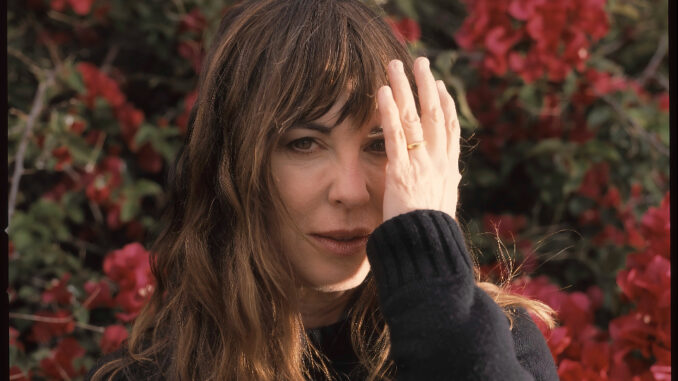
When Los Angeles-based musician and actress Rebecca Pidgeon notes that the recording of her twelfth album, Unillusion, marks a return to the organic, acoustic sounds of her Chesky Records debut The Raven, everything about this album is suddenly heightened because that awareness of space defines the record. She conceived of Unillusion as a more relaxed and intimate recording from the start to contrast with the intricate, polished, layered sound of her most recent albums. When she discussed her ideas with her producer, Fernando Perdomo, he had her look at episodes of the MTV Unplugged series and she decided then and there, “It felt like the right approach – minimal, human, with moments that are as stripped down as just voice and acoustic guitar.”
Her command over repetition – that basic marker of devotional song – and her commitment to building atmosphere creates something that exists out of time. Though it’s indebted to both the expressive lyricism of Kate Bush and the understated acoustics of James Taylor, who Pidgeon cites as influences, what comes to mind immediately on first listen is that it falls into the realm of spiritual and devotional folk music.
One could argue that devotion has always driven the urge to create music – or maybe even create any kind of art—dating back to its earliest forms. Creativity’s nature is such that people will want to indulge the urge to reflect through the medium that most closely brushes heaven. Even when a deity’s grace or attention drove all societal reason or meaning, music was still self-actualisation, an assertion of who you are to those around you in hopes you’ll see yourself in that which you’re devoted to. Even love songs reflect a hope for the highest self to be revealed, capturing the essence of a connection and hoping that memorialising it through repetition and tone will render it holy, a personalised mantra crafted to express your faith in hopes of being saved.
These are songs that slip into your consciousness like whispers of the wind, gently weaving through the tangled branches of your mind, planting seeds of memory that bloom into vibrant thoughts when you least expect it. Maybe this is communicated most clearly through the album’s Hindu mythology. Of course, this concept alone feels plucked out of another time. Still, through a modern lens, it provides insight into how the myths have existed through centuries to inform our current lifetimes.
Given my own studies of Hinduism, with curiosity turning urgent, I asked Pidgeon if the word “unillusion” was another way of saying reality. Her reply was, “We’re all searching for truth in one way or another. What’s another word for truth? I suppose another way to express truth is to say it’s a place of no illusion or unillusion.” Right there, her intent became as clear as a bottle of designer water.
Pidgeon is a practitioner of Iyengar yoga and the learned repetition appears throughout her songs. It works so well in large part because she has such a distinct voice that also feels malleable, letting herself fill any empty role as she would in her other profession as an actress. To place Pidgeon’s understanding of space and atmosphere back at the fore: It cannot be emphasised enough how much her experience with visual art has clearly shaped her understanding of texture, even when it’s employed in an auditory work. This cross-medium pollination can have the effect that the songs feel like they are being transmitted from out of time as she sings ancient stories of the Ramayana until she seems to floats above the music, allowing her to breathe into the songs before coming down to earth in the following interview.
Americana UK: Hello, Rebecca. That is you and not an illusion? Or an unillusion? That’s terrible. Forget I said that.
Rebecca Pidgeon: No illusion. I’m just in my corner for being heard and seen.
AUK: So, is the album title “Unillusion” another way of saying reality?
RP: Well, I’m a yoga student and have been listening to teachings about yoga philosophy. There was one thing that struck, well, many things have struck me, but the idea that knowledge, gaining knowledge is a process of disillusionment and that we’re going along in our own idea of reality. We have our beliefs and then we learn something and we look back and we realize that our knowledge was false or that we were in some kind of illusion. They actually have a category which I thought was so fascinating in this Patanjali philosophy. It’s not that you have no knowledge; it’s that you have a false knowledge. It’s its own special category, and that you are now disillusioned. And so I was thinking, well, we’re all searching for truth in one way or another. What’s another word for truth? I suppose another way to express truth is to say it’s a place of no illusion or unillusion. And that’s where that title came.
I thought it was appropriate for this album because a lot of the songs were inspired by the “Ramayana,” which is the story of Rama and this hero journey, this epic Hindu part of their canon. And we see that across Western writings as well and philosophy. It’s always been fascinating to me, the Joseph Campbell idea of the hero journey. So, I was struck by some of these stories which are confusing and weird and need to be interpreted and seem to be describing our own inner turmoil. It’s gods and goddesses, but they seem to be describing a human experience. Maybe they’re pointing to some sort of truth which needs to be decoded and interpreted. And every time we come back to these wisdom stories, they seem to say something different or they seem to speak to what’s going on within us in our time of life. We think, wow, that story is not what I remembered, and it seems to be talking to me directly anyway. These stories inspired some of these songs, and the other half of the record is really about my own personal journey. So, I thought that “Unillusion” was a good title. I was mulling over what I should call this record, and I came up with that because it’s really about this very human question of what is truth. What is my truth? Who am I?
AUK: The stories of the gods, whether they’re Hindu or Norse gods, they’re parables similar to what Jesus Christ used to bring people closer to an understanding of God.
RP: And also understanding ourselves and our own wicked ways. We have to do this self-study. By that I mean not being intrigued with our own personalities and our preferences and so forth, and being self-obsessed. What I mean is trying to understand what our tendencies are and how to sort of lift ourselves out of these negative tendencies.
AUK: You used the sutras, which is interesting because I have familiarity with Patanjali from visiting his temple in Chidambaram, India. It’s almost like a small city. He wrote sutras from the rooftop. It’s a metal roof and extremely hot to walk on as the sun is always blazing hot there. It has to be a zillion degrees. So how could he write there? At the time we were at this temple, clouds came over and we were able to go up on the roof without toasting our feet. You could feel his presence up there.
RP: Wow! What a wonderful story.
AUK: Yes, but we should be hearing your stories. I understand you moved to Scotland at a young age.
RP: Actually, my parents moved me to Scotland. I was five at the time. My dad was at MIT and getting his doctorate. He’s a physicist. My brother and I just happened to be born there because that’s what he was doing. And then they moved his work to Heriot-Watt University in Edinburgh, and that’s where we grew up.
AUK: Did you learn to play guitar and get started in music while there?
RP: I met my first bandmate, Roger Fife, in Edinburgh, because as teenagers we played songs at parties. I didn’t play the guitar, but I sang. I was going off to drama college. And he said, let’s write some songs and I’ll just send them out to independent companies and see if anybody is interested. I agreed, and yes, we got picked up by an independent company in London called Red Flame Records Run by Dave Kitson, a wonderful guy. We ended up making a couple of records for him, while accruing more bandmates. During that process, I acquired a guitar and started learning how to play it. It wasn’t my first instrument, however. As a kid, I played violin and piano.
AUK: There are some very expressive violin parts on the new record.
RP: There are two wonderful violinists on the record. Andy Studer, who I play with often because he’s in LA and he’s absolutely great. And Eszter Balint, who is a New Yorker, is a wonderful Hungarian folk violinist. She’s also an actress, a great artist. I met her through a mutual friend of ours and was so delighted that she could come and play.
AUK: I read that the musicians you listened to early on were Kate Bush and the Sex Pistols.
RP: Yes, actually, and weirdly, John Lydon, many years later, it turned out he said he was a huge fan of Kate Bush and considered her a punk artist. So, it’s not so very strange and disparate. I mean, she was wild when she first started, and so unlike anything anybody had ever seen before. She was mocked widely but also very loved. I think people slowly realised that she was a national treasure, to put it simply. I love all sorts of different kinds of music and from all different genres and spectrums.
AUK: You went to Hollywood, and it’s not so unusual for actors to be musicians. I’m thinking of Kevin Bacon and Scarlett Johansson and Keanu Reeves and a bunch of others. Is it more prevalent than people might think, actors doubling as musicians?

RP: Oh God, most actors are musicians. It’s part of the same skillset in a way. I mean, they’re performers. Actors have to be musical because if you think about it, they’re dealing with words and cadences all the time, and they’re dealing with timing. They just are musical beings, and they have to develop their voices if they’re in the theater. I would say it’s actually rare to find an actor who’s not musical in some way or another. In the past, people just took that for granted. Look at Judy Garland, Frank Sinatra. There are dancers, singers, actors, all rolled into one.
AUK: I discovered that your stepdaughter is also a musician.
RP: Oh, yes, Willa Mamet is a wonderful singer and songwriter. In fact, all of our kids are musical. They’re all good singers. My son is a composer and my daughter Clara is a singer. My stepdaughter Sasha Mamet is also a wonderful singer. In fact, Clara and Sasha, when they were early teenagers put a band together called the Cabin Sisters.
AUK: ‘When You Were Mine’ from “The Velvet Curtain” album is an intriguing song. Would you tell us the story of that one?
RP: My husband was making a film about Brazilian jujitsu, and he asked me to write some songs in that genre. I was working with Larry Klein at the time, who coincidentally had just married the wonderful Brazilian singer, Luciana Souza. So, I was influenced by Brazilian music, and then Dave (husband David Mamet) was doing jujitsu, and that all came together. Luciana actually came and sang with me on a song called ‘Dawn.’ She also translated it into Portuguese with her mother, who is a lyricist. We sang as a duet, but she also performs When You Were Mine’ in the film. The film is called “Red Belt.”
AUK: Yes, I have seen it. I’m a Mixed Martial Arts fan. MMA fighter Randy Couture was in the film.
RP: The song is pretty dark, sort of a traditional theme of a heartless woman leaving a guy in the dust. But it’s got a gentle, melodic theme and harmonic structure. Somebody said to me that song is so beautiful and lulling, and then I realized that lyrics are about a horrible woman.
AUK: You also played a horrible woman in your husband’s play, “Oleanna.”
RP: This play drove the audience so mad that they stayed in the theatre after the show to argue with each other. The exit door for us actors (Bill Macy and myself) was through the orchestra and out through the front doors which had us mingling with the audience. But I had to take to leaving out of the back door into the alley to escape audience members who were enraged with my character.People would come up to me shaking and upset, confusing me with the character they’d just seen me playing, and would confront me! My friends told me this was a sign that I had given a good performance. It was a lesson to me of how powerful theatre can be. As Shakespeare says it can “make mad the guilty and appall the free.” And to think I got into acting to wear pretty dresses and meet guys. Not that bullshit. Seriously, though, it was a wonderful and awful at the same time experience.
AUK: You were in the Phil Spector biopic. There was some controversy about that one. Spector wasn’t too thrilled with it.
RP: Phil Spector did not want to be consulted on the movie. And I don’t know if he saw it even or what he thought of it. It was not condemnatory of him, actually. But anyway, it was a wonderful film and they used my cover of ‘Spanish Harlem’ at the end.
AUK: You collaborated with your husband on ‘Been and Gone.’ Have you co-written any others with him?
RP: Not so much lately, but in the past, we wrote a country song called ‘Baby Please Come Home Again.’ It was a song I had written, but I said, Dave, can you please improve this one? The thing about great country songs a la Hank Williams is he was a poet, and they always have this wonderful turn at the end. They’re so exposed, these stories, because the chords structures are so traditional, right? And four square that they have to be about the story. So, Dave created this wonderful poem, really kind of a plea to come home. And there’s that lovely twist in it where she says, if you find that you needed a different girl, come home and you’ll find that I’ve changed. I loved that.
AUK: On your new record, Fernando Perdomo produced, and you’ve done three or four with him as producer. He was on the “Echo in the Canyon” soundtrack as were you and tours with Marshall Crenshaw. What drew you to him?
RP: We work very easily together, and he’s a wonderful multi-instrumentalist and has great ideas. He’s open to working to find this vibe that I’m looking for so there’s nothing precious about it. I feel very comfortable about telling him what works, what doesn’t work. When we were recording a guitar lead a few months ago, which he was playing, I kept saying, no, no, that’s not it. It needs to be played like you can’t play the guitar. He kept trying and I kept saying no, and in the end, I said just give me the guitar. I can’t play the guitar so I’ll show you what I want. And then he finally did it.
AUK: On “Unillusion” the songs are more stripped down than on previous albums.
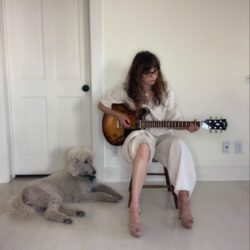
RP: Yes. I wanted to harken back to when I first came to America, I made records with Chesapeake Records. They’re a famous audiophile label, and these were very acoustic records performed live with no overdubbing. I have a fan base for those records, and I wanted to give something back that was more organic, more acoustic. I wanted to have a dynamic range where I’d get to be very intimate in some songs, but then build to where the band comes in. I wanted every instrument to breathe and to have its own space, to not be so multilayered as we’d done in the past.
AUK: Let’s talk about some of the songs on the record. Start with ‘Be My Butterfly,’ which seems to have an Aimee Mann feel from the “Magnolia” soundtrack.
RP: That’s wonderful that you say that. We made a short film actually inspired by “Magnolia” for that song. That is the one song I co-wrote with David Batteau for this record. I’ve worked with him quite a lot in the past, and he’s a wonderful songwriter. We wrote it years ago and released it as a demo, and because there’d been some requests for it by fans, I reconsidered it and brought it back and gave it a studio production. It’s inspired by Los Angeles, the sort of underbelly, noir feel, a motel where anything could happen, the kind of ambiance, kind of place you can just imagine. David Batteau had stayed at this hotel once that had wallpaper of women in strange togas and costumes, and he thought they looked like butterflies. That’s where we got the idea.
AUK: Let’s talk about ’Dasharatrha,’ which is the name in Hindu mythology.
RP: This song was inspired by the story of the ramina (beautiful girl) of King Dasharatha, who exiles Rama at the behest of his second wife because she wants her son to be the heir. So, he banishes his beloved son, Rama, who he adores and then kills himself from grief. I thought, oh, it’s a family drama told in very dramatic terms. But I mean, the complexities of our humanness, you always hurt the ones you love, the ones you shouldn’t hurt at all. What’s that song? The end part of the song is quite different from the beginning. I’m talking about really the cycle of life towards the end of the song.
AUK: It strikes me as similar to some of the folk tales or murder ballads from Scotland and Ireland.
RP: Exactly. That really speaks to me because I grew up in Scotland, I grew up with all of those ballads, and they’re part of my formative years. I love them very much, and they’ve influenced me a lot.
AUK: The landscape and weather of Scotland must be so different from what you are used to in L.A. What does ‘Drumlins’ relate to? Actually, what are drumlins and why did you write a song about them?
RP: No, I find the landscape here in L.A. much more daunting, actually, the harsh desert, we’re in this sort of fake oasis here. But the desert I find very challenging because it’s so alien to me, having been brought up in the cold climate and the hills and also the coast of Scotland. Drumlins are sort of hills. They’ve been formed by glaciers, so they look grassy and peaceful on top, but they hide this ancient grim power. I thought it was a good metaphor for that landscape, for the character of the people, actually.
AUK: ‘Queen of the Fields’ has some curious symbolism: I’m like a laden boat tossed on a stormy sea; My hair writhes like a thousand snakes. Perhaps you could expand.
RP: That was inspired by Sita, who is abducted in the “Ramayana” by Ravana. And Rama sends Hanuman to go and save her. Hanuman finds her, but I don’t know why he doesn’t save her. She gives him a message to take to Rama and tells the story of what she’s been going through. But Sita’s greatness is her acceptance of her fate and her faith, her great courage and her nobility. And she’s also associated with Mother Nature, with agriculture, with the land, and her name, which I think means plow. She is a very inspiring
AUK: ‘Where is the Man’ sounds like it might be a cabaret song.
RP: It is a cabaret type song, a bit tongue in cheek. There’s a point at which the question is asked, where is the man? Where is the perfect man with all of these qualities, these perfect qualities, which are really God-like, which no human could possess? And of course, all of these qualities are possessed by Rama. So, the sages are saying, where is this man, we’re curious? Where could he be? And I thought that was so funny because it’s like the question on the mind of every 25-year-old girl, where is the man, the perfect man?
AUK: For Christians, that could be Adam, at least until he met Eve.
RP: I would have thought Jesus. Rama is the Jesus figure.
AUK: Next track is ‘The Pleasing Waters of Jahnavi,’ a Sanskrit name meaning daughter of Jahnu.
RP: In this instance Jahnavi is the Ganges or the Ganga, the river. Valmiki, the great sage, who is the author of the “Ramayana,” is sitting by the banks of the Ganges, the pleasing waters. And he sees this pair of mating birds coming, flying, wheeling in the air. And their calls are a very beautiful song. A hunter comes along and aims and kills the male of the couple. He witnesses the great grief and crying out of the female bird, so he spontaneously utters this out of his great welling of grief, this curse on the hunter. And to his surprise, the words that escape his mouth are in perfectly grammatically correct form and meter. It’s a perfect verse form, and he is so surprised when he realizes the perfection of this verse that he says, I’m going to call this verse a shloka after the word shoka, which means grief because it was born out of grief.
So, Brahma appears to him and commands him to write this great epic using this form, meter and rhythm, this perfect verse form. I thought that was a rather lovely story. In my version, I say it’s a bit like, as you were talking about the fall of Adam and Eve. God said, okay, so you’re going to bind yourself to a life of pain and suffering. And that little bit is like Leakey says, this is going to be your story now because of what you’ve done, meaning I suppose that the hunter will experience that same grief.
AUK: Next is ‘Monkey Man.’ Earlier you mentioned Hanuman, who was half man, half monkey. Is this one about him?
RP: Of course, Hanuman is not a man. He is a God and monkey man is a little bit tongue in cheek as well. But the most wondrous thing about Hanuman, his greatest quality, he’s the possessor of the perfect love. He loves Rama and therefore Sita. And he says, let me have no needs that you, Rama might have. Let me not sleep when you are asleep. Let me let nothing get in the way of my service to you. So, he’s the perfect servant, which they interpret as the perfect love devotion. Again, I’m a bit tongue in cheek with the song because I make it a love song. But Hanuman’s love, of course, is not like human love.
AUK: Love can be service, one of the reasons why we’re here. You do a service with your music, with your acting. It’s something you’re doing for people, whether it’s working at a soup kitchen or being in a movie and really putting yourself all into that movie or all into that record, giving all of yourself.
RP: Oh, nice of you to say that. The next one on the record is ‘Warm Stone,’ which is a personal song, and it’s not from any book or anything. It’s really about my own journey. And it’s about sort of discovering a steadfastness that is a guardian of oneself within oneself, discovering a kind of, I call it warm stone, because it feels like a kind of an anchor, right? A steadier when you understand there’s a point when you have a moment in your life where you realize, oh, this is a value I have. This is a belief I have, and I will never sacrifice it. I’ll always stand by it. Because there’s this a kind of breakwater within me that won’t let me do anything, but stand by whatever it is that you’ve discovered. Those kinds of realizations come at moments when you’re deeply challenged.
That is a thread through all of the more personal songs on this album, for example. That’s a nice segue into the song ‘Myself,’ which is really about that nobody is going to save me except for me. I have to be responsible for myself. And in the end, we all have to. It’s like the journey from birth to death, and we have to die on our own. It is a process we have to go through. We have to meet our maker and find an acceptance of that and find a companionship. Do you know what I mean? We have to find comfort within; we have to be able to parent ourselves within ourselves. We have to find the guru within. We can’t always be saved outwardly by the world, by other people, by teachers, by our parents, by our children. We have to be the grownup. We have to be the parent of ourselves. We have to be the usher of ourselves.
AUK: Have we missed one? Plenty to ponder from what you’ve said.
RP: There’s a song called ‘Hypnotize Me’ that’s sort of about our addictive cycle, which is I think it’s so easy for us to fall into negative cycles and addictive cycles, but it’s very, very hard for us to get out of those. It’s hard work for us humans, mere mortals, to do anything of worth, but it’s so easy for us to do things that are less than worthy, right? We don’t have to put any effort into that at all.
AUK: We neglected to mention “Songs of L.A.” at all, the album preceding this one.
RP: That was the album that David Batteau and I had been writing, which was so much fun about the history exploring historical things about L.A., the underbelly. Well, I mean, everything’s the underbelly here. It’s such a wacky place, and he’s so knowledgeable about it. We just had a ball writing that record, and it’s quite a lively, jangly, bizarre record at that.
AUK: Lastly, I wanted to ask about your husband. He’s appeared a few times recently on Fox News programs with Jesse Waters and Raymond Arroyo. And with Hollywood being such a very liberal place has that had any effect on your career?
RP: Oh yeah, big time. There’s a point at which the liberal community becomes very “illiberal,” and they don’t tolerate any diverse opinions. It’s sad and nonsensical, but yeah, it has affected us a lot.
The youth are intolerant at the moment, but I hope that they overcome that. But this is why I come around to these stories. I’m like, oh, yeah, that makes sense. He banishes his son. Okay, fine. Then he kills himself. We get into such a mess in families, and it’s so sad when children decide to not continue relationships with their parents or vice versa, and especially, it’s happening in our country a lot at the moment, this division. I think it serves one type of political person, but it’s so destructive to the country. The whole idea of America is that we converse. It’s a conversation. The whole founding of this country was a great conversation. I’m reading this book actually called “The Words That Made Us” by a wonderful writer called Akhil Reed Amar. He’s a constitutional lawyer – I’m not sure which university. It’s just wonderfully written, very clear. It’s a wonderful tale of this great country, and that is the overarching theme, that there is conversation allowed. There are diverse opinions allowed, and it’s so sad when that stops.

