
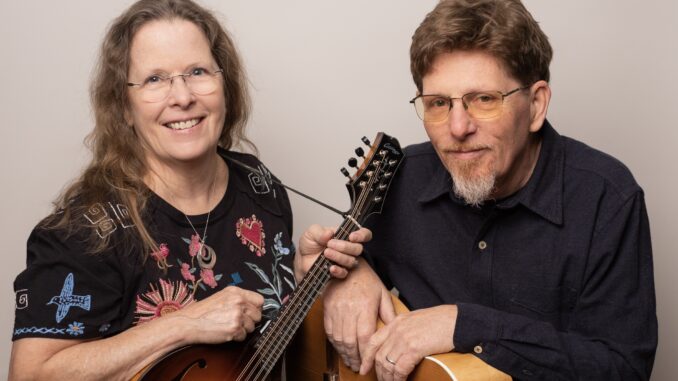
Writing songs with Tom Paxton was like going fishing with a friend.
Paper flowers generally symbolise enduring love, remembrance, and creativity. Unlike fresh flowers, they don’t fade or die, memorialising a love that lasts or a memory that endures. They can also be a symbol of resourcefulness, using readily available materials to create something beautiful and meaningful, for instance, Japanese origami.
For the past ten years, Tim O’Brien has performed primarily with his wife, Jan Fabricius, and their new release, “Paper Flowers”, is tangible proof of that deep collaboration. Look no further than the album’s title track, which tenderly paints a picture of long-distance companionship told through O’Brien’s thoughtful gathering of found objects: a feather, driftwood, seashells, a piece of sea glass, three paper flowers, packaged up during a tour and sent with a postcard with the words one for you, one for me, and one for the miles in between. Lyricism is the shining armour of the song, existing as pensive and full of grace, all while building its own world of ache and yearning in just three minutes’ time.
That mythological token of road-worn, rural folklore is a gentle, crushing ballad, proving that vocalist and multi-instrumentalist O’Brien is a strong lyricist. Together with his wife and mandolinist Jan Fabricius, the duo turns vignettes of family and togetherness into something worth putting faith behind.
But they have not achieved this alone. Besides a standout backing band with bassist Mike Bub and fiddler Shad Cobb, they have welcomed the potent songwriting talents of folk legend Tom Paxton into their writing circle via weekly Zoom calls. Through that platform, they tossed around ideas for songs like a veritable ‘Fat Pile of Puppies,’ a track that began with a noodled riff from O’Brien’s guitar that struck Paxton as the image which would become the song’s title. “It’s a favorite of our grandchildren, Lakelyn, Everett and Ella,” Fabricius said with pride.
The husband-and-wife duo present an acoustic music roots repertoire that’s at once both original and traditional. Its soft centre has the flavour of family, friendships and togetherness, ideals that are making a comeback after an era of self-centred individualism. The opening song, ‘Atchison,’ finds them staying with friends in Kansas when one’s sister had a health emergency in the town of Atchison, which caused a rallying to her side by family.
Born and raised in West Virginia, O’Brien describes the emotions of a child in a way that gives you butterflies, Looking into mama’s eyes I saw a hungry heart, the title of a song about his dad out on the road somewhere, taking odd jobs to support the family. Following an abbreviated stay at Colby College in Maine, O’Brien wound up in Boulder, Colorado, where the 1980s bluegrass band Hot Rize would form. The band had a western swing style alter ego as Red Knuckles & The Trailblazers, parodying tunes like the Weird Al Yankovic-styled “Red on Blonde,” which was a hoot. You have to wonder what Dylan would have thought had he heard it.
O’Brien and Fabricius met in 1993 at the Walnut Valley Festival in Kansas and became a couple in 2013, playing music around the house, learning new songs he wrote, until they began writing together. Ten years later, they became a songwriting threesome (emphasis on “songwriting”) with Paxton after O’Brien was approached to contribute a song to what became the album “Bluegrass Sings Paxton.” Tim and Jan pooled their talents with Paxton and wrote ‘You Took Me In.’ They had met the old folksinger at the idealistic intersection of pure melody and lyricism and, encouraged by the results, continued a partnership which had produced one album and thirty-two songs at the time of this interview.
Americana UK: Hi Tim and Jan. I heard you were just out at the Telluride Bluegrass Festival in Colorado. You’re something of a regular, Tim. How many times have you played there?
Tim O’Brien: I believe this was my 48th. It was just starting in 1973. You might say I grew up with it.
AUK: That is 48 out of 52. Two more years and it will be your golden anniversary.
Jan Fabricius: We haven’t even been married that long. This was my eighth time there.
AUK: Given that Tom Paxton co-wrote most of the songs on your new album, “Paper Flowers,” The question is how did that come about?
TO: I met him at folk festivals. I’m not sure where – maybe Kerrville, maybe Tønder Festival over in Denmark, not sure which one.
JF: Tom remembered meeting me at a festival out in California. I believe it was 2014.
TO: I was a longtime fan. We met, and he was very friendly, and then we just would see each other now and again. He’d talk about possibly writing together sometime, but it never happened. Actually, I saw a picture the other day of us at the Kate Wolf Festival at Wavy Gravy’s Camp Winnarainbow. In any case, a couple of years ago, we were approached by the producer of a record called “Bluegrass Sings Paxton,” and they wanted us to record a song of his in a bluegrass style. One of the options was to try to write a new song. So, we got in touch, and he had practised using Zoom since the pandemic. We wrote a song on Zoom. It was easy to do and we liked what we came up with, so we just kept doing that.
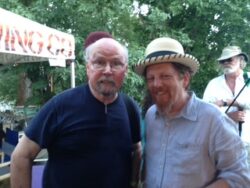
AUK: That song was ‘You Took Me In.’
JF: And we wrote another with him yesterday. We are at 32 songs now.
TO: We have a regular appointment with him, 3 o’clock on Wednesday afternoons. It looks like we’re going to have a volume 2.
JF: There might be enough for a volume 3 pretty soon.
TO: He really is enthusiastic about the songs. There’s a country music slant to him. He’s written a lot of different kinds of songs, and I suppose I have as well.
AUK: I have never met Paxton. Can you tell our readers something about him?
TO: Well, he was just at a rally for No Kings Day just a block from his house in Alexandria, Virginia. He said it had been eating at him that he had gone and didn’t have a song for the occasion. He said, I must be slipping, then he woke up yesterday morning and wrote a song. He is 80 years old and lives to write songs.
Once he talked about being in the army in Fort Dix, New Jersey, and the folk music revival was in full swing in New York. He really wanted to write songs, and he was in the typing pool and didn’t always have stuff to do. He would write songs on a typewriter, and he said, I wrote a lot of terrible songs, and then I finally came up with one that was tolerable, and it’s called ‘The Marvelous Toy.’ That’s one of his first recorded songs, and he just went from there. He is an Oklahoma guy, but spent an awful lot of time in the cities, even though he grew up in the country. He was an aficionado of Woody Guthrie and kind of kept at it.
AUK: What about yourself, Tim? You grew up in West Virginia and then went to school at Colby College in Maine.
TO: I went to Colby for a year and spent most of my time learning Doc Watson songs. It wasn’t part of the curriculum. I got into a bluegrass band up there called The Northern Valley Boys for a brief time. I went back the following year, and they had hired a fiddle player and didn’t need me anymore, so I quit school. From there, I kind of bummed around and saved up money, bought a car and moved to Jackson, Wyoming, where I was ski bumming for a winter. Then I went to Boulder (Colorado) and met a bunch of people there. I realized there was a scene that I could plug into.
AUK: That was where Hot Rize got started?
TO: Right. I moved there in ‘74, and in ‘78 Hot Rize started. It was a good scene, a college town, and a lot of little gigs to play. I was learning a lot about music and playing the fiddle. Then I got a mandolin and kept playing.
AUK: Jan, you were a registered nurse. How did you and Tim meet?
JF: We met at a bluegrass festival in Winfield, Kansas. I was a bluegrass fan and started going to festivals in 1975 at the Walnut Valley Bluegrass Festival, and then some of the Colorado festivals. I’d been listening to New Grass Revival, Hot Rize, Doc Watson and Norman Blake, all those favorites, and playing a little bit of mandolin. Myself, my oldest sister and her husband were big into bluegrass, and so it was kind of in our family.
AUK: Did you play on stage at all before you met Tim?
JF: Not on the big stages. Mostly parties, weddings and jams. My sister and I played fiddle tunes around the campfire, but that wasn’t my job or profession. It was my love of music. Tim likes to say I’m a pro now. Seasoned. For sure, I couldn’t be doing this and still be a registered nurse.
TO: There was a question when we started dating, and then when she moved to Nashville. She got her nursing license here in Tennessee, but I said, well, why don’t you come with me on this trip to Ireland? And then that thing led to something else, and she never went back to nursing.

JF: Just that summer we already had plans, so I really couldn’t say, oh, by the way, I’m going to spend two weeks in Ireland right after I start my job. But during that period of time, Chris Moore, his tour manager, was moving away from Nashville, and so I just started doing some of his job. Tim was touring with Darrell Scott right after I moved in. Darrell’s crew pretty much did a lot of the tour planning and managing, but I helped with… well, I didn’t even do the merch.
That was the period of time where I was learning how to tour manage and what all that entailed. At the same time, Chris did the merchandise and the website, so I kind of folded into just helping because it made more sense for me to do it than to hire somebody else. Now, Tim and I are doing almost everything except for booking the gigs. It is a small business. We do everything out of the house, and he’s got his own record label.
AUK: Being around Darrell Scott must have been rewarding. He is a very good songwriter.
TO: Playing with him was really a great experience. I learned a lot. We had a great duet. Neither of us had to hold back. We could play music we’d never played together before at the drop of a hat.
JF: You guys got put together to write a song, I think?
TO: A guy named Jim Rooney started a publishing company in Nashville called Forerunner, and I got signed. Jim would’ve known Tom Paxton from the early days of the Newport Folk Festival because Jim used to produce it. Anyway, he put me and Darrell Scott together to write a song, and we both liked the song and ended up recording it. Then we got together and wrote more. It wasn’t long after that I asked him if he wanted to tour with me. We went to the United Kingdom and Ireland. We would each play a set, and then we’d play a little bit together. After the first show, we played the whole show together because it was obvious that would work the best. That led to our duo, which went on for several years.
AUK: You two wrote some great notes for the CD booklet about the songs. ‘Fat Pile of Puppies’ was a hoot.
JF: All the adult kids like it, too. After I put it up, there were so many comments about how delightful it was to have a light song with all the heavy stuff in the news.
TO: The regular co-write appointment kind of takes the pressure off writing a song. A lot of times, you make a co-writing appointment, and there’s a lot of anticipation and fear of not having any results. And the fact that we wrote one song, we said, well, we probably can write another one. We didn’t have a lot of pressure on us, and I’ve felt it’s like going fishing with a friend, and if you catch something, fine, if you don’t, fine, you’re just hanging out with your friend. That’s how this has been. And as a result, I think a lot of the songs are lighthearted.
AUK: Tim, you’ve played so many styles of music. Where did it start for you? What interested you first?
TO: Well, I was into Peter Paul & Mary and the folk stuff. Then I got really into The Beatles and Roger Miller. I had a Beatles songbook, a Joan Baez Songbook and a Roger Miller songbook, and I had a guitar and started singing these songs. I’d only been playing a couple of years, around 13 or 14 years old at the time, when I got into Doc Watson and took a turn towards bluegrass.
AUK: Are you a Bill Monroe guy or an Earl Scruggs guy?
TO: I started as an Earl Scruggs guy, but then I got into Bill Monroe. Bill Monroe is hard, kind of like your first taste of whiskey. It’s like, God, why would anybody want to drink that? Right? But then you develop a taste for it and off you go. I want more of that.
AUK: Bill Monroe once said, “Bluegrass is wonderful music and I’m glad I invented it.”
JF: Tim has a story about playing on stage with Bill Monroe. He liked your mandolin or fiddle. What was that?
TO: He had no time for another mandolin player, really, unless you joked around with him. If you played all his stuff exactly like him, that was okay, but he didn’t care about another mandolin player. But I was playing fiddle, too, on the show, and when I met him, he said, I like your fiddling. He kind of looked at me, as if to say are you going to take that? Do you understand what I’m getting at?
JF: I like your fiddling, but you can leave out the mandolin.
TO: It was like God is testing you out. He wanted to see if I understood, and I said, well, thank you. I was kind of was freaked out by him. He was very intimidating. He was a very proud man and kind of secretive. He tested people out. He’d make jokes, and it was so dry you wouldn’t know. I think he was making a joke there. Yeah, I know you play the mandolin, but I like your fiddling. I don’t need a mandolin player. That was Sam Bush.
Bill was enigmatic and very creative. Earl Scruggs’ music was really clear, kind of like Doc Watson’s, very inviting and really easy to grasp. It was well-ordered, whereas Bill’s was a little erratic. He was kind of like the bluegrass Jerry Garcia. He might stumble, but the X Factor was always there, and you were waiting for it to flash out and be put on the floor by how brilliant he was.
AUK: Out of all the stringed instruments you play, Tim, do you have a favourite?
TO: Well, I love the mandolin and the guitar.
JF: He also likes the fiddle and the bouzouki. He loves them all. It’s like how can you pick a favorite child?
TO: Yeah, it’s hard to pick, but I guess I always go back to the guitar.
JF: People ask him why he doesn’t play the mandolin more, but as a band leader who is singing the guitar makes sense.
TO: I’ve led bands with the mandolin, but the guitar is more at the center of things. Then Jan came along with her mandolin.
AUK: Don’t tell me. She said I like your guitar playing. Do you understand what I’m getting at?
JF: No, there isn’t any competition from me. I mostly keep the rhythm going and a few little fills. I don’t pretend to be as good as Tim or Bill Monroe or Sam Bush.
AUK: But you fit into the band nicely. It sounds good.
TO: You know, a band is a cooperative venture. We have a star fiddle player in the band named Shad Cobb, and the rest of us just hold it down. He’s the flashy one.

AUK: Starting with your “Cup of Sugar” album, there seems to be a lot of animals showing up in the songs.
JF: That was kind of the theme of that album.
TO: I’ll make lists of things, trying to imagine what a new record will be. We were starting to write with Paxton, and it turned out there were a lot of animal songs.
AUK: That one about the Tennessee Border Collie is really good.
TO: I love the irony of that story where the guy left all his money to the dog. That’s a true story. The guy that defended James Ray in his second trial was named Kershaw. He was a lawyer and also a sculptor, and he lived in our neighborhood. I found that out from my barbershop. The guy used to go get his haircut at the same barbershop. Anyway, that Nathan Bedford Forrest statue was his sculpture. I thought it was a kind of comic coda to the whole thing.
AUK: I know a little about the story. He was a lieutenant colonel or some high rank in the Confederate Army. That statue was 25 feet high and alongside the Interstate 65 near Nashville. Then it got taken down.
TO: There’s a whole bunch of Confederate flags there. It’s funny. He willed the land to either the Daughters of the Confederacy or the Heritage Society, and they decided to take the statue down, which is good because people were trying to shoot it. They had shot at it, and they painted it.
AUK: You wrote ‘Old Christmas Day’ with Paxton about all the animals talking to each other.
TO: That one was fun. Tom has actually been making a new record, and I think he recorded one or two of those songs of ours. He is a great writer and a really serious student of American folklore. He’s gotten his master’s degree in folklore and teaches at Johnston City, Tennessee at the university. He knows stuff about all kinds of sides of America, like the coon hunting dogs graveyard in Alabama, that kind of thing.
AUK: In the Catholic church, Old Christmas Day is known as Little Christmas or the Epiphany.
JF: Tom knows about all that sort of thing.
TO: At one of our songwriting appointments, I said, let’s write about Old Christmas Day. He was the one that knew about animals talking to each other. He said that was a real old folk story in Germany in the Black Forest.
AUK: In Ireland, it’s known as something I can’t pronounce in Gaelic, but it’s Women’s Christmas Day when the women get to relax and the men do the chores all day.
JF: Hey, I like that.
TO: January 12th, the women go out to the pubs and the men stay at home watching the kids.
JF: They get to sit in the snugs and drink their half pints.
AUK: When your grandkids ask what it’s like being out on the road going from gig to gig, what do you tell them?
TO: Well, I could tell ’em about sleeping in a bus outside of truck stops and taking a shower there in the morning.
JF: What they know is we don’t get to see them as much.
TO: Being away from home a lot is hard. When I started traveling with Hot Rize, we were kind of four guys against the world. We’d leave Colorado, and the other three guys were the only people you knew. But the good news was there was a bluegrass community wherever we went. It was kind of underground then. National Public Radio was just starting to hook up, and there weren’t as many festivals. Nowadays, there’s a trade organization for bluegrass, and there’s a folk alliance that organizes everything and databases and Internet, but there used to be none of that stuff. There was “Bluegrass Unlimited” magazine and there was “Sing Out” magazine for folk music. Beyond that, you were kind of on your own on the college coffeehouse circuit. That was what everybody aspired to. I remember playing some of those with Hot Rize, and our guitarist Charles said, you could probably disappear into one of those dormitories and no one would know you were there. You could sleep in the lounge on the couch, and you could probably eat in the dormitory cafeteria, and nobody would notice. And it was true. But we lived to tell about it.

