
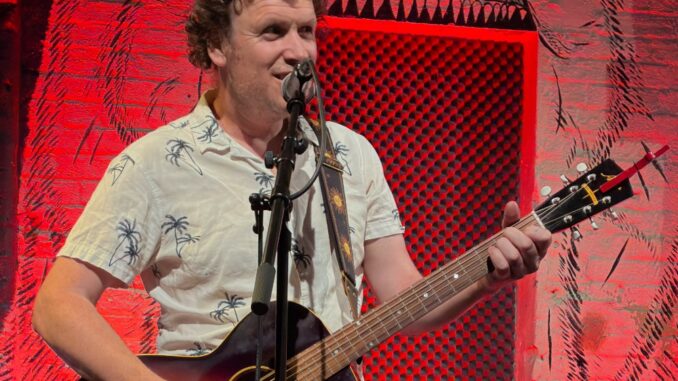
Seamus Fogarty has been very busy performing his unique brand of experimental, alternative folk. Along with many solo gigs and appearances at the Green Man and End Of The Road festivals, he has this year supported the tours of Katherine Priddy and This Is The Kit and, as of the time of writing, will soon be heading out in support of The Delines. “I’ve probably done about 40-45 shows since March, and they’ve all been amazing”, he said during our recent chat. In addition to all the hard touring yards, radio exposure courtesy of Cerys Matthews, Iggy Pop and a Marc Riley session have all helped to boost his profile. Seamus Fogarty is an artist who is getting noticed, and he is certainly worth giving some of your attention.
Hearing snippets of Fogarty’s work could mislead. Beautiful melodies, haunting lyrics, chaotic experimental jazz interludes; it’s all there and a lot more. It becomes clear that he is an artist who defies easy categorisation. At London’s beautifully numinous Union Chapel, whilst opening for Katherine Priddy, he, perhaps ironically, played his rather comedic song, Nuns, a riff on the ubiquity of nuns in Ireland when he was growing up. Yet he also played the atmospheric They Recognised Him, suggestive of the hard-boiled noir of a James Ellroy novel. It was difficult to decide whether we were watching a latter-day Val Doonican or the purveyor of something sinister and nerve-jangling, nocturnal and urban. Intriguing, to say the least. A few months later, at The Bear in Luton, where Fogarty was this time headlining, things didn’t get a whole lot clearer. He played guitar and also played a retro-looking synth mixer drum machine set-up, which he coaxed into life, often with a perplexed look and an expression of surprise and sometimes delight at the sounds that emerged.
Fogarty explained that he likes to have an experimental, improvisational element to his performance. “Live, I do love trying to have a kind of improvisatory element, with the electronics..I used to listen to, and I still do, artists like John Cage and David Tudor, people that have a totally different approach to what music is and also to performance”. No two shows are the same because his synths and drum machines are analogue, stand-alone, without presets. He has to set them up each and every time, and with that comes the jeopardy of not knowing what sounds, if any, will be made. The overall effect of the performance is fresh, engaging, and highly entertaining. All this is delivered with humour and a wry sense of the absurd.
Fogarty originates from County Mayo, Ireland. He has lived in London for 15 years, yet his music clearly retains strong echoes of his lineage. “When I started playing….I’d be kind of singing with a kind of American twang and then I got involved with this Fence collective in Scotland based in Fife, and they were singing in their own accents and, very much embracing where they were from to make this incredible kind of personal music”. The Fence Collective is a group of musicians associated with Fence Records, a label founded by King Creosote (Kenny Anderson) and run by The Pictish Trail (Johnny Lynch), and Fogarty’s involvement with this was for him a strong influence. His songs use the accent, the colloquialisms, and maybe some of the stereotypes of rural Ireland, but in a tasteful, almost reverent and celebratory way. When growing up, Fogarty was surrounded by the tin whistles and fiddles of traditional Irish music; “my sister got a guitar when I was about 10, and I just picked it up, and I was like, yeah, this is much cooler”. Heavily influenced by Johnny Cash’s stripped-down songs on his American Recordings album and further citing the influence of artists such as Captain Beefheart, Jim O’Rourke and John Fahey, it’s easy to see that Fogarty draws from a wide field. Yet the traditional Irish influences are never too far away, and with the help of, in his words, “a crack team” of collaborators, he integrates the experimental and the traditional to great effect.
How to capture on the page the lightning that radiates from Fogarty’s music? In the track Nuns, the plinking banjo backdrops comedic images of nuns driving cars, down the “chipper” and behind the bar, amongst other places. This gives way to an interlude of saxophonic trout mask chaos before the sentimental lament for times, body organs (and nuns) past. And then of course we have a singing horse with a bag of eyes, the tapping rhythm and the swirling synths as a hypnotic vocal line drives the track Horse onwards. I Passed Your House feels more conventional structurally and offers less obvious experimental weirdness, yet it displays Fogarty’s considerable lyrical talent and his special ability to write a repetitive, compelling melodic line which demands repeated listening. The instrumentation on this track and on many others is perfectly judged: the trumpet, the strings, everything minimal, essential. These are just a few examples. None of this has been heard before, and these few references are merely to whet the appetite.
Fogarty has released four albums to date. His first, God Damn You Mountain, was released on the Fence record label in 2012. His next two, The Curious Hand (2017) and A Bag Of Eyes (2020), were released on Domino. He is now with Lost Map for his latest album Ships (2026). Lost Map has also re-released his first album. Along with these, there have been a number of EP’s and singles, generally available in all the usual places.
Hopefully you now have an idea why More People Really Should Know About Seamus Fogarty. To experience something for the first time is a great joy, and therefore, if you’ve not heard his records before, you are lucky; a great pleasure awaits you. With many artists, as you traverse through their songs, you can pick out little references, nuggets of other influences. With Fogarty it’s more of a stretch since he generously overlays his own ideas to such an extent that something new and different emerges. Yet how great is it to find an artist that defies categorisation, and from listening to his various albums and EP’s you may well decide that you need to create a new category in your record collection. The Seamus Fogarty category, of course.



Saw him on Sunday supporting the Delines in Leeds. Very entertaining