
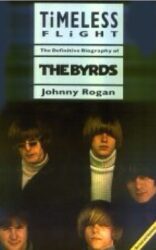
There are rock biographies, and then there are monuments. Johnny Rogan’s Timeless Flight: The Definitive Biography of the Byrds, first published in 1981, belongs firmly in the latter category
Rogan was a twenty-something and still at Oxford when he completed the original book, and it’s very much the work of youthful enthusiasm. There’s a sense that every detail matters, that no session musician is too peripheral to interview, no contractual dispute too dry to document. I’ve got the 1989 revised edition, and he mentions in the introduction that it was up until that point 13 years’ worth of effort. It remains remarkable for the sheer volume of primary testimony Rogan was able to amass at a time when the Byrds’ story was still recent enough that most of the principal figures were accessible, candid, and in some cases still angry about the whole experience. They were also, mostly, still alive.
Rogan refuses to simplify what is by any measure a complex tale to tell. The basic story will be familiar to nearly all AUK readers, I imagine. The band’s personnel shifted constantly throughout their career, producing several overlapping incarnations, each with its own creative logic and internal tensions. Rogan follows the complications wherever they lead, where lesser writers would have skimmed the surface. He gives equal weight to the Roger McGuinn-led folk-rock period, to the country rock that produced Sweetheart of the Rodeo, and to the later configurations which most rock histories treat unjustly as footnotes. Gene Clark’s departures and returns, David Crosby’s dysfunction, Gram Parsons’ brief but revolutionary stay, and, especially, Chris Hillman’s underappreciated role as the stabilising force all get analysed.
The early edition was produced without the resources of later decades, which means it relies almost entirely on interview testimony and contemporary documents rather than retrospective reappraisal. That gives it an immediacy that the Revisited edition inevitably softens. The accounts of recording sessions, management disputes, and label conflicts carry the slightly raw quality of information gathered while memories were still sharp and grievances still fresh. Rogan never romanticises his subjects. He is sympathetic but clear, and his portraits of the band’s internal dynamics, particularly around McGuinn’s often detached leadership style and Crosby’s self-importance, have a detail which some of the subjects have apparently found uncomfortable.
By the time Timeless Flight Revisited: The Sequel appeared in 1997, it had grown to 550 pages (up from 270 pages in 1989). Lots had changed, not least the simple passage of time. This edition represents something different from a simple expansion of the original. Rogan had spent the intervening decades continuing his research, and the sequel draws on a wider base of interviews and documentation than was available in the late 70s. There are corrections to the earlier record, reassessments of disputed episodes, and entirely new material covering the period from the early 1980s onward, including the acrimonious reunion activity and the legal battles over the Byrds’ name that have cast something of a shadow over the band’s legacy.
The physical object matters here, too. The 2008 hardback I’m reading is a substantial and serious book, and even longer at over 700 pages. Produced to a standard that signals the weight Rogan and his publishers placed on the project. Where the 1980s paperback had the feel of urgent, immediate music journalism and had the driven quality of a writer running towards his subject, the 2008 edition carries itself as a definitive archival document. It is the kind of book that belongs on a reference shelf rather than something to be casually browsed.
Timeless Flight Revisited sometimes reads as a writer taking stock, and while that produces a comprehensive source of knowledge, it can also produce sections where Rogan’s thoroughness tips into density that tests even the committed reader. The sequel covers ground that the original could not have anticipated, including the deaths of several key figures and the longer perspective that time allows, but some of the biographical crackle and spark of the earlier version is harder to sustain across the later pages.
By 2008, the band’s influence had been thoroughly absorbed and re-processed by several generations of musicians. Rogan is alert to this, and the sequel traces lines of descent and influence with the same painstaking attention he brought to the primary history. The book also benefits from its subject’s willingness, in some cases, to speak more openly about events they had previously been guarded about. The portrait of Gram Parsons in particular gains additional dimension, as does the account of the Sweetheart of the Rodeo sessions and the complex politics surrounding Parsons’ departure.
Taken together, the two books make up something unusual in music writing: a properly cumulative project. The sequel does not supersede the original but rather stands alongside it. Reading the 1980s paperback first is still the right approach. It captures a moment and a method, and its directness is irreplaceable. The 2008 edition then deepens, corrects, extends, and sometimes reframes what came before.
Rogan took the view that writing a biography was a continuing commitment, and that approach is nowhere better illustrated than in his ongoing allegiance to The Byrds’ cause. And we haven’t even considered the 1200 pages of his later Byrds: Requiem For The Timeless, or its second volume, subtitled The Lives of Gene Clark, Michael Clarke, Kevin Kelley, Gram Parsons, Clarence White and Skip Battin.
A couple of later Byrds songs, which reinforce Rogan’s case for looking more carefully at the post-Rodeo period.

This is the Ulysses of rock biographies. The real J. Rogan did a great service to the Byrds but also to Gene Clark.