
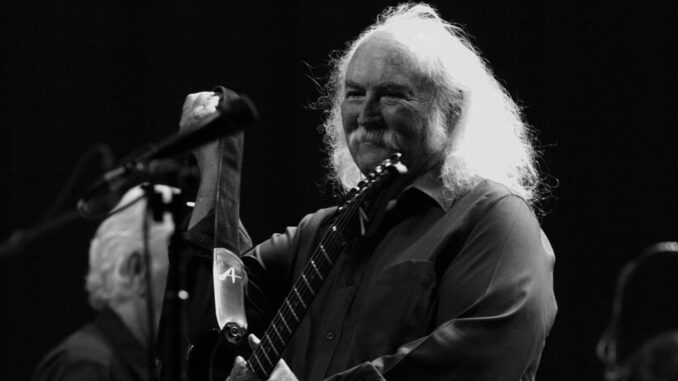
In terms of solo careers, David Crosby’s is somewhat unique. The 60’s saw him becoming a pop and then rock star via his roles in The Byrds and then Crosby, Stills & Nash. The latter grouping (with Neil Young added on) catapulted him and his band mates into the stratosphere in the 70s with all the ensuing crap that fame and drugs delivers. There’s a plethora of albums featuring Crosby and various combinations of the CSN&Y line up thereafter (along with four albums as CPR with guitarist Jeff Pevar and pianist James Raymond, Crosby’s son) but in terms of his solo records he recorded one in 1971 and then waited 18 years to record his second. A third came four years later and then there was a wait of 21 years before a late flourish which saw five albums released, a renaissance allowing him the opportunity to show that he had finally overcome the many demons which had bedevilled him throughout the years.
Re those demons, there’s no need really to regurgitate Crosby’s story here, it’s been well covered by AUK and so many others. The least one can say is that no matter how much of a drug-addled asshole he became at times, at least he could always sing; his voice always had an angelic touch, despite the ever-present demons.
Can‘t Live With It: “Oh Yes I Can” (1989)
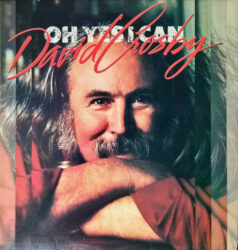 His second solo album, just 18 years after his debut, found Croz back on his feet after a short spell in prison for drugs and firearm offences. Normally, one would reckon that such a strike would lead to cancellation (at least these days) but then, he was a superstar and still an integral part of the money machine that was CSN&Y. So A&M Records set up a stellar lineup of the cream of the LA crop to back him on the album. Unfortunately, the album had several hurdles to overcome, firstly the ubiquitous crap production which marred so many 80s albums, gated drums, synthetic strings, overblown dramatics and so on. It doesn’t help that Crosby seems to have lost his mojo. There’s little here to compare with songs such as ‘Guinevere’, ‘Wooden Ships’ or ‘All Along The Leeshore’. The closest he gets to those halcyon days is the finely woven ‘Tracks In The Dust’, the most pared-back song here. Listening to it again, it stands as a very fine song, an elegy of sorts for the high hopes of the hippie culture. ‘Flying Man’ is a slight return to the hippie scatting which fuelled so much of his solo debut although it’s marred by its oh so corporate rock backing and much of the album struggles as on the title track which is an overblown ballad while ‘Drop Down Mama’ is an absurd attempt to rock out in a blues vein, an idiom Crosby is totally unsuited for; likewise the horn driven rocker ‘Monkey & The Underdog’. The less said about the opening song, ‘Drive My Car’, the better and if you want a reason to find why 80s production sucked, lend an ear to ‘Melody’. Four years later Crosby released “Thousand Roads” which was only marginally better than its predecessor but committed the cardinal sin of allowing Phil Collins to both play on and produce some of the songs.
Can’t Live Without It: “If Only I Could Remember My Name” (1971)
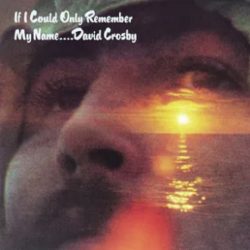 No surprise here I suppose. Crosby’s solo debut was released when he was at the peak of his powers, an ex Byrd and a member of the hippest band in the world. He was the beatific fulcrum of the hippie scene, from LA to San Francisco, a free spirit, unafraid to speak his mind whether it be on free love or American politics, he held his freak flag high.
Despite the success of the first CSN album and its follow-up, CSN&Y’s “Déjà Vu”, Crosby was in a tough place, mourning the death of his girlfriend, Christine Hinton, in a car crash. His drug use escalated and he sought refuge in the studio, assembling a huge cast of characters from the incestuous LA/San Francisco scene for five months of late night recordings in Wally Heider’s San Francisco studio. The players included Joni Mitchell, Neil Young and Graham Nash (no Stills) along with members of the Grateful Dead, Jefferson Airplane and Santana, a conglomeration which was nicknamed the “Planet Earth Rock and Roll Orchestra” by Jefferson Airplane’s Paul Kantner. The songs arose from their jam sessions, gradually taking shape with the tape recorders running all the time, capturing the loose limbed ambience. The end result is perhaps the pinnacle of West Coast music, far removed from the cosy confines of the then burgeoning country rock. If Gram Parsons was the cheerleader for Cosmic American Music, Crosby was its Silver Surfer.
The album flows like a dream, from the opening campfire sing around of ‘Music Is Love’ to the vaulting showcase of Crosby’s voice on the closing ‘I’d Swear there Was Somebody There’. Crosby has never sang better and his multi tracked vocals are to the fore on several of the tracks here. Of the nine songs, only five have lyrics, elsewhere Crosby simply sings with the highlight being the stoned immaculate groove of ‘Tamalpais High (At About 3)’ which has Jerry Garcia scattering crystal shards of guitar while the harmonies of Crosby and Nash on ‘Song With No Words (Tree With No Leaves)’ are a shimmering delight. ‘Cowboy Movie’ is a chunky, almost Crazy Horse-like riff of a song, a second cousin to the grungy ‘Almost Cut My Hair’ (from “Déjà Vu”). It’s a bloody frontier tale which comes across as somewhat akin to Sam Peckinpah’s take on the western movie and some folk have decided that the song is a parable of the romantic crises which assailed CSN&Y as they vied for the attention of the latest edition of what they called back in the days,”their old lady”. ‘What Are Their Names’ opens with Grateful Dead like guitar improvisations before Crosby questions the “deep state” of the time while ‘Laughing’ is the best instance of Jerry Garcia on pedal steel that you’ll ever hear as Crosby takes aim at the false gurus who abounded at the time.
On its release, ‘If Only I Could Remember My Name’ fared poorly in comparison to the rival solo albums being released by Stills, Nash and Young. The reviews were, for the most part, dismissive. Over the years it has grown in stature with reissues (featuring out-takes and demos) garnering acclaim. For this writer it is Crosby’s crowning achievement.



Fine look back, 1971 was a great year for CSNY as individuals and as a band with 4 Way Street. The reality is as a band it was their peak with Crosby’s decline into drugs, Stills was working on his magnum opus Manassas. There was much wasted on the way but as individuals they never recaptured these heights again much was wasted on the way.
Well, no-one (!) could disagree with the can’t live without choice, I’d swap “Thousand Roads” for “Oh yes I can”, but it’s a pretty fine line and that choice is doubtless in part influenced by my first ever Crosby purchase being the 12″ single of ‘Drive My Car’ with ‘Tracks in the Dust’ and ‘Flying Man’ on the B-side. From, I’m guessing, a bargain bin in Woolworths – it wasn’t (in the UK) a chart-bothering song.