
The world of song is made of melody, harmony, rhythm and lyrics, but one can argue that it is lyrics which extend the dimensions and expand the possibilities of this world as much as the other three combined. After all, aren’t songs really poetry set to music? When both innovative and relevant, lyrics can wake up the listener, making him or her more aware, through their elasticity. Reality – in our daily lives as well as our stories – is less prescribed than tradition has led us to believe.
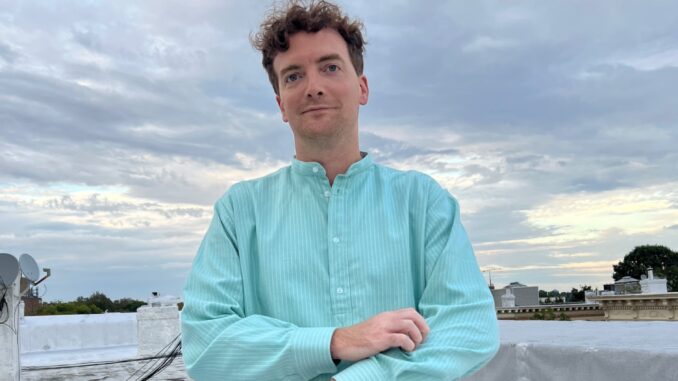
Paul Spring’s lyrics have the capacity to heat up a verse and externalise an image, to lift a phrase out of the mundane mire of pop fluff and lodge it in the luminous honeycomb of the collective psyche. In other words, he is able to squeeze meaning out of a Dark Red beet. Not that there is anything mundane about the Big Three of his music. He is no amateur in that regard.
Spring came from a Minnesota literary family, number 9 of 10 on the sibling totem pole. He is the great-grandson of American poet/war hero Joyce Kilmer and impressionist painter Frederick Frieseke. The Minnesota Public station was always playing classical on the radio at home in St. Cloud, with the occasional variety of Irish music. Once ready to strike out on his own, he moved to crowded Queens, New York, more than a hop, skip and jump from the calmer lifestyle of the Great Lakes region. “Actually, my dad grew up here, so I have some family, some cousins and such,” he offered. “My brother stayed for a year in (nearby) Jersey City, and then my wife has family out here as well.”
It’s the old small fish story, flying under the radar, whatever metaphor seems to fit. How do you get noticed among thousands of other budding musicians? Spring has been making music for a long time, but always self-released and self-managed. “I guess I’ve never broken out as they say. I’m still pretty small, and actually, I enjoy that. I used to get frustrated, but now I think it’s the best.”
Recently, he had a gig at Sunny’s, a beautiful old bar in Red Hook that claims to be the longest-running bar in New York. “It’s really hard to get a gig because they are a fixture for local country and bluegrass acts,” Spring related. “But it was packed to the gills, and being honest, I was a little scared. It had me thinking, what should my next move be, now that I’m starting to build momentum? I have to be a business person as well as an artist. I don’t want to pursue press or record labels because when I’ve done that in the past and been turned down, it made me disappointed and thrown off kilter. This was in my twenties. I’m 35 now and I’ve been in a very healthy, productive, creative mindset since 2021, writing sometimes a song a week, sometimes multiple instrumentals. That’s not to say any opportunity that comes my way, I wouldn’t take it.”
He works hard at his craft, booking his own shows and getting up in the mornings to mail vinyl records. But he doesn’t want to get his hopes up or try too hard. Basically, he just wants to focus on making good music.
Spring counts himself lucky to have a wife who is very supportive and helpful. He has known Sophia Heymans since high school. “She taught me the importance of listening to honest critiques and also to practice daily creating something,” he said. “She’s a lot better at that than me. She paints as many hours as there’s sunlight in the day, usually seven days a week. And she designs all my cover art.”
And that’s a lot of designing because Spring is an extremely prolific musician, working at an album-a-year rate under his own name, and that’s not counting being lead singer of the band Holy Hive until their dissolution in 2021. Each album is a snapshot in time, and any good musician is compelled to represent what they are seeing and hearing at the time as a refraction of life.
The albums keep on coming
“Always Almost Home” (2023) has Spring going deeply into electronic production. It started out as a concept album based on Homer’s “Odyssey”, though strayed a little bit. He was trying to make the closest thing he could to pop music with every one of his influences, and ‘Go-Getter’ was the closest he came to achieving that objective. He shines as a lyricist on this cut: More of your heart, less of the ache, More of the deep, less of the fake.
“I think that song turned out well,” Spring said in classic understatement. “It has elements of a pop song, but it also has these backing vocals that are sampling a Bach chorale, which maybe no one would pick up on but me. I played and programmed and did everything on that record, produced it and engineered it, everything except for mixing and mastering. Sorry, I forgot there was a harpist who played on one song and a drummer who played on another.”
Among the great classical composers, Bach is a favourite of his. In 2021, he recorded “J.S. Bach: Twelve String Transcriptions,” again doing it all on 12-string guitar except the final touches. He was self-taught on guitar with only a few classical lessons, but didn’t learn any Bach except for the ‘Bourrée in E Minor.’ Like so many musicians, the pandemic forced changes in approach. “We stayed in Manhattan, and it was really rough outside,” Spring recalled. “I couldn’t write or play songs, and I just needed something that required a hundred percent of my focus. So, I started learning these Bach songs, and it was perfect. I would spend four hours learning one measure and just constant repetition. I love the arrangement that Leo Kottke did of ‘Jesu, Joy of Man’s Desiring’ and wouldn’t I love to hear a whole album of this. I got lucky because a friend of mine, Robin, lent me his incredible 1920s Stella 12-string, like a Lead Belly guitar, who’s my favorite musician. And it was recorded to a U-67, which is a fantastic Neumann mic from the sixties, straight to tape on a beautiful guitar. I had to play some of those pieces extremely slowly, way down tempo, because those guitars in general tend to be susceptible to rattling strings.
“I kind of want to rerecord that album on a nylon string because I can play most of those songs now about 20 or 30 bpm faster. For two years, I had a weekly gig playing Bach in Manhattan, so I’ve played them hundreds of times. If I were to pick a song that I love on the way it turned out, it would be the ‘BWV 999, D Minor Prelude.’
One of his earliest recordings was an EP called “Borderline.” A friend named Tyler Tholl worked in Minneapolis at a commercial recording studio as an engineer and mixer, and Spring was offered the opportunity to try out recording some songs. “He had a really cool high school band. I brought the six songs I had then written in open tunings, and he added all sorts of strings and stuff. The best song on that is about the explorer ‘Vespucci.’
Spring took that EP and his first three albums off Bandcamp. It had nothing to do with the songs so much as his singing. “I’m proud of the production, the songs, the people who played on them, but I just can’t stand the way I was singing. It was too loudly with this strange voice affectation.” One of those was called “Home of Song,” which is actually an album of children’s songs made through a grant from the state of Minnesota to go around playing at libraries. “I was 23 back then and was doing a program to encourage childhood literacy and get kids into reading books. Most of the songs are from children’s literature, and I have to say my favorite is ‘Sherlock Holmes and Watson.’
In 2024, “Kind of Heaven” came out, and the electronics he’d been using were ditched in favour of acoustic arrangements. The songs were worked out while Spring and his friend Jon Nellen played some shows as a guitar and drums duo. “Jon was about to leave on a long tour with this band, Big Thief,” he said. “But I wanted to record, and we had just two days, but we got it done. Nick Hakim played piano on ‘I’d Be Lying,’ which was recorded in his small basement studio. John was playing drums about 3 feet from me, and we had to play quietly, otherwise it would have bled into the mics. The melody for ‘Far from the Flame’ is based on an Irish jig called ‘King of the Fairies,’ and I reworked that chord progression and interpolated it to make that song. I was thinking about the Icarus myth and ambition, soaring up to this goal, but being cautious of how to touch it.”
Depression era music
In 2019, when “Neptune” was made, Spring had a job as an assistant engineer and manager at a studio in Queens, and part of the deal was he could go in there nights and weekends to record. It had all the best gear, and that’s also where the Bach album was recorded. He had access to incredible microphones and a really nice tape machine and board, and preamps. Unfortunately, he was probably in one of the worst depressions in his life.
“My twenties were a little rough,” he acknowledged. “That was probably my last big depression. I’ve been happy in my thirties. That album, I don’t go back and listen to because it was a pretty dark time. The best song that’s on it is the one where I’m not singing about any problems. It’s a guitar instrumental called ‘Diving’ that I think turned out really cool. That album I played on a seven-string Brazilian nylon string guitar, so a lot of the guitar parts have a low B string, and it sounds really full. And I recorded with this rhythm ace drum machine and an RCA 44, which is an old radio broadcasting ribbon mic, the big square ones that you see in old movies. It has a kind of dark, low, mid-range sound.”
Spring made his self-titled album back in Minneapolis. It’s the only one his wife didn’t do the artwork for. A graphic designer was hired by a guy who became his manager for a short time and invested some money in Spring’s career. “He was really generous and we went to a super pro studio called The Terrarium; it was my first experience working in a really Hi-Fi space. My band was made up of friends, but I had no idea what I was doing. Even so, I think it turned out pretty well. The best song on there – or the one I like best – is called ‘Saul.’ That’s not the Old Testament Saul, but the New Testament Saul, who converted to become Paul the Apostle. It’s a story about falling from grace and picking yourself back up again.”
“State of the Union” was another of the albums on which Spring believes he was singing too loudly. “I guess I was trying to be heard,” he said, almost apologetically. “On that album, I was really into John Prine, so I attempted to write some funny country songs, but some other songs, too. It was confusing, but the best song is called ‘Conversation of Mass.’ Right out of high school, I became a teacher at a Catholic high school, and on Easter break, I took the very little money I had and flew out to Oakland to visit a friend from school who had moved there. I recorded the album in a wonderful studio with my friends: Rob Shelton, Carly Bond, Andrew McGuire, and Danny Vitale.” I wondered, with state of the union being a political term for the President’s speech, did the album have a political theme. Not so much, according to Spring. “There is one song called ‘Type Two Diabetes’ where in the bridge I sing about being the President of eating bad food. Seven o’clock central, you’ll tune in to my state of the Union, and these are the words I’ll say. America’s colors don’t run. America’s cars don’t run, and America’s kids don’t run.
When he first moved to New York, Spring was working as a delivery truck driver for vegetables, and it was unglamorous, early-morning work. He badly wanted to have a regular gig and came up with the idea to play instrumental guitar for parties, and that could be a good supplemental income. He bought a Tascam cassette recorder, set it up in his tiny bedroom and recorded an album of instrumentals called “Sleeper.” It was tough because the machine was picking up through radio frequency a guy on my block playing first-person shooter video games. While I was playing a soft nylon-string guitar and doubling it, I would hear him shout, “Headshot!” That made it tough, and besides, it was 90 degrees, so I’m playing in my underwear. I love this 12-string song based on a Chopin chord progression called ‘March on March.’
Speaking of video games, the “Thunderhead” album was recorded amid replaying the video game, “The Legend of Zelda, Ocarina of Time, which is referenced at the end of the album as a tribute to his brother. The only song Spring didn’t write is ‘Fairy Fountain,’ by Koji Kondo for the game’s soundtrack. With all that, the song that Spring is most proud of is the title track. “I had started learning traditional Irish flute, and that song borrows and interpolates a melody from a tune that the Chieftains made famous called ‘The Dunmore Lassies.’ This was one of the first times I heard an Irish reel that wasn’t played at a ridiculously fast speed. The Chieftains slowed it down and made it more of a dirge. I experimented with electronics on top of that, and that became the template for the rest of the album.”
During his junior year of high school, Spring and his younger brother were homeschooled by their liberal arts professor parents, with a focus on learning Classical Latin and Greek. Recent events led him to recall the lessons on Caligula and Nero, and he felt drawn back to his old textbook to read about a crumbling empire. The result became Spring’s latest album out in June 2025, titled “Vita Brevis,” literally “brief life,” usually associated with the phrase “ars longa, vita brevis,” meaning “art is long, life is short.” What the old Greek physician Hippocrates was saying is that humans don’t live long enough to become masters at their profession. In Spring’s case, however, his aim was to couch what he was feeling in order to avoid offending anyone. “I had things I wanted to sing but couldn’t. Simple cathartic phrases and statements, nothing fancy, just things like ‘I curse our evil empire’ or ‘Life is short’ or ‘May there be peace on earth for all nations.’ But I know that if I were to play a record and hear someone sing these lines – I would turn it off immediately.”
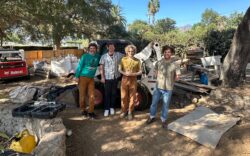
Spring enlisted Taylor and Griffin Goldsmith of the band Dawes to record “Vita Brevis” live in Altadena, CA, in October 2024, the only album to be completed in their recording studio before it tragically burned down in the Eaton Fire. “The track that is the focus of the record is ‘Pacem in Terris,’” he stated. “The music side was influenced by old hymns, the writings of Karl Marx, Beach Boys acapella stems (specifically the unused background vocal stems of ‘don’t talk put your head on my shoulder’), and Bach Motets / Chorales.”
The only musician that has a canoe for a tour vehicle
If I had been able to translate the Mohican name for the Hudson River in New York state, I would have learned that is “The River That Flows Two Ways,” the title of his 2024 album. Thanks to Spring, who is something of a river savant, technically, you could call the Hudson a fjord. There is only an 8-foot elevation difference between New York City and the Capital city of Albany, 160 miles to the North. It’s a brackish river, mixing fresh and saltwater in the tide, which runs all the way to its source at Lake Tear of the Clouds in the Adirondacks. Geography lesson concludes.
The album’s impetus was Spring had never made a solo performance record, and secondly, he needed something to promote on his river tour. He is far from a John Hartford with steamboats, opting to use rowing propulsion in a canoe. “Having the album out helped me to book the ten shows as I canoed down the Hudson from Albany,” Spring said, probably with thoughts of resting tired arms. “I wished I started up at Lake Tear, but there are many class 2 and 3 rapids, which I didn’t want to go through with a guitar on the boat. It’s really tough because the tide switches every 4 hours, and you can’t paddle against the tide. The song that’s representative of that album is ‘How to Love You.’ It highlights the guitar arrangement, which the original electronic recording does not. That one I tuned down two and a half whole steps very low.”
In 2015, Spring wrote songs for the album “Toward the Center” and promoted it while going down the Mississippi River. By now, you are likely sensing a pattern. His voyage started at the headwaters in Lake Itasca with Sam Phipps, a high school friend who happens to play accordion, keeping him company. They played many shows together at stops along the river. His favourite song on the album is called ‘Father’s Day.’ “My father died when I was 18, and I was away from home at the time. I came back to Minnesota to be closer to my mom and siblings, and that song is about going up to my dad’s grave with my mom and thinking about the processing of grief and also the gratitude and communication with somebody who’s left the world and how you remember them.”
His roots may be in Minnesota, but Spring has lived in several places, one being Ireland for six months when his dad brought a study group from school abroad. He has returned to Ireland on several occasions since and recently did a tour there. “The last time there, it was for a dozen days, and every night we went to a session at a pub. I would sit in and sing a song or play with whoever was on stage. Here in New York, a guy named Matty Stapleton leads a regular session on Wednesdays. I sing with him and Isaac Alderson on pipes and another guy, Alan, on bouzouki.”
It wouldn’t be surprising to learn Spring has moved to Ireland at some point. “I mean, the whole country is beautiful, but I could narrow it down to three places: Connemara is a Gaelic-speaking region northwest of Galway. It’s very remote, but that would be my dream – number one. Number two would be a town called Ardara in County Donegal, and number three would be where my family is from, Castlemaine, down in County Kerry. I’ll see where the best pub with the best music is located.”
When I mentioned being in Ireland at a time when British soldiers lined the roads leading into Belfast, he recommended reading one of his favourite books, called “Say Nothing: A True Story of Murder and Memory in Northern Ireland” by writer and journalist Patrick Radden Keefe. “I think you might like it,” he said. “It’s about ‘The Troubles’ in Northern Ireland through the lens of these secret interviews with members of the IRA.”
Spring’s music sounds and feels very expressive in a music therapy kind of way, as if he is self-healing through the process of writing and recording. The music is a stylistic representation of how he deals with his place in the world. “Sometimes, if I’m in a really good place, I try writing a song that isn’t about me working through a problem, but almost always the songs start with a question I have on a personal level or one for the world to figure out. I’m bipolar, fortunately and unfortunately, and have had therapy, but I think the thing that’s done the most for me are songs and being able to work through this crazy life along the way.”

