

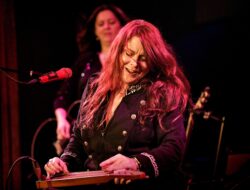
Carolyn Wonderland is much more than your average blues guitarist. For one, she’s a woman in a male-dominated genre. Secondly, her choice of material is seriously strong musically and lyrically solid. Third, she keeps that telecaster humming like an epileptic bumblebee. As with most guitarists, she has an array of axes and other instruments at her disposal, which she listed, smiling like a cat that had just swallowed an entire cage of parakeets. “There’s probably three or four acoustics, and I’d say eight or nine electrics of different varieties, couple hollow bodies, probably five lap steels, a couple banjos, some mandolins, some ukuleles, some… well, there’re all kinds of stuff around here, a couple pianos, a harp, a bunch of trumpets.
“I’ve been a Tele girl for so long, but it really depends on the song as to what I’ll play,” she continued. “I switched when playing with John (Mayall). It’s something about the register where his voice and harmonica and keys were. I felt like the Tele was just a little intrusive and sharp, having like an Albert Collins or Roy Buchanan bark to it, and it felt like it was getting in the way. So, I went back and I listened to all the practice tapes again, and I was like, what am I missing? Peter Green, P90s, you need some damn P90s girl. I had this Blueshawk that Patrice Pike had given me years ago in a guitar trade, and that became my number one with Mayall.”
She displayed her talents on Mayall’s “Nobody Told Me” for one, following guitarists from Eric Clapton and Peter Green to Rick Vito, Coco Montoya, Buddy Whittington and Walter Trout. The list goes on and on. Was she a little anxious following in those footsteps? “I tried really hard not to think about it too much,” she admitted. “It would paralyze you with fear otherwise. When I joined the band, he gave me a couple of practice tapes, these CDs, mostly live board tapes of Peter Green and a whole lot of Buddy Whittington. Those two guitar players approached it so differently, and John’s main thing with people was like, I don’t want to hear it the same way twice and I want to hear you in it. I don’t want to hear who played it before you.”
She mentioned learning a lot from Mayall’s love for J.B. Lenoir’s music and some of Otis Rush. “John told me to establish where the head lick is, but then jump off the diving board. When you thought you were done, he’d turn around and smile at you, say do it again. But I’d run out of notes. He always gave at least a moment for everyone to shine, so it was like, where do I come in? Oh, maybe if he quotes ‘Alfie.’
In the beginning….
She was born off of NASA Road One in Houston. “To quote Juke Boy Bonner,” Wonderland enthused. “it’s an action town. It’s a great place to grow up playing music because you can play five nights a week with different players and never play to the same people twice it’s so spread out.” Her mom played and it was her guitars that Carolyn started messing with as a kid, though her mother favored quiet folk music. “She was our Girl Scout leader for a while,” Wonderland remembered. “Everybody would call her the guitar lady. She’d pop around and make sure that we knew all the words to Woody Guthrie songs like ‘This Land Is Your Land’ and don’t skip that last verse.”
She had issues with schooling and got thrown out twice – the second time stuck. There were protests involved. “It is very much mirrored in what we’re going through now,” she said. “It was a time where there was this whole satanic panic or whatever, and they decided that some of us shouldn’t be in school. The first protest was actually just a sit-in during the time of Tiananmen Square. All we did was skip lunch and they decided to throw us out of school. And that’s kind of the way it goes around here. As the school board goes, so do the kids.”
One time she “borrowed” a car to sneak out to jam, rolling the car down the driveway and popping the clutch, and ended up swapping songs with Townes Van Zandt at Houston’s Local’s on White Oak. “I had no idea who he was,” she confessed ruefully. “At one point somebody had requested ‘Pancho & Lefty’ and I said my mom’s band used to do that song. He said that was his song, and I said you liar. I thought they were going to throw me out of that place. The bartender said, well, what do you want me to do with her Townes? I realized right then what I had done, but he was super nice. Every time I’d see him, he’d razz me about that and then say, what have you been writing?”
At the age of 19, she left home and moved to Austin, one day finding herself at the High Sierra Festival in California where she ran into into Doug Sahm. “He told me Austin was the place to be; it was the land of free guitar lessons and he wasn’t wrong,” she said with a wink. “I’ve covered ‘You Never Get Too Big and You Sure Don’t Get Too Heavy.’ It was a good lesson that no matter what he played it sounded like him.”
Often at High Sierra, people would camp there at the site. They had these little lodges where the bands would stay, and Sahm saw her Texas plates. She vividly describes that first meeting. “He comes out in his boxer shorts and his cowboy boots, his hat and sunglasses, and then he sees two girls come out of the van. He goes I’m sorry ladies, when’s your birthday? We start talking and it turns out he shares a birthday with the guy that invented the sousaphone, and he starts marching around the parking lot in his boxer shorts singing be kind to your web-footed friends because a duck could be somebody’s mother. My favorite memory of hanging out with him that day was how in the autograph line he made everybody feel like he was there to see them. And I thought that was really cool.”
She and Sahm used to record by Willie Nelson’s Cut ‘n Putt, and Wonderland was referred to as Rainbow Head. “I don’t think he knew my name for the first couple of years, and he’d say there’s Rainbow Head again. To be fair, I did have pink and purple hair.”
Home but homeless in Austin
Despite spending two years homeless (or as she puts it, “van-full”), Austin was fertile ground for Wonderland. A series of each-better-than-the-next discs began with “Alcohol & Salvation” in 2001. “Those are songs about booze and God; records are a time capsule of what happened that year.” In 2003 “Bloodless Revolution,” then 2008’s “Miss Understood,” 2011’s “Peace Meal” (recorded at Bismeaux Records and Levon Helm Studios in Woodstock) 2015’s “Live Texas Trio” and in 2017 “Moon Goes Missing.”
In the early 1990s, Wonderland was invited to the Guadalupe Street Antone’s. It was a good bar to hang for her and the band, the Imperial Monkeys. They called it quits a few years later after a run-in with black ice and a semi that landed young Miss Wonderland in the hospital.
Sometimes people say you can’t play blues unless you’ve lived sorrow and pain. Springsteen said some of the greatest blues music comes from some of the darkest moments. Did she think it is accurate that you can’t play blues without living it? “I mean, you can play at it, but I think until you feel it, until you’ve experienced what you’re singing about, it cuts differently. I know I wrote some songs in my 20s where I thought I had heartbreak, and then you experience it and now I can walk in those shoes a bit better. I think I’ll write a different verse. It is just a peeling back the onion, but that’s true of I think all of our life’s experiences. Once you get a little perspective, it’s a different color for sure.”
Remembering well those years spent with her van for a home led her eventually to volunteer for an organization that helped the homeless. “We kind of take for granted the appreciation for just being able to put a key in the door and unlock it, get into your own bed and take something out of the fridge when you want to eat or drink,” she said. Wonderland was part of a group called HOME (homeaustin.org) that is in its twelfth year. They began when their friend Lavelle White, who just turned 96, found herself facing homelessness. “It just was incredibly unfair that this woman who has given so much of her life to music and is such an inspiration for so many people would find herself in dire straits. We did what musicians do. A bunch of us ladies got together at Marsha Ball’s house and decided to throw some benefits every six months or so and keep Lavelle in her house. We gave out hundreds of emergency grants. Our main goal is to keep musicians 55 and older in the Austin area in their homes.”
In the million miles club a couple of times
Wonderland has played the blues throughout North America and in several other ports of call. She has heard and played in many different styles. “John (Mayall) had more of Chicago in his style. Then there’s more jump in California and more city when you get to Kansas City. Every place has a feel. In Houston you could definitely feel the influence, not just from Louisiana where you get a lot of good zydeco, but you could also get a lot of the norteñas and things that you wouldn’t expect. You might get a little feel from a German dance hall or something soca. But it all ends up sounding very Texas. There’s a definite line that you can draw where you still can have Mance Lipscomb and Lightning Hopkins and Stevie Ray Vaughan in the same stew.”
She knew Jimmy LaFave from Austin and was always excited having the opportunity to play with the Texas legend. “He had such a pure and honest voice either interpreting other people’s songs or writing his own. There were specific times when I think about myself and Jimmy and Steven Bruton being asked to do different things for the city. Once Steven asked me to come and do one that I was worried about as I was really opposed to this group that we’re about to be playing for. I didn’t want any money, but I wanted to play this protest song. And he says, well, that’s why I hired you. Steven and Jimmy were both super open with that stuff.”
Wonderland raves about getting to play with Levon Helm and covered a song Rick Danko wrote (‘Orange Juice’) on her latest album, “Truth Is” (Alligator Records, 2025). She had been considering giving it all up until the chance to play with Helm intervened. “I didn’t know what I was doing, and I felt like I was just getting beat up in the undertow of the music business,” she ruminated. “That man embodied joy. He beat cancer that should have taken him out and there was no woe is me. He didn’t have his singing voice and one night he asked me to sing on the second set. My husband came by and suggested ‘Let’s Go Get Stoned’ (the song not the joint). In the middle of it all, you could hear Levon shouting the chorus. That was absolute magic.”

Truth is the blues ain’t easy
Albert Collins once said, “Simple music is the hardest music to play, and blues is simple music.” Wonderland can appreciate the analogy. “It’s true. I’ve seen him play so many times. I remember being underage and I’d already snuck in and gone out to have a cigarette, and I’m standing out in front of the club when he does that hundred-foot guitar cable walk during the ‘Fourth Ward Blues.’ He stopped playing and looked at me twice with the pink and purple hair and said ‘your hair is pretty.’ And then he kept playing and walked in and I was like, oh God! He could have said something far worse. But he was so nice and just wide-eyed about what are you doing out here?”
Learning a few licks from one of the masters, I suspect would have been her answer, though she didn’t mention any response from her side. I do remember seeing Collins once doing that signature walk she spoke of. Collins’ solos took time to build, like a volcano before erupting into hot molten flows of licks. Listening to “Truth Is,” you could corroborate Miss Wonderland had her eyes and ears open.
Hearing that Dave Alvin had produced not only her latest but the previous album, “Tempting Fate,” alone was enough to send me scurrying to the Alligator Records’ site to check this out. If Dave had thought enough of Wonderland to produce, co-write and play some on her records, that is about as strong an endorsement as she could receive.
“As it happened,” she recalled, “I had been on tour in John Mayall’s band for a couple of years and didn’t have a label anymore. I was talking to my friend Cindy Cashdollar at her house in Woodstock, New York, and she said, ‘well, what are you going to do?’ I had a lot of songs and wanted to make a record. In a perfect world, I’d have someone like Dave Alvin producing it. So, she called him up and he said yes.” Wonderland had been a Blasters fan from way back. “I’ve gone to see Dave play in a billion different bands and opened up for him a couple of times and man, he knows how to get inside of a song – efficiency with words and cuts right to the meaning. He really helped me edit a lot of my ideas of what I meant to say. What came back was way clearer than the mud I handed him. And he knows how to get into a genre-less approach to music. What does this song want to do? It doesn’t have to be married to the blues or to rock or country or zydeco. I like that approach a lot.”
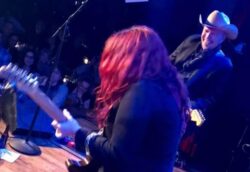
Wonderland happens to be on a blues label but is certainly not limited to that. She knows how to fire up one, though. ‘I Ain’t Going Back’ is spicier than a Texas chili pepper. ‘Whistlin’ Past the Graveyard’ jumped out of the headphones as if smothered in hot sauce. She claims Alvin’s wizardry still blows her mind, how it expanded her palette by prodding her not to be shy about trying new ways. “For example, I pulled a trick that I learned when I was in Jerry Lightfoot’s Band of Wonder many years ago. He had this great rhythm section; it was Larry Fulcher on bass and Barry ‘Frosty’ Smith on drums. To keep a song from sounding like any other song on the record, one of them would name an era and the other would name a city. It’d be like 1940s cakewalk, take it to New Orleans. What? And sure enough, it brought great life to the songs. Dave liked that and said let’s move in that direction.”
She dedicated “Truth Is” to both Mayall and Gene Taylor, who had recently perished in the Big Texas Freeze. The last song on the record is called ‘Blues for Gene.’ “Dave played on it with me, and I got my friend Henry Herbert to come and play piano. He was kind of a protege of Gene’s. I mean, he’s an amazing piano player on his own, but he really understood how to capture the spirit of Gene. It was beautiful and devastatingly haunting at the same time.
“Gene Taylor was one of the first musicians I met when I moved to Austin,” she continued. “Actually, I was a teenager still living in Houston at the time, and I was coming up to play at Antone’s. If I showed up early, Clifford Antone would introduce me to a couple of the folks so I could say hi. It was cool as hell. Here’s Lou Ann Barton and there’s Kim Wilson and this is Gene Taylor. From the Blasters? I lost my mind and he kind of laughed it off. But he’d always include me in stuff if he saw me in an audience – say, you want to come jam? When we lost him, it was just such a fucking travesty. I mean, hundreds of Texans died at the same time. It was during the freeze, and it wasn’t the weather. Maybe to an extent, because it was bitterly cold for over a week here. But the real reason that he died was because the power grid went down, and that was people’s greed that didn’t have too much to do with the weather.”
She didn’t find it hard at all to write that song. “When I’m happy, that’s when I find myself dancing or having a good time or singing. But when I’m upset about something or I don’t understand something or it really pisses me off, it seems like there are pens and papers on every surface. There is a lot of that on this record, trying to figure things out. Why are we doing what we do? How can we make it better for each other?”
Wonderland has brought her guitar stylings, blues or otherwise, to so many places and with so many musicians it would take more than space will allow to list them all. It all began for her when she felt the pull of Austin and the blues. “I feel super lucky that I get away with this still,” she said modestly. “It’s hard to believe sometimes I still get to go play. That’s pretty awesome. So, I would encourage folks to go check out their local scene and find their favorite musicians there, because that’s where the music starts.”


Small correction: Carolyn was born off NASA Road One in Houston.