
Diaz’s final chapter to the heartache trilogy proves to be her rawest and starkest yet.
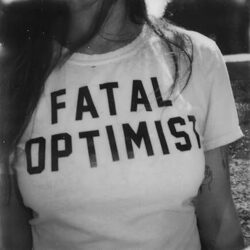 Madi Diaz’s latest offering, “Fatal Optimist”, is a rapid follow-up to last year’s two-time Grammy-nominated album “Weird Faith”. Having initially entered a New Jersey Studio with a group of friends to flesh out the songs that would eventually become the new album, Diaz came to accept that something wasn’t working and that these songs required to “sound like isolation”, and thus mirror the experiences that had originally inspired them. Abandoning the northeast, she relocated to Southern California and the Infinite Family Studio of Gabe Wax, whose previous collaborations include well-known artists such as Soccer Mommy and Zach Bryan. Here, the arrangements became deliberately more minimalist, with just the occasional accompaniment from a baritone guitar or bass to support the almost brutal honesty of Diaz’s narratives. The simplicity of the production inevitably shifts the responsibility towards Diaz’s storytelling to carry through the message from song to song, as she intrinsically traces the different phases of what could be described as the ultimate break-up album.
Opening number ‘Hope Less’ sees Diaz’s fragile vocal delivery resting upon a barely audible acoustic guitar that gradually builds in intensity as she recounts the time the romantic spell was fully broken, while the following number ‘Ambivalence’ endeavours to capture all the oscillating emotions of the post-break-up period. Up next is ‘Feel Something’, where energetic acoustic strumming, along with a languid electric guitar, helps to convey the sense of frustration and angst within the narrative. With little in the way of a musical crutch available for these songs, the pressure is on Diaz’s vocals to deliver the message within each story, which she tackles by showcasing a newfound confidence, probably garnered from her previous album, displaying a greater understanding of the craft and art of phrasing and thus better directing both the tension and empathy within the poetry.
However, trying to put the responsibilities for a whole album purely on the delivery of the vocals and the narrative is a tall order, and occasionally the heavy mood results in a rather dense listen. There are times when the lack of a distinct melody tends to stifle the message, whereas a little more variety in the arrangement would have helped cement their individual identity. That said, there are some excellent songs, such as ‘Lone Wolf’ and ‘Heavy Metal’, that linger long in the memory, drawing a slight comparison to Kacy Musgraves at her most reflective, while ‘Flowers, with its bittersweet melody, is an album highlight, for all that the narrative continues to pummel the heart. The title track closes out the album on a relatively positive note, suggesting that Diaz has finally exorcised the ghosts of this emotional rollercoaster period of her life and is ready to move on.
“Fatal Optimist” is an incredibly brave album on numerous levels, which, through its uncensored narratives and emotionally raw poetry, reveals Diaz at her most vulnerable. Her vocal delivery, with its subtle use of phrasing, endeavours to capture all the emotion of a romantic break-up, from the sense of loss and futility through to urgency and panic before hope finally filters in. Choosing to present all this emotional turmoil upon such a sparse arrangement undoubtedly helps to present a hauntingly stark ambience wholly intent on directing the listener’s focus to the lyrics. However, at times, the brutality and directness within the narratives cry out for some level of musical juxtaposition to offer up both a sense of release and also some much-needed colour and depth. The decision to present these songs in such a simplistic setting is both understandable and commendable. Still, one can’t help but feel that the use of a slightly broader musical palette would have benefited the whole listening experience.


