
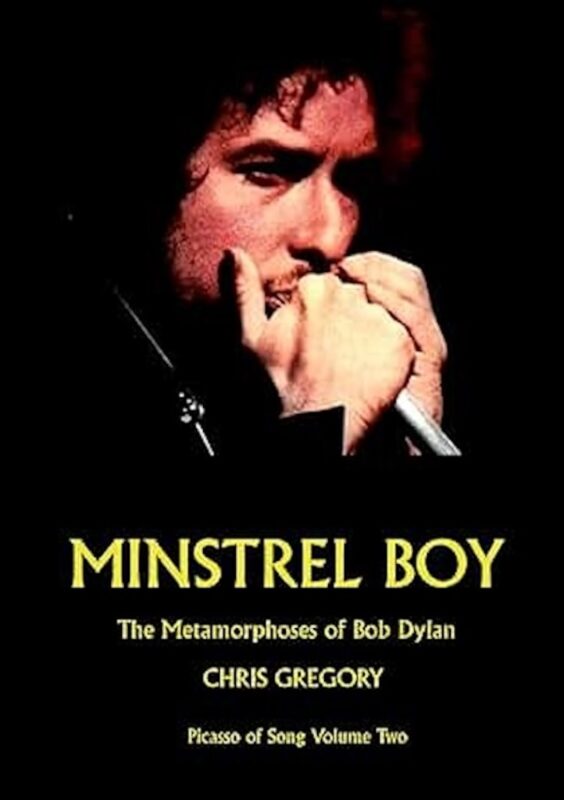
 Following on from his highly acclaimed 2021 book, “Determined To Stand – The Reinvention Of Bob Dylan“, which took a detailed evaluation of the legendary singer-songwriter’s career between the years of 1992 – 2020, author Chris Gregory has returned with the second instalment, “Minstrel Boy – The Metamorphosis Of Bob Dylan”, covering the period from 1967 to 1990. Adopting a similar forensic approach to its predecessor, Gregory has now turned his focus on what has often been described as Dylan’s “years of struggle”, recovering from his motorcycle accident, coming to terms with the pressures of fame, and settling into family life. This period, however, also included what is considered to be some of his finest work, and is sure to be of particular interest to regular readers of these hallowed pages and americana music fans in general. The fact that Gregory has chosen to work backwards, with the years here predating those previously covered, in what can only be assumed to be the first of a trilogy of books, is immaterial, with both working as separate entities and running chronologically throughout.
This book is divided into three parts, with part one subtitled “Retreat”, concentrating on the years 1967 – 1973, starting with his time spent with The Band writing and recording the songs that would eventually be released as “The Basement Tapes”, through to “Pat Garrett & Billy the Kid” The second section entitled “Return” covers the period from 1974 -1978, which includes such classic albums as “Blood On The Tracks” and “Desire”, before, under the subtitle “Rebirth” the book focusses on the years 1979 – 1990, covering Dylan’s conversion to Christianity and albums “Slow Train Coming” through to “Under The Red Sky”.
Within each section, Gregory has taken every song from all the albums recorded during this period and placed them under the microscope. Line by line, bar by bar, the poetry and the musical structure are dissected and analysed, with layer after layer peeled away to reveal hidden depths and meaning that even the most avid Dylan fan is unlikely to have uncovered on their own. Gregory’s encyclopaedic knowledge of Dylan’s work, combined with a scolastic approach and a perceptive eye, enables him to unearth the germ of inspiration, linking the source of much of Dylan’s poetry to either some Greek epic, or the King James Bible, possibly Shakespeare and often the romantic poets and the Beat generation. Just as inspirational was Dylan’s own depth of knowledge in traditional music, be it folk, blues, or country, from which he continuously mined, often borrowing lines and phrases, and which Gregory has also traced back to their sources.
Dylan also drew much of his inspiration during this period from his own experiences, trying to escape the pressure of being hailed the ‘New Messiah’, balancing family life against the urge of his own artistic drive, along with an ever-increasing interest in religion. Here again, Gregory is on point, carefully stripping away the distraction and subterfuge so prevalent during this period of Dylan’s career, enabling the reader to better understand, not just the heartbeat of each song, but to a certain extent, the heartbeat of the artist.
As well as studiously exploring the contents of each album, Gregory dovetails his analysis by continuously incorporating key live performances, revealing how narratives within songs constantly changed, continuously evolving to become something more, leaving the original album version to be more akin to a work in progress. Even the songs that didn’t make the cut for their intended album but would later appear on one of the “Bootleg Series” don’t escape Gregory’s scrutiny, and while Dylan’s songs are the main focus throughout, he still takes time to evaluate Joan Baez’s most famous song about Dylan, ‘Diamonds And Rust’. Here again, a song so familiar and scrutinised over the years that one would rightly feel it had nothing left to reveal, succumbs to Gregory’s forensic approach to uncover depths previously undisclosed.
Throughout the book, Gregory’s writing is both fluid and succinct, and where in lesser hands the weight of information might well have resulted in a rather dense reading experience, there is a constant sense of clarity and even pace that enables the restructuring and redefining of one’s initial perceptions to be easily digested.
Whether you are a lifelong Dylan fan or relatively new to the work of the Nobel Prize winner, this book will continue to entice, and if read whilst listening to the albums, will prove the perfect companion. You may not agree with all of Gregory’s insightful interpretations, in particular some of the throw-away lines Dylan came up with while recording “The Basement Tapes”, but the analysis remains intriguing and revealing from start to finish and is a worthy successor to Gregory’s first instalment in finding new ways to interpret the songs of Bob Dylan.
Chris Gregory’s “Minstrel Boy – The Metamorphoses of Bob Dylan – Picasso of Song Volume Two” is published by the Plotted Plain Press and is available to purchase now.


