
Already a legend, the unwashed phenomenon, the original vagabond.
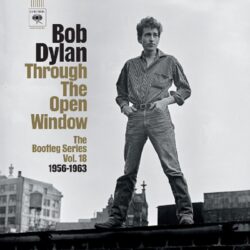 It is surely no great coincidence that with the recent success of the film “A Complete Unknown” that we should find ourselves here, on the latest Bootleg series release, right back at the beginning. This is Dylan’s dawning and the astonishing revelation is that everything that was ever said about the young Dylan is undeniably true. The earliest date quoted in the title is represented by a single recording – a fifteen year old Dylan singing ‘Let the Good Times Roll‘ on December 24th, 1956 in Terlinde Music Shop in St. Paul Minnesota. It may be scratchy and a bare 36 seconds long but this trio recording to a DIY-acetate is unmistakably Dylan. As is another home recording ‘I Got a New Girl‘ dating from three years later, and, somewhat shockingly, with Dylan singing with a voice we wouldn’t really hear again until “Nashville Skyline.” Disc 1 of this 8 CD set continues to document Dylan’s development through a series of mostly home recordings, leading on to early radio appearances. And it’s astonishing – because the confidence and poise Dylan displays does appear to match with Baez’s later description of how he would appear in Greenwich Village – already a performer, already a songwriter, already a young man with a considerable repertoire of Guthrie and acoustic blues.
It’s also quite remarkable just how many recordings are available – and sure, there were far more outlets for folk music at that point of time, and yet even with that here’s Dylan recorded at home or at the homes of friends, at clubs, on radio shows and radio live broadcasts from music venues. And, later on, in the Studio and at Newport Folk Festival. Along the way there’s plenty of evidence of Dylan flirting with different styles – Guthrie, of course, and pre-war blues as well as English folk but the recordings from July 17, 1963 – Home of Tony Glover, Minneapolis, MN that appear on disc 6 of the set include the love lasts but a while of ‘Eternal Circle‘ and the story of a brief romance of ‘Liverpool Gal‘ both of which feel like Dylan trying to do Paxton, before thinking better of it.
As Dylan’s star rose he was steered away, by Albert Grossmann, from the small folk clubs towards more prestigious venues – the Carnegie Hall appearance is here with Dylan in complete control of his audience, jokey banter as introductions to songs such as ‘Dusty Old Fairgrounds‘ which would not be deemed worthy of a studio recording – but whose tune would reappear as ‘When the Ship Comes In‘. There are alternate studio versions from the Freewheelin’ sessions, and there are genuinely historic – and genuinely ragged – recordings such as Dylan introducing ‘Blowin’ In The Wind‘ at a voter registration rally by the means of printed off song sheets. One of the most moving cuts has no music and no singing: ‘Last Thoughts on Woody Guthrie‘ from the April 12th, 1963 appearance at New York’s Town Hall, is Dylan the Beat Poet pouring out his emotions about his early influence and spiritual musical mentor. He stumbles in places in his urgency to put everything he wants to say out there, but it’s undeniably honest. Similarly honest is a song from Newport, where Dylan sings with Seeger’s support ‘Playboys and Playgirls‘ a song full of forthright finger-pointing. Sure, it’s simplistic but it lays out in basic rhyme Dylan’s core beliefs of the time, no-one would dare to sing a song so full of a Pete Seeger-ish unvarnished honesty without meaning at least most of it. Elsewhere, duets with Baez show the stress of their relationship – sometimes Dylan’s playing and singing becomes so rough that Baez seems hopelessly adrift from her musical partner, but when he’s feeling more generous they can appear convincingly as the king and queen of folk.
As with other recent Bootleg series releases the material is a collection of the “previously unreleased” and material that has seen the official light of day before – with quite a large number of tracks having had a release of sorts on the short lived, keeping it in copyright, albums “50th Anniversary Collection 1962″ and “50th Anniversary Collection 1963″. Even with the “previously unreleased” songs there have been numerous bootlegs which have gathered up house concert tapes and the early radio sessions – it’d take a Dylan obsessive to identify if there is a truly never before heard item. That doesn’t really matter, these are the best available versions of all of these songs and spoken introductions, and they’ve been put together chronologically and boxed up with what can only be described as a sumptuous document consisting of track details and rare and unseen photographs from the time, and a genuinely fascinating essay by Sean Wilentz that runs to 125 pages.

What does it all really mean, though? Despite the detailed essay the important thing about the collection is not that this is music to be pored over in a solely academic way, as if identifying some important historical documents, it’s more that this is a vibrant representation of a musician – and a poet – already in full swing. The huge repertoire of traditional song not only demonstrates undeniably that Dylan cast his net widely, but also shows how he was able with such apparent ease to add his own music in alongside these songs as rightful modern continuations of a long lineage of music.
To go from schoolboy Robert Zimmerman to Dylan preparing for his second album – the first that would be all Dylan – is a rich journey. And, as ever with these releases, the album score below is somewhat meaningless. If you already hate Dylan, then this won’t persuade you. Conversely if you already are the kind of cat who digs Dylan then a copy is doubtless making its way to your door already. Maybe, though, if you were somewhere in the middle, and maybe if you were intrigued by Timothée Chalamet’s performance and wondered if it could really all be true then this is the set for you – it was, it really was, and, perhaps unsurprisingly, the truth is better than a movie.


