
Songs for times set to cinematic sounds.
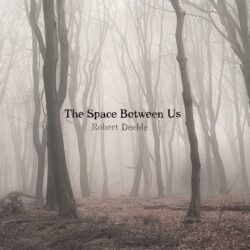 “The Space Between Us” is Robert Deeble’s seventh album in nearly 30 years. Over that period, he has developed a unique style that weaves orchestral sound around his poetic lyrics. Raised in Los Angeles, his music seems more influenced by Hollywood than Laurel Canyon.
The album was written and produced over a four-year span from 2020. Deeble worked with producer Ric Hordinski, using different studios and enlisting musicians from around the country, including bassist Viktor Krauss (Allison Krauss/Robert Plant) and drummer Lacey Brown (Damien Jurado). Hordinski contributed string arrangements and guitar. The result is a lush sound, rich with cello, viola, ambient guitar, harpsichord, and organ.
A lot happened in America and the wider world while Deeble was creating “The Space Between Us”. There was a pandemic. Divisions in American cultural and political life widened. Deeble’s writing echoes these changes, making them personal without losing the universal. He was also influenced by several books, which he cites as inspiration. This combination of current events, experience and literature makes for songs that acknowledge the communal, reflect the literary while still deeply personal.
The opening song, ‘The Forest From The Trees,’ is a good example. It uses images and ideas from Peter Wohlleben’s The Hidden Life of Trees to describe moments of awareness: “And in the dim of darkness/ I think I finally see/ The blessed ties that bind us/ like the forest from the tree/” This is followed by the ballad-like ‘Orphan Song’, inspired by Frank M. Young & David Lasky’s graphic novel The Carter Family: Don’t Forget This Song.
After the instrumental ‘Prelude’, Deeble goes back to literary sources to reflect on the situation today. In ‘Not On Your Team’ he uses the biblical condemnation of greed, corruption and abuse of the vulnerable from the Book of Amos to comment on today’s political elite: “He draped himself in the American flag/ he wore her wealth like a body bag/ The silver tongues of liars flow from rivers into streams/ pooling up around the statute of your liberty.”
Interestingly, Deeble’s song ‘Covid Moon‘ is a lyrical instrumental with echoes of John Fahey and whispers of background vocals by Sage Rose. This is followed by ‘The First Lady of Peru’, a song inspired by Peru’s former first lady, María del Pilar Nores Bodereau de García, who is an economist and social activist. It’s a slow song built on the drums, viola and cello. ‘The Attics of Desire’ is a personal song with references to youth and loss: “Misspent in ventures far too grand/ like best laid plans, that fail/ to the weight of intentions/ As youth, and its glorious engine/ stalls by the fuel of its dreams.”
Deeble notes that ‘Pleasure to Burn’ is inspired by Ray Bradbury’s novel Fahrenheit 451. Had he not mentioned it, the influence would be hard to discern other than the reality of the firefighter’s world – kerosene, matchsticks, fire, soot. But the lyrics are enigmatic, making the song less accessible than most of the others.
The last song, ‘Boy Like Me’, reflects on the divides in the U.S. today, which disrupt families and friendships. Written in 2023, the song recalls a young friendship: “Just a boy like me, had our hair like Sean Cassidy. Just a boy like me. There was no space between us.” Circumstances have broken the friendship: “We feel the pain of this great divide/that’s the space between you and I.” Deeble is able to portray the distance between the estranged friends in just a few lines: “Just a boy like me. Your id-eo-lo-gy/gets stuck at odds/ between the dialogue/ What I call love/ you call po-li-ti-cal/ Where I bend the knee, you storm the Capital.” It is a great song for this moment in American life.
“The Space Between Us” is a great example of movie soundtracks’ influence on americana and Deeble’s experience of current events and the books he loves.


