
Valerie Smith goes on a bluegrass family history journey.
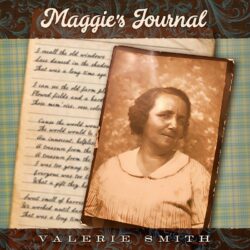 Valerie Smith has spent a dozen years working on this project, which was birthed from a chance discovery of a handwritten journal in a cheap notebook by two of her cousins. The notebook was the personal story of Smith’s great-grandmother and described a life lived in rural Missouri that was a tale of poverty, abuse and sorrow in the years after the conclusion of the American Civil War. The memories of Margaret Attebury Brooks-McCamis were of a childhood where she was the unloved child amongst brothers and a favoured older sister, of years of beatings from her father and of her mother scheming to be rid of her by marrying her at just 14 years of age to a man who was both years older, if anything poorer than her own parents, a drunkard and later a drug addict thanks to the opiates taken to control his syphilis that he caught, as Valerie Smith puts it in the song Blue Bottle Of Bad, because “He hangs around, sleeps in town / with those strange women / Gets their disease.” As a result, Maggie gave birth to sickly children, one of whom died at just a few days old. It’s no wonder that she declares how she never really cared for him on the song I Never Learned To Love Him. It’s somewhat like a field recording brought to life through a combination of readings from Maggie’s journal that are each followed by the sense of the words brought to life through a song, rendered for the main part as bluegrass. After a few listens, as a bonus, one could program the listening sequence to be just the music or just the spoken word options, meaning that there’s an audiobook as well as an album in the double-album package, which adds an extra twist.
It’d be easy to think that this would be as gruelling a listen as the life was to live, but Valerie Smith has the skill to deliver these hard times in a highly listenable way, and has also recruited a solid band – in the form of Cody Kilby (acoustic guitar, mandolin), Stephen Burwell (violin), Evan Winsor (upright bass), and Scott Vestal (banjo) – who, for the most part, keep the accompaniment suitably restrained, but with additional power added to the songs which add a more despairing and angry set of emotions. Warm My Feet And Cry is an early standout as Maggie tells of her endless chores, trudging through snow with no shoes, and Jealous is an up-tempo, bitter complaint at being labelled as ungrateful; the rich harmonies on the chorus are particularly impressive. The last song on the album, A Raggie Thing Like Me, moves closer to traditional country, with mandolin and fiddle to the fore – it is a painful complaint to god for his lack of love and care, as Maggie concludes that he, like everyone else, never cared for her. Amongst many fine songs the hard-banjo driven Jim O’dell, Straight From Hell is a put down of Maggie’s husband and also explains the motive for the memoir “Jim O’dell, straight from hell / What you’ve done to me / someday I’ll tell / Bound to write the whole thing down / I’m gonna spread it all around / You’re a devil straight from hell.”
There’s a real truth to the songs, which accurately pick up on the mood and words of the original text. It’s much more than just an interesting historical piece; it lays bare a life of grinding poverty and the twisted family relationships that this could produce. And then turns it into a concept album of bluegrass and folky americana that hangs together beautifully, and is more than worth hearing on its own merits.


