
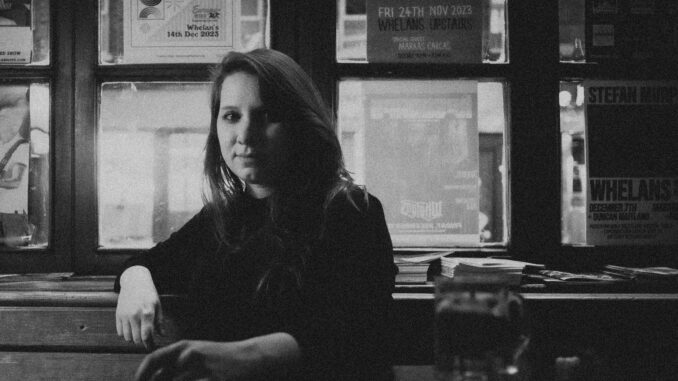
From the first, rhythmically strummed notes of Blue Mind, Tess Liautaud, the Ōtautahi-based Franco-American singer-songwriter who has immersed herself among the characters on the New Zealand roots music scene, creates a lush, twangy, rock and country-soul sound of joy and warmth on her October 2024 sophomore album. Give yourself a break, stay in for the night, go outside when you’re lonesome, step into the light she sings effortlessly, the sentiment perfectly matching the music. Her americana flair is imbued with an easy grace; her skills as a singer shining just as brightly as her musicianship.
The ten songs on the record display the deftness with which Liautaud and her band can shift tempo and style from the emphatic to the absorbing. The title track and “It Was Meant to Rain” are co-writes with Adam Hattaway of the Haunters, who is also her guitarist. Elmore Jones and Michael Kine from the same band are also on board. The first thing that strikes you about Liautaud is the emotion in her delivery, which highlights her skills as a narrator, drawing out small details that enrichen the songs, whether comparing a burning cigarette to two lovers turning to ash on “Here Go the Lovers,” to either asking a lover to stay for coffee (“I Wanna Know”) or a dark, sickly coffee stain running down a guy’s shirt in “Black Machine.” Her voice almost trembles as she sings, and you can feel the conflict between knowing she’s in a bad relationship but also being unwilling to throw in the towel.
Liautaud draws on her experiences growing up in America then living and playing music in Liverpool and France, prior to settling in Christchurch, NZ. There she found a welcoming scene with musicians that fit her vision and helped her to embrace who she was. She was asked to be interviewed for Americana UK, while also providing background and inspiration for the tracks on Blue Mind, and the result poured out through email like water sluicing from an overburdened dam.
Americana UK: Your first album was more folk-y than Blue Mind. What changed your approach to a more rootsy sound?
Tess Liautaud: My first album drew from more solitary times, movement, and introspection and going everywhere with my acoustic guitar in my van during my first two years in New Zealand (Aotearoa). It also was inspired heavily from the energy that isolation and covid lockdowns brought, which gave me space, pausing, yearning etc.
Blue Mind was a time of new direction, actually realising there was a direction, having a much more clear framework and people, a whole environment to work with. I was also more supported in the creation. This second round I had a wider community of talented people who knew how to get me to where I wanted to be. The more rootsy sound was natural; the energy coming from those songs felt like moving forward. The feeling I got when I moved to Christchurch of this whole living underworld of music was maybe transcribed in there, a sense of opportunity and excitement, wanting to make a bigger bang!
AUK: Would you say there is a theme of sorts to the songs on Blue Mind or rather a collection of songs that developed into an album?
TL: I think that Blue Mind was an interesting new process, a drawn out recording and writing exercise. I had some solid songs to start with and was able to shape the album over two years. It really created what felt like a coherent album, but the main thing was not losing steam in the over time. I think there is a theme that connects to the first album but with forward energy, also connecting with my influences more. This leads to songs that are more assertive, more hooks. My way of performing evolved during those times too, so I think the album reflects that strength.
AUK: I looked up Blue Mind and found a book by Wallace J. Nichols with that title. It has to do with how humans are much happier and calmer either near the water or in it. Is that where the title of the album came from and please explain or expand upon that?
TL: In a way yes, except I originally read about it in a magazine, the blue mind concept, while I still lived in Wānaka, a small town by a lake and mountain in the south island of New Zealand. It was lockdown, and I was connecting with ways to keep mental health up, although I knew that being by the water and nature was good for my mind. The idea that bodies of water had such a powerful effect on our brain chemistry, creativity, anxiety and safety was really interesting to me, and I made sure I walked around the lake everyday after that. Reading about this blue mind was something that stuck with me, so much so that I saved it as a future song idea. Having that song and the idea behind represent the album felt right, and it’s not so far off from what music has the power to do to our brains, which felt like a meaningful metaphor. I liked the play on words with having a blue mind, which could also be sad.
AUK: The title track was co-written with Adam Hattaway, who also plays guitar on the album. How did that partnership develop? Any other musicians who have been key to your career?
TL: Finally getting to the part where the song idea took roots came from talking to Hattaway about the idea of song just based on a title I had bookmarked in my brain and the theme of water’s influence. He commented how it sounded like a song Van Morrison or Bob Dylan would sing. So, let’s write it! He’s always been very supportive of my music and is extremely prolific, so helping me with my album while he works on maybe two other albums of his on the go, no problem.
The Christchurch scene is vibrant and I’m almost shocked at the huge talents I found there. They have all influenced me in a very positive way, and I have made many lifelong friends too. The guys that are part of my band and also helped shape my album in many ways are Adam Hattaway & the Haunters. If you want to hear one of the main alt-country indie bands from New Zealand, they currently have seven albums out. I sing on a few of those albums as well. There is also the hugely influential band, the Eastern, known as the hardest touring and pioneering roots and rock’n’roll band in New Zealand. Jessie Shanks, who is accompanying me on banjo during the tour, is one of the co-founders and songwriters. I’m very grateful to have her with me. And not to forget some other greats from our scene, to cite a few: Marlon Williams, Delaney Davidson, Al Park, Aldous Harding and Holly Arrowsmith.
Besides that, I have had two key musician encounters – Bruce Springsteen and Glen Hansard – that have become stories that are part of my career, shaping a vision and beliefs. The main thing this all taught me is the power of dreaming big. It was an extremely valuable lesson that confirmed and instilled a confidence and understanding of this special language that is music and being a musician in the world, and I’m certain, has helped inform many of my life decisions ever since. WIth Springsteen, right time, right place, right mindset and some other major magic dust in the air. Inside, I knew he’d pull me up on stage. I had told him I played his songs (in the bars in Paris), so they handed me a guitar to strum along while we sang “Dancing in the Dark.” It was in Paris, 2016, and the heat from that moment remains! Funny enough, during one of my first encounters with Glen Hansard, we spoke of that very moment, and he asked me to show him the video of being on stage with Bruce in Paris. Glen Hansard has been a very real encouraging presence for many years now. At his show in Paris, he invited me up on stage to sing a song that lifts you up and out (“There’s No Mountain”). It was a powerful moment.
AUK: From what I gather, your influences seem to be a lot of Baby Boomer musicians. Why do you think that is rather than more modern artists and bands?
TL: I have so many influences, but for this album there was definitely some Bruce Springsteen, Jackson Browne, Glen Hansard, Wilco, Lucinda Williams, Neko Case, John Hiatt, Van Morrison, Bob Dylan, The Band, John Prine, and some 50s soul classics that seeps through the songs. I think this comes from being aware of how music shapes other music, but it might come from the storytelling, the feeling the music gives you, a sense of freedom that comes from it maybe. and the singularity of such artists, unique voices and songwriting.
I built most of this repertoire on my own but do have very music-loving parents. They don’t necessarily listen specifically to these artists, but have in some way or another listened to a few that would have led me to my current influences. My father is french and mother American, a nice melting pot of rock’n’ roll, blues, roots and folk coming to my ears from them growing up, and with my mother we’ve spent many years going to concerts together. One of the first that I ‘dragged her’ to as a 17-year-old was Paul McCartney. We had to sleep on the street by the Olympia Theatre in Paris. The concert was ecstatic and emotional. (I did this many more times, more notably and repeatedly to see Bruce Springsteen shows.) Our latest concert together was Patti Smith in that very same venue 17 years later.
AUK: What drew you to Christchurch and talk about the music scene there. I read you’ve been sort of nomadic in and around NZ. Somewhere you traveled Te Wāhipounamu. Please explain what all that is about.
TL: For me, it has been a very welcoming scene, kind of serendipitous. The scene I landed in, or was pulled into, appeared after a few years of already being in New Zealand after the lockdowns and having gone up and down the country, I came to Christchurch again. I knew a few musicians, they included me in a lot of events, and eventually I stayed and have been evolving there ever since. There happened to be a thriving folk, alt-country, roots scene there over the last decade or two, with some very prominent musicians, especially from the nearby harbour port town of Lyttelton. It’s a tight knit community, like a big family.
My moving around started when I went to study in Liverpool after high school. Being such a huge fan of the Beatles drew me there, and thought I better try and keep studying music over there. I played my first ever open mics in Liverpool, and had my first taste of performing original music. Then I lived in Paris and it took me a little while, being focused on my studies, to come back to performing again. But I suddenly opened up a whole world once I found how alive the open mic scene was, and this alternate nightlife took hold intensely for a good few years. I immediately started getting gigs in bars weekly, and even hosting my own open mic nights every week too. It was mostly a covers scene, but I loved playing my favorite songs night after night with all my friends. There was something quite romantic about roaming Paris at night in search of some cellar bar, with our guitars on our backs.
In2019, I decided to come to New Zealand, not really knowing how long but with a 1 year visa. I’ve now been living here for 7 years. I didn’t have any ambitions for my music here; I maybe even needed a little break from it, feeling a burnout, but that never really happens when it’s a part of you. I was given some bar shows in each city or town I went to and started hosting some music nights too. I still live in Christchurch, but I’m expanding my music back to Europe, where there seems to be a good reception. But I’m still discovering so many new places to play my music (Sweden, Netherlands, Spain just a few months ago), and there are many more plans for this kind of touring coming up soon.
Liautaud didn’t identify the region. The Southwest New Zealand World Heritage Area encompasses 10% of New Zealand’s land area at 2.6 million hectares. Te Wāhipounamu translates in Maori to ‘Place of Greenstone’ and was given this name in recognition of the great cultural significance of the area to Maori.
AUK: What is next on your musical to-do list?
TL: I have been very nomadic as you can tell, but I have been focusing on building more roots, in New Zealand and France again. This takes time and effort. I definitely don’t have another album ready to go just yet, but not so long ago I put down a few songs in the studio with my band, leaning into a rootsy acoustic “Comes a Time” vibe (double bass, banjo, softer drums, etc.) It’s low pressure for me, but I’m excited to share those in the coming months. And as I mentionned, some Europe/UK-side touring late summer this year is in the books along with some Australia shows somewhere down the line.
Tess Liautaud takes us behind the songs on her Blue Mind album
1. Blue Mind – I lived for two years right beside Lake Wānaka, in the South Island of New Zealand, and during the covid lockdowns, I read articles that explained the positive feeling bodies of water can have on your mind. I saved that article, and signposted it as an idea for a song. At the time I was walking everyday around the lake to get out of the gloom, it felt important to write this song. Adam Hattaway found a chorus and sent it to me in the middle of a cold winter spell, I picked it up from there, and the song was born. It became a bigger sound with the band, and the layers of harmonies and guitars, but at its core carries this compassion and melancholy like how you would talk to a good friend.
2. Here Go The Lovers – Probably the most personal song, although they all feel like that, but when I perform this one, it always feels real and raw, and liberating. During my shows, I often tell this story about going to a Jackson Browne concert when he came to Christchurch a few years ago. I was listening to a lot of his music in one of those informative moments, music helping you move through life. When I attended his show, years later, it did the thing that only music has the power to do, brought me right back to some very real emotions. But also the magic of live music helped extrapolate the emotions, things that were okay but now needed to be transformed into this song that was waiting in the wings. I went home and the next day started writing this song. I tried a few styles, a more rock’n’roll approach, but the one I ended up with just made sense. I played it to my band and producer Dick Picton, and their excitement around the song was palpable. It all came together with the beautiful piano played by Frankie Daly, which has main character energy, and the cinematically moving rhythm section (Michael Kime and Elmore Jones). I couldn’t be happier with how the song came out. It has that special tribute to Jackson Browne in it, and even has a touch of Glen Hansard, as he called me one day to talk about the song and gave me a little tip for the closing lines crescendo: Before that calling of the road, I hear it calling me on… that made the song all the more special.
3. Black Machine – Songs are meditations, a little drop of medicine for the songwriter and for anyone else who cares to listen. “Black Machine” was written on the first day of 2021 as a challenge to write a new song for the new year. This is about moving through, letting go and courage. I follow the arc of two characters as their relationship loses balance, the heavy weight, the drowning, the searching, the breaking free and eventually the finding. There’s a push and pull that juxtaposes a sense of great movement with a solid linear rumble at it’s core like you’re driving in a dream. The song has a drop D tuning, which I love, but on the recording the sliding guitar gives it a second voice, like this extra narration between the lyrics.
4. Gold Digger – I wrote “Gold Digger” in Otago, a region where I first lived after arriving in New Zealand, near the mountains, old gold mines, and a place where I was able to make more space for my writing. I started imagining a song that John Prine might sing. I think the result is uniquely my own, but there is a throughline – honest truths cloaked in humorous word play and a simple melody. It was the song that got us working on my album, and it is so much fun to play live. We filmed a wonderful music video for it in the mountain village called Arthur’s Pass, near the train tracks with a classic NZ mountain backdrop, and also at the nearby miner ghost town of Otira, in the old pub which was perfect to capture the quirkiness of the song and old spirit of the gold diggers.
5. The Way It’s Meant to Rain – One late winter’s day in 2022, Adam Hattaway and I sat together in our tiny Woolston flat, showing each other drafts of barely written songs, hoping to find a spark in the night. Adam’s melancholic melody over a sketch of chorus with the thought provoking words the way it’s meant to rain struck a chord. After listening to a good measure of John Hiatt and Van Morrison, I emerged with the finished version in March of 2023. Leaning into the swagger of a big band sound, “The Way It’s Meant to Rain” came swinging to life in the studio. The recording captures the raw, unbridled energy of players playing live together. Its folk roots foundations are laid down by the rolling groove of the rhythm section (Michael Kime on bass and Elmore Jones on drums). Frankie Daly’s organ, piano, accordion and trumpet performances lend the song. It’s loose and wild honky tonk flavour, while Hattaway’s americana guitar hooks and Jessie Shanks’ subtle banjo meanders seal the deal.
6. Ember – This song came along during some winter months where I needed to feel the light was there at the end of the tunnel. I had a lot of uncertainty in my life: I was unsure if I could get a visa to stay in NZ; I didn’t have a home to live in and was crashing at friend’s place. The cold and darkness around then were brutal. I symbolically wanted to go to sleep and wake up in the springtime when things would be clear and feel easier, which is how the opening lines came along: I’m digging a hole in the ground, for a while before I must be found, the rest of my life might be fine, send us ladders for us to climb. The ember represented the hope, the flicker still alive, or symbolising a death and rebirth metaphor.
The song’s dark feeling came from experimenting one day with my friends parlour guitar, which he had tuned in an unusual open tuning. I thought it would be a good challenge to try and write a song in that tuning. I’m familiar with open tunings and have written songs like that before, but this one was new to me and I loved what I heard. There’s something so full and resonating about these tunings, a more intricate sound, never just one thing I find. “Ember” was born/reborn on that day.
All of my songwriting at some point or another, gets onto my voice notes app, as well as a good old notebook which I need to let my thoughts wander. It’s always interesting revisiting the voice notes, and the progression of a song over time. The recording of this one was fun as we were venturing into quite a sonic soundscape, more folk, more alternative, another palette of sound I carry in me. Albums are great for that, being able to showcase different parts of yourself, or even just a snapshot of a period of life.
7. Sleepless In Christchurch – Bringing it all back to Christchurch, this is where I’ve been living for the last four years in New Zealand after my many wanders. It’s a town where I found my people musically, an extended family feeling, a tight-nit community. I wanted to write something light but reflective about the feelings around living this musician life full time, fully in it with all the various characters that inhabit this life. It’s also a song about friendship, how it ebbs and flows, never knowing when to let go. Sometimes communication between us dramatic artists can be flawed. As working musicians, I’ve found we’re slightly doomed to always question if we’re doing the right thing, bargaining our whole lives yet still fully considered, because how could we do anything else than keep believing through the sleepless nights.
There’s something quite melancholic within the upbeat melody. It features harmonica, which I play, and I’m actually surprised it’s the only song on the album with harp on it. My inspirations are obvious here, and yes I’m a proud Springsteen fan, but it’s been interesting hearing what so many people around the world think it sounds like.
8. Come Knocking – Written during a second round of lockdown in NZ, late 2021, I happened to be in a completely different part of the country, meant to be house sitting at friend’s for a week, which turned into two months of solitary confinement in a place that wasn’t my home. When I arrived in this new place, the first feelings I had were about the conflicting pull of the road, while also needing grounding and rest, needing time to gather my thoughts. I had been on the road for most of that year and didn’t have a home. I had my van (Van Morrison) and was going up and down the country wherever I was called, travelling to spend various stretches of time in places and play shows on and off. The song came from a feeling, if you come knocking again, and I know that the pull to go with that flow will always be there. Oh everything’s pulling me back to the street, the discomfort building around my feet. It was a strong feeling at the time that also alternated between how a person could make you feel, knowing you went your separate ways, but if they came knocking again that pull might be inevitable.
9. Wanna Know – I wanted a soul song to display more of my musical references. One of my favourite songs to play is “Wonderful World” by Sam Cooke. The simplicity that comes with these songs just hits you straight to the heart. People don’t write songs like that anymore. I was also thinking about more modern feels around this kind of music, and was of course thinking of how Springsteen has often paid tribute to the best in Soul Music. Somehow these two thoughts kind of transpired, and it came out with this song that’s kind of pure in the delivery, a new light through love, the unknown of beginnings and endings, and a call to be present with this feeling.
10. John Prine – I wrote this song as a tribute. It came to me in my bedroom, the night he died, and then the next morning I finished it. A full moon night. This was in the early days of the covid lockdowns (he died from Covid). I sang some of his songs in my van when he was sick, and the connection I felt was even more enhanced in those uncertain days, bringing me a lot of comfort. His death hit harder. When I came back up to Christchurch, I was invited to play a tribute show to John Prine on the anniversary of his death in 2021. I sang two of his songs and also my song, “John Prine.” This drew the attention of the musicians present, all from the local scene there. and it immediately started some of my long lasting friendships to this day. We decided to keep it raw and acoustic on the record, to let it breathe and deliver it’s own message, exactly like it was first written on that night.

