
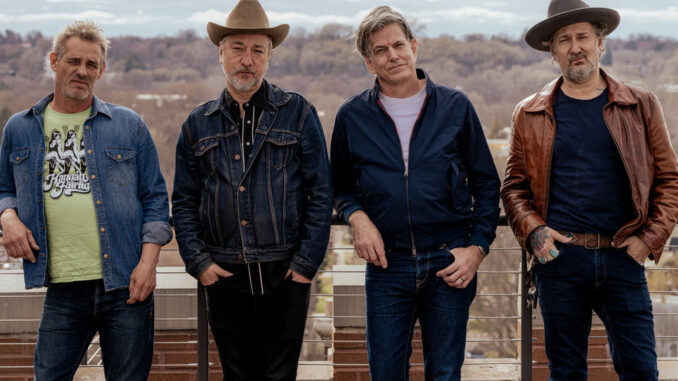
Experiencing a rebirth with Algebra for Broken Hearts, the St. Paul, Minnesota band’s twelfth album on Julian Records (2025), is crucial language, one voicing an undersung American existence. Like the novel, I Cheerfully Refuse by Leif Enger, a quiet, poignant tale about traversing a changing landscape near Lake Superior, the Honeydogs focus on finding meaning in small, personal connections. The content of the album is stunningly furthered by its aesthetic form, wrought in close detail by Adam Levy’s songwriting.
Of all the bands to emerge from the folk-rock renaissance occurring through the 1990s and 2000s, the Honeydogs’ legacy is a cautionary tale of how the major labels giveth and taketh away. Seen a Ghost was their third album and first for Mercury Records. “That was the one that sort of pole vaulted us into whatever national radio recognition we may have had,” Levy stated. It wasn’t a generational opus, but had a wealth of catchy melodic songs like Those Things Are Hers. The Milwaukee Journal-Sentinel called it the fifth best album of 1997, writing that it “sidles up to an easy-going collection of pop songs and country rockers, all of them unassuming, irony-free and irresistible.” It began to crumble for the band shortly thereafter, though, when Mercury was merged into the Universal group, shuffling the band off to Island Def Jam. In the interim, guitarist Tommy Borscheid was let go, and bass player Trent Norton had a near-fatal asthma attack. Levy and the reconstituted band recorded the next album, Here’s Luck, which lingered in limbo until Ryko-Palm put it out in 2000. It had some wonderful Beatlesque songs like Wilson Boulevard and Pins and Dolls, along with a clever tune about circus oddballs (Freakshow).
The band continued putting out solid records, seven more coming every two or three years until Levy and his brother and drummer Noah decided to put the band on pause after 2016’s Love & Cannibalism. Adam Levy was burnt out and, years later, hinted at the experience in the song Orange 8 on the Algebra album. “I don’t know if I’d call it a nervous breakdown,” Levy said pensively, as if thinking of the correct word to a crossword puzzle. “I was not doing really well and checked myself into a 72-hour mental health county center, a very bizarre jail-like unit called Orange 8. I couldn’t have anything that I could do any self-harm with, and I had to beg and plead to be able to get a guitar, finally, with a staff person sitting with me. I basically wrote the song with somebody breathing over my shoulder, which was a little awkward.”
Levy felt isolated from the outside world, reading the newspaper with a cup of coffee mornings. He thought a lot about Lakshmi, who is the Hindu goddess of luck. “Apparently, Lakshmi is also about why people repeat patterns and cycles in their lives until they figure out why they keep doing this same thing over and over again. That’s why I referenced Lakshmi, because I felt like I was in this locked pattern of behavior that was really hard to break.”
Once back in circulation, Levy relied on day jobs to pay the family bills, managing employment-service programs for youth offenders and dislocated workers, teaching songwriting and production classes while dabbling in a handful of side projects such as: Liminal Phase, an improvisational instrumental group with his students, the all-kids-music Bunny Clogs, a “bowling night” r&b cover band with his brother Noah, Norton and other players called Hookers $ Blow. Currently, he teaches history and government classes while engaging in a trio with two other singer-songwriters (Savannah Smith and Barb Brynstad) called Turn Turn Turn, releasing in March 2026 its third album, All Hat No Cattle.
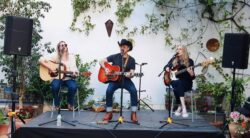
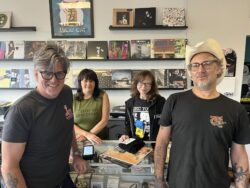
In the midst of all this, the opportunity came in 2023 to re-release the Honeydogs sophomore album on vinyl. This prompted the reconstitution of the original lineup, with the Levy brothers and Norton getting together with Borscheid to perform a record-release show at the venerable First Avenue club in Minneapolis. That was the spark that lit a fire and led to Algebra for Broken Hearts coming out two years later. “I was putting a lot of energy into Turn Turn Turn,” Levy said, “but some of the songs I had written could have gone in different directions. I came to the conclusion they could easily be Honeydogs songs. It definitely felt different; Tommy hadn’t recorded with us in 25 years.”
With its Zeppelin riff bombast, album opener Attic Brain (a pun on “addict brain”) is a fitting calling card, announcing the band’s triumphant revival. “That’s a song about struggling with compulsive behaviors and sets the tone for the album. It’s got a nice rock riff,” Levy said, understating its panache. A rippling guitar solo from Borscheid highlights “I Don’t Want Fight,” a song Levy wrote while thinking about how it’s almost impossible to have conversations in this era with people holding differing political views. “You have such different sets of what is true,” he posited. “It becomes hard to even agree on some very simple ground rules about the world that we live in. That’s the place we find ourselves in.”
Kill Switch is a rocker on the order of ‘70s bands like Faces. Levy wrote it using memories of a trip to Istanbul, the song as gritty and expansive as the Turkish capital city. “It was the last song for the record,” Levy said, lowering his voice and boring in like a drill. “We’d been recording for probably two days, and our producer, John Fields, thought we needed one more rocker. ‘Just go home, Adam, and write something.’ And I’m like, dude, I’m exhausted. There’s no way I’ve got enough energy to write a song. That night, I went home, and I was fuming like, dammit, why can’t he just see the songs I’ve delivered as enough? But I just dug in and finished something by the next morning, and you could say it has a raw energy.”
One of the things that was most striking to Levy in Istanbul was all the history: the Romans, the Greeks, Islamic, medieval, the Crusades, everything that passed through this magnificent city. “I talk about things that I noticed, like the men had a certain scent, wearing a strong perfume while they were fixing cars. So, I referenced that, and I talked about the Byzantine Ruins and the layering of history.”
Levy showcases a sardonic wit on par with Randy Newman on Righteous Came the Stranger. Its protagonist has a dead-end job in a mausoleum town, wrought in close detail how Billy has never voted, stocks shabby old convenience store shelves so he can get plastered Friday nights, and packs heat he bought at the Walmart. “Billy is a typical Randy Newman character,” Levy allowed. “There are paramilitary accelerationist types with guns in our country, who see themselves as victims. The character I created is based on the headlines.”
The evocative, oddly affectionate word pairing of the title track captures the essence of the songs he had been writing, unfiltered snapshots of life in America zoomed in on people and places, some that newspaper writers grab on a slow day. The title is derived from an expression someone once mentioned to Levy. “I can’t remember how the conversation came up,” he said, trying to recall the event, “but she knew a mathematician and had asked him what algebra was about, and the guy said, well, it’s a way to kind of fix things. It’s a system of numbers that puts things together from brokenness. And then she said to him, well, I wish algebra could fix a broken heart. Now, that’s an interesting idea, slightly surreal, but also the sort of intangibles of human experience that technology and science can’t really solve.”
Two of the songs on the album are attributed to Tommy Borscheid, which was special for Levy, as there never before had been a song on a Honeydogs record that wasn’t his composition. The prodigal guitarist returned with Captain, a glam rocker, and Bend or Break, about what we do when going through difficult times. These are two of the denser offerings, but unabated yearning seeps from every cranny of the gnarliest constructions, deluging every corner of the heart.
Of the remaining two tracks, Tulsa tackles the Oklahoma race massacre in the 1920s from the perspective of a bible salesman who stumbles into a brothel and has this hallucinogenic experience, then awakens to horrific violence and a city in flames. “He can’t figure out if what he is witnessing is actually real,” Levy adds. Irish Goodbye has nothing to do with the Irish mob dispensing of a traitor, rather how compulsions can get the best of us. The chorus line is: I gave her the Milky Way, the Taj Mahal, the Golden Gate and all I got was an Irish goodbye. Levy explains that the idea is how addiction takes everything from us.
The intersection of present and future
For every band, there is an origin story, faded memories, and photographs recalling times that cause you to wonder if that was really you. “It feels like a lifetime ago,” Levy said in a manner that indicated he clearly wondered where the time had gone. “I have children now that are almost the age that I was then, and that’s a little strange. There’s a part of me that feels like it’s yesterday, but there’s another part of me that feels like, wow, I’ve lived several lives between then and now.”
The beginning was not all that different – two brothers saying let’s start a band. “I was not at that time much of a songwriter. I was just a guitar dude, and my brother played drums and invited me to be in this band in Minneapolis called the Picadors. We did some touring, and after a couple of albums, kind of ran it into the ground. My brother noticed I was starting to write better songs and said we should get our own band together. We spent a year thinking, what was the band going to look like? Another year came around, and we started recording.”
By most estimations, the Honeydogs’ most fertile period came from 2003-06, during which they released the exceptional concept album 10,000 Years and Amygdala, referencing the almond-sized part of the brain that deals with fear and addiction. These were weighty topics for an alt-rock band, and they pulled them off masterfully. I was introduced to the band during that time at an outdoor show in Minneapolis and left wondering why the whole of America was not yet into these guys.
Prior to writing 10,000 Years, Levy had been reading journalism about post-Soviet ethnic conflict around the world in Central Asia and Africa. He pointed out: “I was working with refugees who were coming from places like Rwanda, Sudan, Somalia, and Ukraine. I can’t remember the point at which I put together this science-fiction, dystopian future, but things were percolating in my brain. It was pre-9/11. We were about to go in the studio, and my brother’s like, ‘dude, you’re talking about airplanes dropping bombs and poison gas and everything. This feels too now; let’s just make a fun record.’ I didn’t know what else to do. This was what had been going on in my head. It means a lot to me. The world was in a really dark place with the invasion of Afghanistan and Iraq, and the so-called weapons of mass destruction. That was the mood when we were recording.”
Because it is situated at the intersection between present and future, love and grief, beauty and ugliness, 10,000 Years is a thorough act of faith. Foreshadowing its purpose is the album’s cover artwork: a soft-toned mural by a Twin Cities graffiti artist from the 1960s, Alvin Carter. “I worked in social services for about fifteen years,” Levy said, “and that fascinating mural was in my building. I was working with communities of color, low-income folks and people who had lost jobs or were transitioning off of public assistance, which is where the story of 10,000 Years came from. I got some wind under my wings in terms of songwriting, and when I listen to that record, I’m still really proud of it. I feel like the next record beat it musically, however. Amygdala maybe didn’t have the kind of conceptual consistency of 10,000 years, but a lot of people loved it.”
Some people think other Honeydogs albums have been their pinnacle. It depends who you ask, and that’s really a good thing; it indicates most of their recorded output has been solid. “You could call it my life’s journey,” Levy mused, “to just keep making more records, whether Honeydogs, Turn Turn Turn or something else. A couple of years ago, I couldn’t imagine putting the effort into another Honeydogs record until we played the record release show with the original line-up back together. It regenerated my interest in the band.”
The result was Algebra for Broken Hearts, the song and the album. I was told there would be no math in listening to music, but this is an equation worth spending your time to solve.