
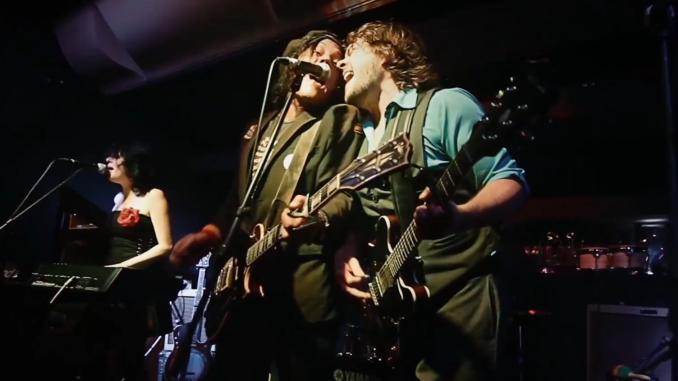
Marah is at their best when singing about lonely urban streets where bums warm their hands around trash fires in rusty 50-gallon cans, transvestite prostitutes wrap their feather boas a little tighter against an unforgiving 4:00 A.M. wind, and catfishermen nurse warm beers under the grimy overpass as they dangle their chicken liver bait in the murky Schuylkill River.
So, Round Eye Blues is a bit of an outlier: it’s a first-person telling of a Vietnam Veteran’s struggle with debilitating visions of horrors he’s witnessed, sleeplessness, and survivor’s guilt set against production Phil Spector would commend, with a (albeit dark) singalong chorus. It’s also a prime example of the often overlooked and underrated lyrical potency that runs through so many of the band’s songs.
The Wall of Sound thing makes sense, as Marah take pride in being a Philadelphia band. Round Eye Blues appears on the band’s 2000 album Kids in Philly, the cover of which is an image of a grinning boy at a Mummer’s parade. There’s always been a strain of doo-wop in many of Mariah’s songs, the kind you might hear acapella on a Philadelphia streetcorner. Echoes of Philly Soul reverberate in their catalogue.
Round Eye Blues incorporates all of this, the sound and the band’s reverence for their hometown’s musical forebears. These influences merge seamlessly with the band’s signature acoustic/electric instrumentation: banjo stands in for rhythm guitar, propulsively underscoring the tension of the narrator.
“Last night I closed my eyes/And watched the tracers fly/Through them jungle trees”, Dave Bielanko rasps, “Like fireflies on a windy night/Pulled up and onward by the breeze/I can still hear the far off tin-canny sounds/Of their machine guns comin’ unwound/And I was shakin’ like Little Richard/And I was sweatin’ like ol’ James Brown”.
It’s a song about the aftermath of blinding terror, being frozen by fear, crouched far from home in a world without pity or hope. It’s a song about desperately trying to hold on to one’s sanity back home, after the madness and immediate peril of the moment has passed. It’s a song told by a man who feels he’s losing that battle. It’s a song about despair.
The chorus, which evolves as it repeats, offers little solace: “Take the hits, boys, take the hits/Don’t smoke your Bible and don’t lose your wits/Because the sky is filled with shrapnel/and your eyes are filled with tears”.
A detractor might ask where a Gen X band gets off appropriating horrors about which only the previous generation can speak authoritatively, but the song is executed with such reverence that it can only be heard as an earnest tribute, an attempt at understanding the sacrifice of uncles, fathers, and others who served in the cataclysm. And if that isn’t enough to satisfy the most cynical critic, they need look only at the history of narrative song and the tradition dating back to the earliest folk songs’ personifying of grief-stricken mothers, murderers. and assorted lost souls.
Accordingly, literary types have championed the band through the years. Nick Hornby has extolled their virtues to anyone who’ll listen. Sarah Vowell is “buds with Marah”. Stephen King called them “the greatest rock band in America nobody knows”. Bruce Springeen endorsed them and invited them to join him onstage, notably on their never-released (as a studio recording) live staple Reservation Girl. Steve Earle is a fan.
Marah has gone through changes since the release of Kids in Philly. There was a brief and forgettable attempt at “breaking big” with the Owen Morris-(over)produced Float Away With The Friday Night Gods (though a later, band-issued release of that album’s demos validated the strength of many of its songs), a fan-favorite return to roots record If You Didn’t Laugh, You’d Cry, and even a folk album based on lyrics found in a 1931 book that compiled never-recorded Appalachian songs, Marah Presents: Mountain Minstrelsy.
At one point, it looked like the Marah story was over: half of the band’s songwriting team, Serge Bielanko, “retired from rock ‘n roll” to have a family and write* prior to Mountain Minstrelsy. But a series of reunions (often at Christmastime, always along the East Coast of the United States), kept the dream alive, at least for those lucky enough to catch one (or as many as possible over the years) of the band’s blistering, legendary live shows.
There are a dozen or more songs that one might single out as “the signature Marah song”, and, given the epic feel of Round Eye Blues, perhaps a subtler, more acoustic song like Sooner or Later better deserves such an honorific. But for the nod to the Philly sound, the peak synchronicity of the band’s playing, and the pure grandeur, it’s hard to beat. And it fuckin’ kills live.
*Band member Serge Bielanko’s “Real-time American Memoir” Thunder Pie, has evolved over the years into a respected ongoing project. It is now available on Substack at sergebielanko.substack.com.
NOTE: As of this writing, Marah seems far from reuniting any time soon. Fans live in hope.


Those were the days mid 2000’s. Marah killed it every night. Never cruised. Thanks to many SXSW trips and uk tours was fortunate to see them over 30 times. Such a shame they never made it. But life on a shoe string budget isnt sustainable. Like many others ( Patty Hurst Shifter , Rex Hobart) they called it a day after giving it all☹️