
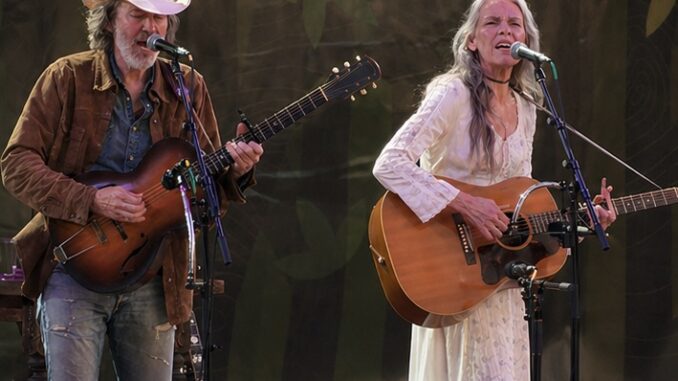
There is something quietly compelling about seeing Gillian Welch and David Rawlings in a setting like Guthrie Green. Beneath a full moon hanging low in a cloudless and distinctly chilly Oklahoma sky, this free, open-air show, part of the Off The Cuff series, felt less like a casual, drop-in event and more like a very special occasion. And so, it proved to be. By any measure, this was one of the most well-attended events here since the space opened in 2012. Their last Tulsa appearance was at Cain’s Ballroom in June 2009, and the size and engagement of tonight’s crowd only reinforced the sense of a long-overdue return. Following a brief detour that included an Australian run and a dozen U.S. dates under the Acoustic Reckoning banner, the latter built around interpretations of songs from the Grateful Dead’s 1981 live album Reckoning, this was the resumption of the Woodland tour, returning the focus to their 2024 album of the same name, with newer material woven into a catalogue that now spans decades.
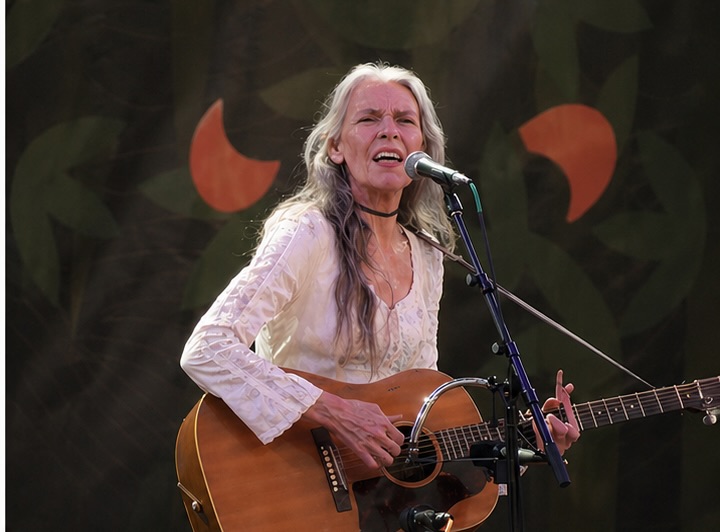
The setting brought its own curiosities. Among the audience were American fans Sterlin Harjo and Ethan Hawke, director and star respectively of the Tulsa-based television drama The Lowdown, which is both set and filmed in the city. Yet such peripheral intrigue quickly gave way to the singular focus demanded by the music.
Opening with Elvis Presley Blues, drawn from 2001’s Time (The Revelator), there is an initial sense that the evening will lean heavily on earlier material. That notion is quickly dispelled. Songs from Woodland: Empty Trainload of Sky, Howdy Howdy, North Country, What We Had, Hashtag, sit assertively yet comfortably alongside older work, not as contrasts but as part of a continuum; a deliberate accumulation of fine work from across the years. If anything, the newer material reinforces that continuity: Empty Trainload of Sky carrying a quiet sense of transience, What We Had reflecting on memory without sentimentality, and Hashtag offering a wry, contemporary counterpoint that never feels out of place.
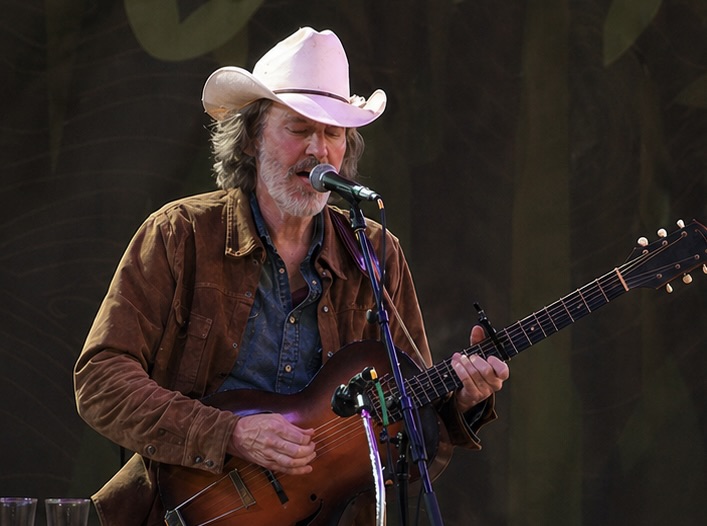
It takes only a handful of songs to register the full extent of Rawlings’ guitar virtuosity, yet any early sense that its limits have been reached proves fleeting; his contribution to each song extends what feels possible, his playing gathering momentum as the set unfolds, the dry, woody bite of his 1930s-era Gibson L-2 cutting cleanly through the night air. By the time Revelator arrives, the solo is nothing short of breathtaking, yet even this feels less like a peak than part of an ongoing ascent. Earlier, on Red Clay Halo, he nonchalantly places and removes a capo mid-song to facilitate his lead break: a moment of technical dexterity delivered with such ease as to almost pass unnoticed.
There is, too, a quiet humour to the presentation. With no guitar changes across the entire set, the employment of a guitar tech would seem excessive. The banjo, however, proves less cooperative. When tuning issues arise, Rawlings assumes the role of technician, leaving Welch to fill the space as a reluctant storyteller; an endearing, unscripted interlude that only reinforces the intimacy of the performance, even in an outdoor setting.
Individual songs carry their own weight. Cumberland Gap arrives as a rousing highlight, while Ruby is instantly recognisable from its opening figure. Welch’s Hard Times is followed by a recommendation to seek out Mavis Staples’ more gospel/blues interpretation from her recent album Sad and Beautiful World, a reminder of the song’s life beyond its composer’s original version. Six White Horses provides one of the evening’s more unusual moments. With Rawlings handling banjo and harmonica, Welch provides thigh-slapping percussion and a touch of tap-dancing, giving the performance a rhythmic life of its own. As if on cue, a helicopter passes overhead, its rotor blades slapping the air in time, and, uncannily, in key with the song drifting upward from below. The local context surfaces more explicitly with Song to Woody. Having spent part of the day across the street at the Woody Guthrie and Bob Dylan Centers, the duo explains their dilemma: how best to acknowledge both artists. Their solution: Bob Dylan’s 1962 homage, “Song to Woody”, neatly collapses the question into a single, fitting tribute.
The closing stretch leans into communal tradition. Make Me Down a Pallet on the Floor, credited as traditional, although the modern version is often associated with W.C. Handy, is delivered with a nod to Doc Watson’s influence on their arrangement. I Hear Them All segues into This Land Is Your Land, prompting a full-throated singalong from a partisan Tulsa crowd, before the gospel standard I’ll Fly Away brings the evening to a close in suitably unadorned fashion.
What lingers is not any single song, but the cumulative effect of the performance: the sense that, over time, their songs continue to evolve, deepen, and reveal new facets. Nearly two decades on from that last Tulsa appearance, Welch and Rawlings return not as a legacy act revisiting past glories, but as artists still very much in motion, delivering a performance of striking precision and understated power.

