
An ambitious debut album that bravely tackles some very British subjects with an americana-folk twang.
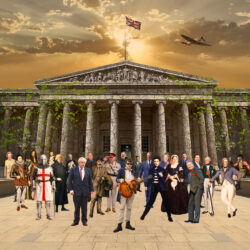 The genre may be americana – and America is most certainly struggling with its own set of problems right now – but Glaswegian band Elgin and the Marbles decided to cover some distinctly British themes on their debut album, The Sun Never Sets. A concept album of sorts, it seeks to look at Britain over the past decade, with all its ups and downs, looking at things like Brexit and the previous Conservative government. If you’re wondering where the keenness for current affairs comes from, it is key to note that frontman Callum Baird was an editor at Scotland’s The National newspaper for seven years, and he’s now editor-in-chief of a publishing group that includes lofty titles like The Herald and Glasgow Times.
“We were born before the world burns / But after the people all got rich,” Baird sings, laying out the bleak reality for those outside the boomer generation on the harmonica heavy opener Before The World Burns, concluding that he “Can’t afford to buy a beach house / But at least they still exist” before grappling with the climate crisis and social media addiction amongst our modern disconnect from each other. The British Museum is a sharp, biting look at British history and colonialism, told through the eyes of a curator at the titular institution. Conveyed earnestly with just Baird’s voice and an acoustic guitar, Something Good is as pure as a love can be when he expresses how different it makes things to have “someone to keep that smile on your face / Someone just to share all these sunny days”.
Stick to the Plan, a raucous romp, packed full of violin, is built upon the theme of Westminster’s dismissal of the idea of a second Scottish independence vote, namedrops not just the late ex-Scottish First Minister Alex Salmond, but also ex-British Prime Minister Boris Johnson, and, less predictably, wartime songstress Vera Lynn and right-wing comic Jim Davidson. Coronation Day is not just the expected attack on the Royal family and the pompous spectacle that was the King’s coronation; it also skewers historically entrenched slavery: “They say that people make Glasgow / But it was sugar and tobacco / And we call them lords / Now the streets are all named for slavers.” Baird delivers his lines in a straightforward and unfussy manner that, while not fancy, is always packed with pure conviction.
With three different verses told from the view of three different figures (Sir Francis Drake, Lord Nelson and Rishi Sunak), Stop the Boats proves that Baird sees clearly the tactics and hypocrisy of the anti migrant brigade: “Because this sceptre’d isle / Has never been invaded / Well except for 1688 / But that doesn’t count / I know you’ll think I’m great / I know I’ll get your votes / If I just stop the boats.” The mandolin-drenched My House, told from the perspective of a property-rich landlord, makes a point about how the greed of him and his type continues to worsen the housing crisis for ordinary people, while The Treasury’s in Love takes aim at one of the enablers of such fat cats, George Osborne. When We Were Special finds Baird longing for the innocence of the 90s, and stripped back with just vocals and piano, on Nothing Like You he confesses unabashedly how to him, someone is like no one else, and indeed, his perfect match.
As any Brit will agree, these past ten years haven’t been easy, but Elgin and the Marbles have managed to turn the gloom and doom into something thought-provoking and, at times, humorous. There is hope here, too, because if there are people out there like Baird and his band that see the dark and ridiculous absurdity of it all, maybe the next decade has a hope of being brighter than the last.



enjoying the album and this great review!