

New Yorker Jesse Malin began his performing career in the New York hardcore band Heart Attack, before assuming the role of vocalist of glam punk band D Generation. Between 1994 and 1999 D Generation released three LPs with limited success, despite the band attracting big name producers such as Ric Ocasek of The Cars and Tony Visconti (whose list of artists worked with reads like a who’s who?). D Generation split in 1999, only to reconvene several years later and release an album, Nothing Is Anywhere, in 2016.
Malin’s career as a solo recording artist kicked off in April 2002 with the So-Low Demos EP. The first full length released followed later in 2002 with The Fine Art of Self Destruction, which we’ll come on to later in this piece. So far, Malin’s solo career has spanned nine studio and three live albums, the latest being 2024’s live release Chasing The Light.
Malin suffered a spinal stroke on 4th May 2023, leaving him paralysed from the waist down. Since that time he has undergone extensive treatment, including spending time receiving treatment in Argentina; he has seen some improvement and he has returned to giving performances (seated and occasionally standing with assistance). It is still unclear whether Malin will ever again be able to walk unaided. In 2024 a tribute album, Silver Patron Saints: The Songs of Jesse Malin was released, with the joint aims of honouring the talent of Malin and of providing support to Malin through his ongoing treatment. Featuring artists such as Counting Crows, Bruce Springsteen, The Hold Steady, Willie Nile and Lucinda Williams performing Malin’s songs, it’s a tremendous record and a fitting tribute to the man and his music.
In April 2026 Malin released a single, Hollywood Forever which is a tribute to former D Generation band member Howie Pyro, who passed away on 4th May 2022 (Malin suffered his spinal stroke whilst marking the first anniversary of Pyro’s death). Pyro had a long standing wish to be buried at the Hollywood Forever Cemetery in Los Angeles.
Can’t Live With It “On Your Sleeve” 2008
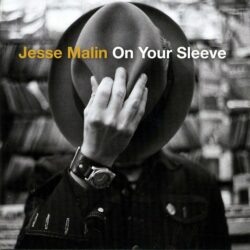 On 3rd of June 2011 at the wonderful venue that is the Bridgewater Hall, Manchester, Malin played a song for your humble writer. Malin was opening for Ryan Adams on his solo ‘comeback’ tour, prior to the release of Ashes & Fire and I had turned up at the venue relatively early to check out the stage times. As I was leaving the venue, Malin was coming in through the front door, on his mobile phone. As he approached, I mouthed “Will you play Brooklyn?” and he responded by pointing in my direction and saying “For you!“. During his set, Malin introduced the song Brooklyn thus, “This is for a gentleman that I met in the lobby“, and I sat there with a huge grin on my face. Also during the set, which featured Malin playing solo, he talked extensively between songs including references to the On Your Sleeve album, about which he described how, on its release, he received numerous messages from friends and family, informing him that they had heard him singing on the radio, or while shopping at Walmart. Malin said that this was exciting and he anticipated receiving a nice royalty payment for all of this exposure; however when he received the royalty cheques he was disappointed in the amounts paid to him and it made him realise that it’s the songwriters who make the most money, not those who cover their songs.
Interestingly, there are two versions of On Your Sleeve; one released for the UK market (released in April 2008) and one for the US, which was released some six months later. There are numerous track differences, with five that feature only on the UK version and similarly, five which appear only on the US version. The UK version misses out on Bad Brains’ Leaving Babylon, It’s Not Enough by Johnny Thunders and The Heartbreakers, Lady From Baltimore by Tim Hardin, The Pogues (featuring Kirsty MacColl)’s Fairytale of New York and Springsteen’s Hungry Heart.
It begs the question why the differences? Also, which is the better version? I’ll concentrate on the UK version, as that’s the one that resides in my collection.
Opening with Neil Young & Crazy Horse’s Looking for a Love from the 1975 LP Zuma, compared to the original Malin’s version of this Young composition is far more rocky; the original’s jangly guitars replaced by a much bigger sound and the sweet massed harmonies of the chorus are gone. Next up is The Ramones’ Do You Remember Rock ‘n’ Roll Radio? and while anyone who has heard the original will recognise Malin’s version, it lacks the rough edges that gave The Ramones’ version its charm. It’s a whole different story with The Rolling Stones’ Sway, which has been given an electronic style that just doesn’t work with this blues song.
Other songs, such as Russian Roulette by The Lords of the New Church and I Hope That I Don’t Fall in Love With You, the Tom Waits song from 1973’s Closing Time LP (which is probably the album’s highlight) profit from being a little more faithful to the original versions. Whereas Lou Reed’s 1972 classic Walk on the Wild Side, from the Transformer record and The Clash’s Gates of the West, along with Me and Julio Down by the Schoolyard by Paul Simon (which Malin transforms into a straight forward rock song) don’t come across quite so well.
The term that I would use to describe the changes to the songs from the original versions to those appearing on On Your Sleeve is that, in general, they have been sanitised. I can understand the desire by Malin (or indeed any artist recording an album of cover versions) to want to put their own stamp on the songs, otherwise what’s the point of covering something? I also recognise that Malin has selected a pretty good bunch of songs to cover; however in a number of cases, this has resulted in losing the qualities that made the original special. You might even think that many of them start to merge into one after a while. Contrast that with the breadth of writing that Malin demonstrates on much of his (pretty consistent) self-written output.
It’s not that this is a bad record, far from it and it can be an enjoyable listen. It’s just that it pales in comparison to much of Malin’s other work. You have to ask yourself; are any of these versions a) as good as, or b) better than the originals? Obviously the answer here is going to be subjective, however I would suggest that in just about all of the cases, the answer to b) is a firm ‘No‘. The late Johnnie Walker had a feature on his Sounds of the 70s show on BBC Radio 2, entitled Better Than the Original, where listeners would nominate cover versions which, in their opinion, surpassed the original version. You wouldn’t expect that many of the versions here would appear in such a feature.
Malin has released a solid, consistent output of good quality records, but On Your Sleeve doesn’t live up to the same standard; it just doesn’t sparkle in the same way as Malin doing Malin material. This isn’t unique to Malin, of course. Artists such as David Bowie with 1973’s Pin Ups and Counting Crows with 2012’s Underwater Sunshine (or What We Did on Our Summer Vacation) are among countless other artists who have released albums of cover versions with, at the very least, mixed success.
Can’t Live Without It “The Fine Art of Self Destruction” 2002
The Fine Art of Self Destruction was first released in 2002. In fact, the record was released in December 2002 for the UK market, however the US listeners had to wait until the end of January 2003 too get their mitts on a copy.  The cover picture shows Malin at Delancey Street subway station in Manhattan.
The singer songwriter nature of the album demonstrated quite the switch of direction from Malin’s roles in Heart Attack and D Generation. Produced by Ryan Adams, recording was concluded in a mere six days and Adams commented on Malin “He scares me, he’s so good“. At the time of the LP’s release, ‘Uncut’ magazine awarded it the award of the magazine’s ‘Album of the Month’ for December 2002.
Malin is such a great songwriter, his songs are finely crafted and sometimes laced with sharp humour. The lyrics are often personal and usually gritty. Malin has the ability to create believable characters, in a way not dissimilar to Willy Vlautin of The Delines.
There are numerous standout cuts on The Fine Art of Self Destruction, many of which appear to be autobiographical. The themes covered include growing pains, mistakes made, failed relationships, band breakups and the emotional turmoil that surrounds these things, not to mention the divorce of Malin’s parents when he was young. There are frequent references to New York City and surrounding areas.
Kicking off the album is Queen of the Underworld, which was released as a single, and received a fair amount of radio airplay in the UK at the time. It’s a fine way to open the album, suggesting parallels between Malin’s character and Persephone, the Queen of the Underworld in Greek mythology.
TKO, written by Malin with bass player extraordinaire, Johnny Pisano (who plays on the record) is a rocker with gritty lyrics; “Calling Miss America, Have you heard? Out in California, Writing spoken word, Moved in with her parents, Gave the kid away“. Wendy harks back in style to the best of the D Generation songs. It’s an uptempo song with sharp lyrics about faded dreams and being let down.
Downliner has a persistent riff and sharp lyrics “With funny memories and a broken nose, Lots of baggage and not much clothes” and a brief guitar break. While the catchy Riding on the Subway has a chorus which brings to mind Simon and Garfunkel’s Mrs. Robinson. Equally melodic is High Lonesome, reflecting on difficulties in pursuing a career in music, at one point Malin states “I’m dropping out of circulation, gonna change my occupation“. Brooklyn appears twice, once in acoustic guise, and again in a band version; it’s a song about mistakes, regrets and people growing apart, “You started out with nothing but lonely days, You used to like the sad songs of doom and gloom, You started out with nothing but throwaways, You couldn’t live with me so you moved to Brooklyn“.
Almost Grown was written by Malin with Joe McGinty (The Psychedelic Furs), who also contributes keyboards to the LP. Uptempo and sounding upbeat, with a guitar line sounding almost like surf guitar, the overall sound of the song belies the nature of the lyrical content; “My parents split up in the first grade, my father never did come back” and “And you’re all alone, And you’re almost grown“.
On an album packed with standout cuts, it’s hard to pick out the highlights, but Downliner, Brooklyn and Almost Grown fit that description.
This is such a mature debut solo record, full of great songs, with memorable melodies, sharp lyrics and fine playing, allied to Malin’s distinctive voice. It has to be said that Adams’ production fits the songs like a glove, too. It’s such a good way to announce yourself as a solo artist, but has also stood the test of time. In 2022 a 20th anniversary edition of the record was released, featuring a second disc with alternative versions of nine songs from the original album.

