
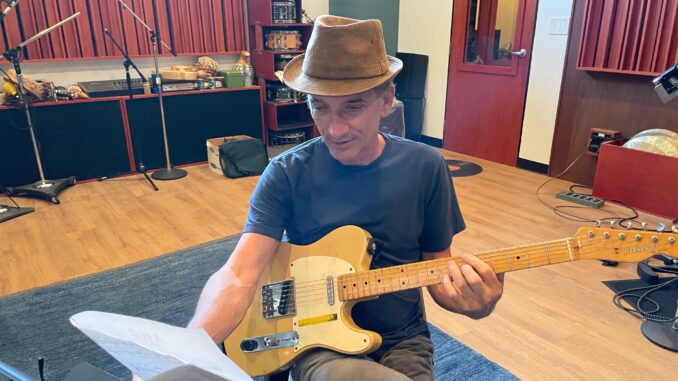
To say Ben Vaughn has had an eclectic musical career would be a gross understatement. He grew up in the Philadelphia area, and his journey into music began when a kind uncle gave him a Duane Eddy record. It literally changed his life. He formed his first ‘proper’ band in 1983: the Ben Vaughn Combo. They had a five-year career and released two albums to excellent reviews. Rocker Marshall Crenshaw was mighty impressed with what he heard and covered a track from the band, I’m Sorry (But So Is Brenda Lee), for his Downtown album.
This was the start of an amazing career where, to date, he’s released twenty albums and produced three albums for the Elektra Records American Explorer series (including Memphis rockabilly legend Charlie Feathers and Muscle Shoals country soul singer Arthur Alexander). He’s scored five films and received worldwide fame when he recorded the soundtrack to the TV sitcom 3rd Rock From The Sun. He has produced albums by Ween, Los Straitjackets, Mark Olson, Nancy Sinatra and the Swingers soundtrack album.
Vaughn has recently started a new podcast series, Straight From The Hat With Ben Vaughn, hooking up with Laura Pochodylo from Sun Records. In each episode, she has picked random people whom Ben has worked with, written their names down, put them in a hat, and picked out one each episode, from which Ben tells some amazing, true stories relating to his wide-ranging musical career.
AUK’s Paul Russell caught up with Ben recently from his remote home in the California desert for a fascinating insight into a career that’s never been straightforward.
Americana UK: So, just to give us an idea, Ben, where are you actually speaking from?
Ben Vaughn: I am in Parts Unknown, USA, which is actually the Mojave Desert out here in California. I’m in the middle of nowhere. You can’t see my nearest neighbour.
AUK: Is this good for making music, a source of creative inspiration, being in the middle of nowhere, miles from anywhere?
BV: Oh, it really is, because you see nothing but possibilities, like open sky, and you can just see miles and miles of desert. So there’s a lot of room for new ideas. There’s no clutter. It’s great for writing. It’s just great for living, you know?
AUK: And how long have you been there?
BV: Almost 30 years. I bought my house 28 years ago. I’m a desert rat.
AUK: We’re here to talk about your podcast, Straight From the Hat, with Ben Vaughan. What’s the core idea behind it?
BV: Well, the idea behind it is, my co-host, Laura Pochodylo, she runs Sun Records in Nashville. She’s the head of the label down there, and we became friends when I was working on a reissue project with them for the 70th anniversary of Sun Records. They hired me to do a compilation, and we started talking. I realized that she had the same record collection that I have and also a real love for Sonny Bono, of all things. We both are Sonny Bono historians, kind of Sonny Bono fanatics, which is a lonely life! When you find someone else who is as into Sonny Bono as you, you stay close with that person. So we became really good friends. She’s younger than I am and loves older music, and the more she got to know me, she realized that I either worked with or had met a lot of the people in her record collection.
She would ask me about them, and thought the stories that I had were immediately funny for some reason. So we both agreed, let’s take all these names, write them down on slips of paper, and throw them in a hat. Then let’s record a demo of the two of us, her pulling a name, and then I talk about it. She interjects and asks me questions and kind of encourages me. We ended up recording for three hours, and we pulled 21 names out of the hat. It sounded really good to us, so we played it for other people, and they all said, “Boy, you should cut this together and turn it into a podcast. You have something here.” We were ahead of schedule already, as far as delivery, so we put it all together and launched it on January 22nd (2026). The reaction has been great, really positive, and it’s building. Something’s happening here, and podcasts, they’re different than the record business. Word of mouth is what really works with podcasts. A friend tells a friend, and that’s happening big time. So we’re thrilled.
AUK: And I’m fascinated with it, because I’ve worked in podcasting for about ten years. How do you see the main benefits of its success?
BV: Well, the main benefit for me, personally, is now I don’t have to write a book! So that’s good. I got that out of the way. And I don’t have to think about my memoirs. How do I leave my stories behind? It’s a real relief, actually, because I do have a lot of experience in the music business, and I get a chance to share that. Now I don’t have to worry about whether that’s never going to be heard, so that’s cool.
But also, it’s really how they pan out. The episodes that we record, they start out like a music fan kind of thing, but we really get into other subjects, like how difficult it is to be an artist, to be a creative person. In a capitalist system, you know, art and commerce come together. And in order to create great art, you are born with a sensitivity that has allowed that to happen. But once you get into the music business, you know, it’s hard being an artist. I don’t think that that’s discussed often enough, how difficult it is. We’re very sympathetic toward the record business people, too, because they need to make money or they go out of business. Laura works at Sun Records. She understands that side of it. I’m an artist, and I understand this side. Both sides have to be happy, and both sides need success.
AUK: Have any of the questions flummoxed you? Have there been any questions that have given you a little bit of hesitancy in answering?
BV: She pulled one. Are you familiar with Esquivel?
AUK: No. (Juan Garcia Esquivel was a Mexican band leader, pianist and composer mixing lounge music and jazz with Latin elements).
BV: Esquivel was this crazy, R&B rocker, like a Little Richard kind of guy, with a huge hairdo. I mean, it was like, insane. He played piano and sang in falsetto. She pulls the name Esquivel, and I said I’ve never met him, never worked with him. She’s like, nothing? I said, I got nothing. That was a pretty funny moment.
AUK: You grew up in Mount Ephraim, New Jersey. What was your childhood like in terms of gaining interest in music, and what were the music influences growing up?
BV: So, I grew up with Philadelphia radio and American Bandstand, so my first knowledge of music really was Chubby Checker and Dee Dee Sharp and the “Twist” and all that kind of stuff, “The Mashed Potato” and also doo wop was really big in my neighbourhood. There were guys singing on the street corner in my neighbourhood, and it was a real thing. My uncle worked at RCA, and they gave free records to the employees. They gave him a copy of Duane Eddy’s Twistin ‘n’ Twangin’ record, which he gave to me. It was the first record I ever owned, and I played it probably 5,000 times. It was my first realization that rock and roll was my language. I was only 6 years old, and I knew it. And then Beatlemania happened. By then, my grades went down in school, and I just wanted to grow up and be in the music business. I didn’t even know in which capacity; either be a DJ, a songwriter or a performer. And now I’m all three, so it worked out pretty great!
AUK: What was it about that Duane Eddy album that really sparked your musical interest?
BV: Well, I was too young to intellectualise anything. I felt his guitar. Those low notes, you feel it in your stomach when he plays, you know? And it was just so powerful. I was mesmerised. It really affected me in a big way, and I’ve been chasing that sound my entire life, always trying to recreate that feeling of what it felt like to hear Duane Eddy for the first time.
AUK: It wasn’t until 1983 that you actually had your first major band, which was the Ben Vaughn Combo. You released two really strong albums, The Many Moods of Ben Vaughn and Beautiful Things, and included in the lineup was accordionist Gus Cordovox, who you’ve worked with almost ever since. I can remember hearing both of those and thinking that this was different, with a great sense of humour within. On Beautiful Things, you also included a vital percussion instrument: a ’69 Rambler car hubcap! What are your memories of those first two albums?
BV: Trying to find the perfect microphone for a hubcap! Oh, boy, that band was so much fun. They were my friends from the neighbourhood. The drummer, Lonesome Bob, we grew up together, and we were in bands when we were teenagers. We were a funky, low-budget outfit, but when we got on stage, we had a really good thing going. Every time we played, we never bombed, and we would open for people, and then the headliners would have trouble going on because we were determined to have a good time and bring everybody along with us.
I remember when we recorded the first album, we didn’t have enough money to do it during the day, so you could go into a studio at 11 o’clock at night and work until 7 in the morning for half the amount of money. We had a recording studio up in New York. We were being produced by the guy who produced the Violent Femmes (Mark Van Hecke). We lived two hours away from New York City, and we all had day jobs. So we would leave at 8 o’clock at night, drive up to New York City, and record all night, and then drive back and go straight to our day jobs. I remember not sleeping during that record at all. When I hear that record, it’s immediately 3 AM for me!
AUK: On that first album, The Many Moods, there’s a beautiful song called The Apology Line. It was covered again, wonderfully, by Barrence Whitfield on his album Ow!Ow!Ow! Any memories of working with Barrence and what it was like to have your songs covered?
BV: Well, my memory of working with Barrence is that he could be taking a nap in the break room, and you would wake him up and say it’s time to sing. He would go, “Oh, okay,” and get in front of the mic and go from 0 to 100 miles an hour. You could wake him up in the middle of the night, and he could scream his head off. That guy is amazing. Great guy, really funny guy. I love Barrence. When he recorded The Apology Line, that song is based on a real radio show that was on the air in Philadelphia. I used to listen to it every night, and I wrote that song and took it over. I remember after I wrote it, I recorded a demo and I took it to the DJ, who was the host of the show, and he played it on the air.
AUK: So, you slimmed down to just Ben Vaughn for your next album in 1998, and again, I noticed that unusual instruments were part of the sound on that album, including a plastic water cooler bottle, played by Palmyra Delran. You like a wide range of instruments on your recordings, don’t you? It gives you that unique sort of Ben Vaughn sound?
BV: Yeah, I like to experiment, you know, I’m fascinated with instruments and arrangements. From the time I was a little kid, I could pick apart the instruments on a record. It was a relaxing meditation for me to listen to a piece of music and pick apart all of the instruments. I was a kid with a lot of restless energy, and I was emotionally turbulent, I guess, is what you would call it. And I was living in a neighborhood where being a creative person was not really appreciated. So I would escape into the music, and when I finally got a chance to make my own records, I had a lot of knowledge on what kind of instruments might be of use, and what kind of arranging might be fun to work with, or be appropriate for the song.
AUK: Your next album in 1989, Dressed in Black, featured a pretty damn impressive selection of guest musicians, including John Hiatt, Marshall Crenshaw, Alex Chilton, Peter Holsapple, and Gordon Gano. What was it like working with all those guys together? That must have been quite an atmosphere recording that album.
BV: It was great. I’m a big fan of an album by Doug Sahm called Doug Sahm and Band, which has Bob Dylan, Dr. John, David Fathead Newman, David Bromberg, all these people on it. I love that record, and I thought, let me do my own version of that sort of thing. I knew all those people personally from being on the road, and I felt it was time to make my Doug Sahm and Band record.
AUK: Your next album in 1993 was Mono, which was a collection of really interesting covers of lesser-known songs, and you said at the time: “If it proves anything, it’s that there’s lots of great songs out there that nobody ever does.” There were songs by the likes of Dion, Andre Williams, Bobby Fuller, and Link Wray. What was the main reason for choosing those particular songs?
BV: Well, I was imagining a hit parade from an alternate universe. These songs all should have been hits, in my opinion, so I was imagining that you’re tuning into a broadcast, and these are the Top 40 hits of that broadcast. I also really wanted to work in mono. The album was recorded and mixed in mono, and I wanted to experiment with that, because when you’re working in stereo, it’s easy to create space by going left and right. You’re panning an instrument to the left, and maybe you’ll put reverb on that instrument, but you’ll pan it over to the opposite side, so it kind of travels. In mono, it’s more about foreground and background. It deepens your ear on how to place things. It’s a challenge.
AUK: The next album was quite prescient inasmuch as it was Instrumental Stylings, a selection of instrumentals, and obviously, I say that because you’ve become very famous for your instrumental music. Have you always had a passion for instrumentals?
BV: Yeah, starting with Duane Eddy, who was my first love. Pre-Beatles, you know, I was a fanatic for Eddy, the Ventures, and surf music, so that was something I had been meaning to get back to eventually, and I finally did with that record. On the Mono album, there are, I believe, four surf instrumentals. A music supervisor in LA was working on Pulp Fiction, and she placed a couple pieces of music in that film. She heard the Mono record and said to me, “If you move out here, I can get you work, because your style of guitar playing is going to be huge. There’s a movie getting ready to be released that’s gonna change everything. Surf music is going to be really valuable, so you should come out here.”
So I quickly recorded Instrumental Stylings as a composer reel to play for people and show what I’m capable of. I moved to LA in on New Year’s Day of 1995, and that record came out a week or two after that. Within three months, someone from the TV show Third Rock From The Sun heard it on the radio and hired me to do that show. And then, boom!, I’m an instrumental TV composer!
It was all around great. I mean, that show became a hit. I won all these awards. I got hired to do all these other shows. It was amazing. But I guess the main thing that I felt was this is all happening because I was true to myself. And that’s the advice I give anybody starting out in the music business, is be true to yourself, because there’s a real chance that you could be successful because of exactly who you are, not what you think the business wants you to be.
AUK: Ben, you’ve also got a pretty damn impressive producing catalogue, working with the likes of Mark Olson, Nancy Sinatra, and the amazing Arthur Alexander. What’s been your proudest production achievement to date?
BV: Probably the Arthur Alexander record. He had disappeared from the music business for 25 years. He was driving a bus up in Cleveland, and I was a huge fan, but I had to win his trust to get him back in the studio. We became really good friends. I guess the proudest moment is protecting him. I had an opportunity to protect him from the bad parts of the music business, and that really felt good. I felt like I was giving back because of all the great things that music has given me, that I’ve received, to have an opportunity to give back and protect an artist like Arthur from making a bad record. There are a lot of ideas out there on how you would produce an older artist and introduce him to a new audience, and a lot of them are really bad ideas, very slick ideas, having duets with famous people and all that kind of stuff. I didn’t want to make that kind of record with Arthur.
AUK: Your 1997 album Rambler 65 was, and this would only happen with a Ben Vaughan album, recorded entirely in your Rambler car in your New Jersey driveway. Now, I’m sure there were very good creative reasons for that, but how on earth did that come about?
BV: I like how you assume there’s a good reason for that. Thank you for that. Well, what’s really funny about it is I thought I was avoiding a midlife crisis when I recorded that album, and then a friend of mine pointed out a guy moving his entire studio into the driveway of his house, into his car, is the ultimate midlife crisis. So, I did not avoid it at all. I was right there in it.
AUK: How was it? I mean, it can’t have been easy?
BV: No, it was not easy. I like a challenge, obviously. I recorded in mono, I achieved that, now it was time to move my studio into my car. I mean, doesn’t that make sense? It’s the next logical thing. Well, actually, it was inspired by a real-life incident. I was producing something, I forget what it was, up in New York in a really expensive studio, and we were trying to get a good sound on these conga drums. And for some reason, even though it was a fancy studio, they just didn’t sound good. They were ringing, and there was some kind of overtone, so we put some baffles around it, and then the guy played, and we’re like, “That’s not it.” Next thing you know, we have a blanket over the baffles. We’re building a tent just to record conga drums, and I made a joke. I said, “I could probably move those conga drums out to my car, and with one microphone get them to sound great.” Because music sounded great on my car radio, you know? Everybody laughed, and then, a friend of mine said prove it, that you can make a good-sounding record in a car. So I had a dare. And I was turning 40 at the time, so my midlife crisis kicked in, and next thing you know, I’m dragging everything out to my driveway to record in my car. And then the record came out and sounded really good.
AUK: Then in 1999, you had a two-record deal with a Scottish record label called Shoeshine, which is based in Glasgow. They released albums by the likes of Laura Cantrell and Paul Birch. How did you come to record with them?
BV: That’s actually a pretty funny story. I was friends with Alex Chilton. He calls me up and said, “I just got back from Scotland, and I did some gigs with Francis MacDonald, the drummer for Teenage Fan Club. He told me he was a big fan of your music, and he wanted to know if you were still alive.” And Alex told him that I was very much alive, to which Francis said, “Well, can I get his phone number because I want to work with him?” So Francis brought me over to do a tour, and he asked if I had any new recordings, because it would be great to put out an EP or a record before I came over, so they have something to promote and connect with. At the time, I was recording a bunch of songs where I played all the instruments, and he put it out as A Date with Ben Vaughn. That came out to coincide with the tour that, and it was great playing in Scotland. The audiences there, they love music, and really love American music, so it was it was really cool. He put a band together with the guy from Belle and Sebastian, Stevie Jackson. Then I made another record with Stevie and Francis, Glasgow Time, with a bunch of Scottish folk musicians who played accordion and fiddle.
AUK: A recent incarnation for you has been the Ben Vaughn Quintet. You recorded two albums, and one of my favourites of your more recent songs was Piece de Resistance. I always giggle whenever I listen to it. I read a review of a live gig that you did with this band, and the journalist commented that your guitar playing was “controlled chaos.” How did that particular quintet come about?
BV: I’m not sure about the controlled part. It always feels that I don’t know what’s gonna come out of my guitar when I play. I have my moments on guitar; I’ll tell you that much. There are times when something comes out of my guitar, and I’m like, “Wow, where’d that come from?” There’s always potential chaos when I play guitar. I have no control over that. Gus Cordovox is in the Quintet. He was also in the Ben Vaughn Combo. Mike Vogelmann is on bass, and I’ve been playing with him since 1988. And Seth Baer, the drummer, I’ve been playing with him since 1990. The new guy, we call him the Ron Wood of the band, CC Crabtree. He’s still the new guy even though he’s been with us for 25 years.
It’s a great band, and when I’m on the East Coast, that’s who I play with. We know close to one hundred songs, and we don’t even need to rehearse. We just show up, and I count off a song, then we’re off and running, and it may fall apart here and there, but I enjoy that. When I’m an audience member, I really appreciate it when performers take chances, because then you’re sharing a moment with that performer that maybe didn’t happen before and may never happen again. That’s how I look at it myself. Rehearsing is the enemy for me. I prefer to get up there with no preparation, because then I’m really excited, and the audience picks up on that. It’s like, we’re in this together, and are we gonna make it through? Sometimes it feels like you’re not even gonna get to the end of the song without everything falling apart.
AUK: To go back to the podcast, presumably, it’s got a lot of legs, because there’s a lot to talk about. Have you got plans to continue doing that for the foreseeable future?
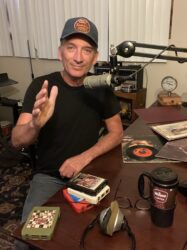
BV: Originally, we were going to only do 12 episodes, but the reaction has been so great that we’re getting ready to record new stuff. There’s no shortage of names, I’ll tell you that much. Laura is in Nashville, and I’m in Parts Unknown out here. We do it remotely, and she says that the hat is still filled, so we could go on forever.
AUK: Well, it’s a really good and fun listen, and it is fascinating. Any chance of Ben Vaughn coming over to the UK to play live anytime soon?
BV: Oh, I would love to. I’d be there in a minute if a promoter contacted me with a reasonable offer, and I’m a pretty reasonable guy, you know. I’m playing music now for the love of it. Playing in England or Scotland, I would be over there in a second if the right offer came in.
AUK: Any new music, potentially, on the horizon for us to be tempted with?
BV: Yeah, I have a new album coming out October 30th with a band called Deer Tick. I just recorded an album with them backing me up. They’re my favourite band right now. And they sought me out, sort of like Francis MacDonald did. They found one of my records in a used record store, and then decided to try to find me. Like I’m an old blues guy now! So we ended up getting together. They all live in Rhode Island, and I flew to the East Coast, where we spent four or five days recording an album in a barn. And it came out really great. I’ll be playing some shows with them. There is a gig in June in Brooklyn with Deer Tick. I’m gonna open for them, playing solo acoustic, and I think the second half of the set is gonna be them backing me up. You have to hear this. I am blown away by what they brought to the table.
AUK: This sounds amazing, Ben; what a combination! Is it a different sound from your last album, The World Of Ben Vaughn?
BV: It’s edgier. I don’t play guitar on it. I decided they have two guitar players in that band and three lead singers. That band has too much talent, actually. And the two guitar players are amazing, so I just sing on it, because I wanted to hear their interpretation of my music. So I let them arrange my songs however they wanted to, and I just sang. It was great, a wonderful experience.
The project began after I released an album called Imitation Wood Grain and Other Folk Songs, which was a solo acoustic record of all new songs. I guess I put that out maybe six or seven years ago, put it out myself as a self-release. Nobody even knows it exists, and those guys fell in love with that record. We had a conversation about wouldn’t it be cool to do a full-band record of these songs? That was going to be the project. It was going to be Electric Wood Grain, and then once we got in the studio, I wrote some new songs, so it’s a combination of those songs from Imitation Woodgrain and some new stuff that I wrote. If you like Deer Tick and you like my music, you’re gonna love what we did together because it’s really different.
AUK: This sounds like a fascinating project, and we’ll look out for it in October. Thanks for your time, Ben, we really appreciate it and best of luck with the podcast.
BV: Thanks, it’s been a pleasure.
Straight From The Hat With Ben Vaughn is available to listen now as a podcast, and in the ten episodes released so far, you can hear Ben talking about Gene Pitney, Jonathan Richman, Ween, Nancy Sinatra, Roky Erickson, Arthur Alexander, The Cramps and Winona Ryder, amongst many others.