
For our second Americana story we have a contribution from Vicki Wilson, a journalist, poet, playwright, songwriter, and fiction writer. She lives with her husband and son in New York. She has also sent us one of her songs, Coyotes In the Yard, which you’ll find at the end of the story. The story itself looks at how children signal independence and growing up through what they wear. Something many parents and grandparents will recognise.
Keeping Warm
By Vicki Wilson
In the right pocket of the red down jacket, they found sheet music for violin.
*
“Sammy, get your coat on. Time to go,” she yelled. Sammy stood near the coat closet.
“It doesn’t fit,” he said from behind her.
Karen turned. “What do you mean it doesn’t fit?” They were already late for the concert. Sammy played the violin. He had a solo in “Go Tell It on the Mountain,” which she’d heard him practice every day after school for the past six weeks. It wasn’t always good.
She tugged at the zipper on the coat, pulling it up.
“See?” Sammy held his arms straight out like a scarecrow. At least two inches of his wrists stuck out from the ends of the arms.
Karen tugged at the sleeves.
How in the heck had an eight-year-old grown that much since last year? The coat was big on him when she bought it. “We’ll have to get you a new one,” she said. “In the meantime, though, you’re going to have to wear it tonight.”
Sammy groaned. “I’m going to look like a dork.”
“You can take it off as soon as you get in the school,” Karen said. “But for now, wear it in the car.” She held the front door open, motioning for Sammy to hurry. It was snowing.
“You excited for your solo?” she asked on the drive to the school. Sammy sat buckled in the back seat.
“Eh.” he said.
He was definitely growing up.
The concert was held in the typical elementary school auditorium — the seats were old and stained, but were cushioned. The chorus of little girls and boys sang Christmas carols off key. When it came time for Sammy’s solo, Karen realized she was holding her breath. The conductor pointed to Sammy to stand, and a dim, inexpensive spotlight shone on her son. She could see him inhale before he started.
He didn’t miss a note. The tune was identifiable as “Silver Bells.” And the purity of sound was as good as any eight-year-old could make it. The audience clapped politely at the end when he sat down, and Karen could see his cheeks burn red. Good job, Sammy, she thought. Good job.
After the concert was over, she found Sammy in the hallway near the music room packing up his violin.
“Well, kiddo?” she said.
“I think I did OK,” he said, not looking up from his violin case.
“I think you were perfect,” Karen said. She waited until he looked up into her face to continue. “Everyone loved it.”
“Good,” he said. He blushed again. He stood, holding his case in one hand and the too-small coat in the other. Karen wouldn’t make him put it on to go home.
“Was I really OK?” he asked.
“You were better than OK,” she answered, swinging an arm around his shoulders. He didn’t shrug it off. “You were great.”
They walked together toward the school exit. Right before the doors, to their left, was a large box as big as a refrigerator with a sign, “Toys and Clothes. Donate Here.” Sammy stopped next to it.
“Can I, Mom?” he asked.
She nodded.
Sammy tossed his old coat into the bin. When they stepped through the doors, she raced him to the car.
*
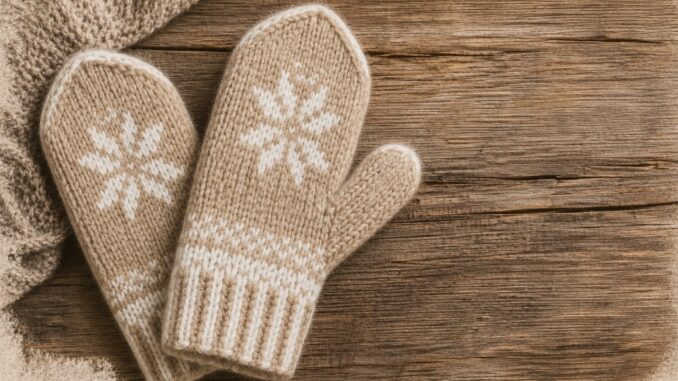
The mittens and matching hat were obviously hand-made.
*
She had picked the white and tan yarn specifically because they would match anything, no matter what color coat her granddaughter wore. She was trying out a new pattern: the mittens had ribbing on the ends and a nice twisting design over the fingers. The yarn was fluffy almost like angora but not quite as flamboyant.
Ella learned to knit from her grandmother. Her grandmother used to make all kinds of things, not just sweaters and mittens, but aprons, dresses, and the occasional pair of pants (that no one ever wore. Knitted pants were never in style). Now that Ella lived alone, knitting was how she passed much of her time. She would knit so many things, but there was always someone to give something to. Sweaters for new babies. Hats for the bell ringers.
Ella was pleased, though, with the new mittens and hat for Cora. Cora was due to get off the bus today after school at Ella’s house. She had made shortbread cookies and was boiling hot cocoa. Sometimes she forgot that Cora was 13, and that she, herself, was old enough to have a granddaughter who was a teenager.
Three o’clock came, and Ella looked repeatedly out the front window. Finally, at 3:15, she heard the bus pull up in front of the house. She drew back the curtain in the door, and looked out at Cora, walking up her drive.
Cora had long, blond hair and the tall, thin body of the girls Ella saw in department store sale flyers. On her head was a bright green leather cap pulled tightly down to her ears. She wore an oversized coat and a short skirt that fell above her knees paired with green leggings. On her hands were slim leather gloves that matched her green hat. She wore lipstick and, Ella thought, eye shadow.
“Cora!” she said, welcoming her granddaughter into the house. Cora held up one finger, as if to say, “Just a minute.” She was talking on her cell phone.
Sometimes Ella forgot that Cora was 13. Ella stuffed her homemade mittens and hat into the pockets of her cardigan. She could always donate them somewhere.
*
The boots and socks must have been new, just off the shelf at the store.
*
“Well? Which ones?” Michael asked. He and Nate stood in front of a long shelf of boots four shelves high.
Nate couldn’t make up his mind. There were superhero boots. Plain black boots stuffed with down. Boots with cartoon characters on them. He finally reached out and pulled down a pair with tan and red plaid patches. “These,” he said.
“You’re sure?” Michael said.
“Yes, dad.” Nate rolled his eyes. He was not a baby. He was eight.
“What size are they?” Michael asked.
“Mine.”
“OK, then.”
Michael took the boots from Nate and looked at the price tag. $14.99. “You have $20,” Michael told Nate. “What do you want to do with the rest?” Michael raised an eyebrow.
“The rest is for the socks,” Nate said. “Duh.”
“Right,” Michael said, smiling. “Socks.” They picked gray wool socks for $3.
At the checkout counter, Nate handed over the $20 bill. The lady cashier said, “You got yourself some nice new boots here.”
Nate nodded, and insisted on carrying the bag to the car. They drove to the church hall, parked the car, and went inside. There was a line 20 people long. At the end of the line was Santa Claus. Each child in the line held a bag; some had toys in them, other clothes.
“I’m glad we got boots,” Nate said. “I don’t see anyone else with boots.”
“Neither do I,” Michael said.
When it was Nate’s turn to sit on Santa’s lap, he handed over the boots and socks. “My, my,” Santa said. “These are some fine boots.”
“They’re not for you,” Nate said, which made everyone within hearing distance laugh.
“I know,” Santa said. “They’re for some boy who doesn’t have any.”
Nate nodded. “So don’t forget to give him the socks, too.”
“I won’t,” Santa said, looking from Nate to Michael. “Thanks for helping out the cause.” He handed Nate a candy cane.
*
Nadine watched Carl play outside. The snow fell hard, with big flakes, perfect for Christmas Eve. She couldn’t believe how well everything fit him. The coat was a little big, but would be fine and might last another year, God willing.
The funny thing was how well everything matched: the tan and white hat and mittens; the red coat; the red and tan plaid boots. As if it had been planned.
“He’ll look like he stepped out of a Sears catalog,” the man said, when he dropped off the box full of the clothes and food. How he had got their names, she didn’t know, but she was glad for it.
On the stove, Nadine warmed a can of tomato soup. It was time to call Carl in from outside so he could eat his dinner, but she didn’t have the heart to do it. He was having so much fun. He was trying to build a snowman but the snow wasn’t cooperating; it was too cold out. The snowballs he made kept disintegrating, falling down to his feet.
She stood at the window of their apartment, debating. John Prine’s Christmas in Prison was on the radio. I’ll let him stay out, she thought. It wasn’t yet dark. The soup can be rewarmed. And Christmas Eve was only once a year.
Nadine had two presents hidden under the bed, which she would place under their little tree for Carl to find when he woke the next morning. One was a book on dinosaurs that she found at the thrift store. It looked brand new. The other was a pair of jeans — not so exciting, but he desperately needed them. The man who brought the box of clothes and food had also left three wrapped presents when Carl wasn’t looking. The tags said simply: Love, Santa. She had no idea what was in them.
Nadine looked out the window again. She knew Carl would come in if he were cold. She turned off the soup on the stove and sat down at the table. She saw Carl attempt another snowball, which fell apart.
She felt warm, watching him.


