
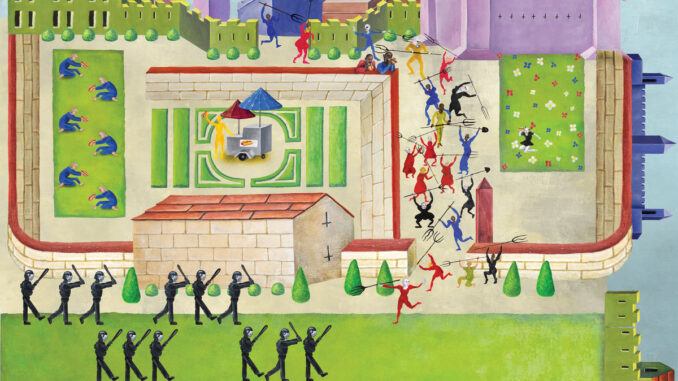
Musings on the state of the world, now and in the past, the solution is in the hot dog.
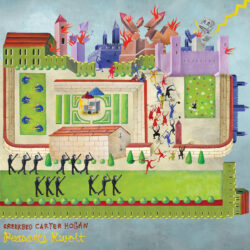 When an album announces itself as “a rollicking medieval-Americana manuscript” it’s clear that we shouldn’t take anything that follows over seriously. A series of 10 vignettes that are more like reportage which Hogan describes as having been “written living and moving between the North and the South; sung by a body both pre- and post-trans affirming healthcare; and recorded during a time of genocide, federal occupation, and workers’ uprisings.”
The music itself is exactly the blend of styles that you might expect from an artist who has surrounded themself with a group of musicians playing Baritone Guitar, cello, Banjo, Saxophone, and Casio PK-1. Cutbank of Cleves sits on a stuttering bass line and penny whistle (created by the aforementioned Casio). The words verge on the abstract: “O glass jaw shaker, St. Martin’s beggar. Will that cutbank cover you both? A man is a razor, and a god is a taker. That well there is poisoned with Holy Ghosts.” There’s a classic country inflection to most of the music. Burn’s pensive pedal steel and climate aware lyric is where it all starts to make sense. “I hear it’s warmer than it oughta be. Up there at the start of the Mississippi. And the evergreens are like candle trees. They’re leaning into the burn.”
This is an album that needs to be heard as an album as Hogan’s thought process expressed in the songs needs to be played through. The songs are very much a collaboration. Mirrors is a duet with Jude Brothers musing on trans pain-turned-pride. The spiralling words which close this song are stunningly effective.
The title song quotes Wordsworth’s sonnet To Toussaint Louverture. Reflecting on a poem is about community and support for the oppressed makes sense in the context of an album which takes as its Manifesto “Here’s to everyone trying, with everything they’ve got, to look their neighbor in the eye and say, “I’m with you.” Whether it’s a 14th century riot of peasants, a 20th century miner’s strike, or our modern-day hell, Peasants Revolt was made to help us sing for our supper so we can reclaim a better world for ourselves.”
As the album progresses the music becomes simpler, more stripped back. Games Of Pretend is just Hogan and a guitar on a ballad which could have been written anytime in the last century.
If as Hogan would like us to believe the album is the final breakdown of society viewed from a hot dog stand then that seems like a good vantage point. The last song proper Hot Dog! Apocalypse suggests that salvation is in fact to be found in the “hot dog I’m dreaming of.” Which is about as good a summing up of the state of the USA in 2026 as you are likely to hear. The album opened with The Last Supper, a mix of radio static, and bits of random song After the Wurst of It ends with snatches of music heard from afar. Art and hot dogs will it seems survive the coming crisis, which is reassuring.

