
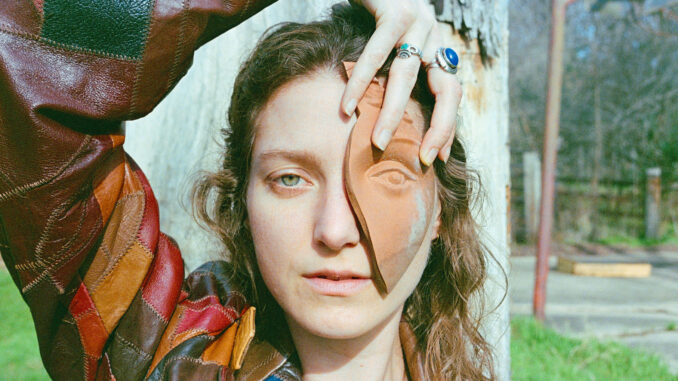
Carson McHone’s music is utterly timeless, of the type that listeners of many generations can find appealing. For much of her career, we’ve known the Austin, Texas, singer-songwriter to engage in wistful americana tunes that avoid the formulaic approach of Nashville pop country. These days, with her fourth album in ten years, she digs deeper into the palette of her art, peeling off the layers as described by the title of the record, “Pentimento” (Merge Records, 2025). In the study of physical art, the pentimento is an artefact, a remnant of a previous draft or altogether different painting that’s apparent beneath layers of paint on a finished canvas. Almost immediately, you can hear how the album organises itself around this idea.
Much of the country, however, has been filtered out of the album in favour of a nod towards artists like Tori Amos and Fiona Apple. “Pentimento” was recorded directly to 8-track cassette by her husband and producer, Daniel Romano, in southern Ontario, where the couple now resides. Other musicians on the project include Colleen Coco Collins, Michael Cloud Duguay, Raha Javanfar and Steven Lambke. The songs are more literate, and the hurt woman trope has been disengaged. You can hear more restraint, poise and metaphor at her disposal. Her vocals sound grounded, unhurried. In the haiku-like ‘Abstract Spring’ she intones, And morning found no new scar / Am I at last now reconciled?
The mood is intimate and dusky, luxurious and hypnotic. It’s the right milieu for an album that treats ethereal music as a space for composure and desire. Still, McHone doesn’t reinvent her wheel so much as buff the rims to a mirrored sheen, composing her record for people who like to feel the emotion and think of underlying meanings. She is not averse to taking risks assuredly as on “Downhill,’ a propulsive tune that falls into a push and pull across time signatures, leading you to think she is over her skis, falling, I remember sweat in my eyes / I remember the bitter taste of asphalt / I remember blood in my hair and I cannot yet forget / The memory last impressed upon my skin / From falling fast.
McHone bends form until it squeals while still maintaining a present clarity, controlled tempos, velvet hooks and a vocal style that favours precision. Her flex is subtler, and the result is winning on the consistency of the music, trusting her phrasing to carry the songs to fruition. The scope of the album is expansive, a diaspora of contemporary music. She explains: “All of the songs of “Pentimento” began as poems against the backdrop of global crisis, national borders, civil unrest, birth, death, bad love, new love, true love.”
The record’s polish comes from curation as much as performance, allowing her lithe vocal signature to glide like lip gloss, sounding weightless and self-assured. On the inviting ‘Vision in the Verse,’ she ponders solitude, desire and longing: Imagine through a rhyme what it might be to touch a face / But falling from so far away, I realize is strange. The whole of the song feels like an invitation and a boundary at once: How might I rephrase / How’d I put it yesterday / And if tomorrow be the same / What of time?
‘Idiom’ gives her space to flirt in the margins: If unholy the heart, what then is the love? / I’ll choke on my song, so spare the dove. Her knowledge reads lived-in, not borrowed, with her lyricism the constant centre of gravity. There are moments – especially on her more edgy cuts – where you wonder if the veneer will crack, but she and Romano are fully in command even when letting one or two of the songs roam freely.
At its core, “Pentimento” asks: How can love and beauty exist in the presence of brutality? McHone makes her case without grandstanding, proof that command can be quiet. It is wondrous how serene she sounds in these choppy waters. This is a record that is most replayable at 1 a.m. when you are alone with the crickets and your headphones.
To quote McHone: “All of the songs of “Pentimento” were written in the desert. There, history and time are visual in the drama of great boulders, in layers on a rockface – the potential and past energy of the ancient seafloor. Some of these lyrics were written on postcards and in letters. Others began as embellishments on watercolor paintings, or captions for a photograph in a diary, or were written as responses in the margins of a journal to a child, newborn, from a generation past. These “artefacts” from writing/living informed what would eventually become material for this record.”
Behind the songs of “Pentimento” as expressed by Carson McHone
Winter Breaking – I had very specific recording and mix ideas for this one; I saw it as “parts” flashing on and off, like streetlights. The outro is me and Daniel playing acoustics while Kenny walks towards us with a microphone from across the room.
Abstract Spring – The birds still chirped, like it was just another spring.
Downhill – “They say you never forget how to ride a bicycle” was the original title in its initial poem form. And they do say that, but memory is a fickle thing… Coco played bass on this one. I love what she played and where she didn’t (!) so much. The part I played on the Mellotron when the song breaks down, I could hear in my head, and, which is kind of rare for me, it was nice to feel that kind of conviction – and then to find it on the keyboard.
Vision in the Verse – “In a love that’s whole yet fleshed apart, desolation knows its name by heart, so we keep a rein on the holy word, still the time stands still like the hummingbird” – from Daniel Romano’s ‘At Last There is no End’ (after Henry Miller).
This was a big one for me – sort of a realization that I could construct something I wanted to hear, which is funny, I guess, coming from someone who writes songs. Often, I feel I write out of necessity – at least the lyrics and the crux of the lead melody – that it’s almost this desperate thing that happens, and I’m grasping at it and then have no idea how I got there. With this song, it was different, and I think it was the first like this in a way for me (though I bet I have said this before and surely I’ll say it again, but that is the magic of music in a way, that it can feel new (again!)). I wanted it to sound like the joy of anticipation, just hanging there, like a sweet scent on the air or something, not too syrupy, but beautiful. And it represents that to me, and I think it sounds that way too – being able to appreciate the pleasure of possibility, being able to have that perspective when in all other aspects of reality you are isolated. It was a way to exercise the freedom of the word, of mind, of music.
In the Summer the Streets Burned – Language is tricky – we bow to it, we bruise it, we betray it, and each other with it. It’s very powerful, and yet, intangible.
Idiom – Must we mean what we say; must we say what we mean? Written in the Chihuahuan desert during a dust storm out of the Sahara that settled in Texas…
Fruits of My Tending – A little bird caught inside an airport inspired this one, along with the tyranny of impulse… This song has one of my favorite moments on the album. It was also one of the most fun to record. Daniel did a live guitar swap mid-take, and when Steve picks up the rhythm on bass in the outro..!
Forbidden Kiss – This one speaks for itself, one of the postcard poems, and it kept its form, sung. I think when I wrote it, I had recently ripped the poem “Fulfilment” by Langston Hughes out of its book and sent it to a friend. This is the only one I wrote on piano. The run that Michael plays on the keys reminds me so much of a Judee Sill song, but he’d never heard it before. And the recorder! This one truly breathes.
The Canvas – This is a fully desert song, but where does the desert end and the sea begin? Which is the shadow, which is the not-shadow? One of the verses was pulled from a painting I did out there, another from a postcard I sent to our mailman, who had been, as was his duty, attending to our correspondence while the border was closed. This was one of those songs that was “built” – I had really specific references and parts. When I recorded my guitar, Daniel manually flipped the tremolo on and off on the amp in the bathtub down the hallway.
Lucentum – “What if a key shone to the sun?” This was the title of a drawing my godson André made. I wrote this poem for him, another that kept its exact form even when sung. I spent a day alone at the studio before we went out east to record, finding the melody on guitar, and when I felt I could sing it all the way through, I sent a voice memo to Daniel, and he just said, Don’t change a thing. Even though the structure wasn’t exactly normal, it made so much sense to me. It felt very natural that the poem just sang its way off the page, the same way it was written.
Wake You Well – The calm, Cool face river, Asked me for a kiss. ~ “Suicide’s Note” (1926?), Langston Hughes
Triumph of the Heart – The first poem I wrote after moving to Ontario, sent to a friend on a postcard. The quote my mother reads before the last song is in response to Emerson’s quote, also taken from her journal written to me in my first year, 1992.
September Song – This song was built from a poem I read at my wedding as my vows. It was a joy to record with the live band; we just leaned in. And the laughter you hear is legitimate. It was really fun. This was one of the songs we had Raha come in and play violin on after the fact, and she’s just such a technical master, but I asked her to get real loose and just play with it, leave no rock unturned, and she went wild, just so wonderful, she can do it all.

