
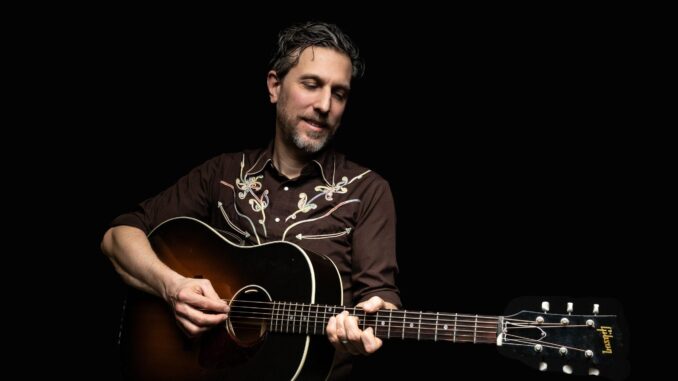
As we meet, Tony Dekker is sitting outside a café in Vancouver, Canada. It’s a fitting setting for a conversation with the Great Lake Swimmers’ frontman – calm, thoughtful and quietly attuned to the world around him. For over two decades, Dekker has crafted songs that move between stillness and motion, the personal and the natural, always searching for something luminous in the ordinary.
Now, with “Caught Light”, the band’s recent album, Dekker reflects on time, memory and creative renewal. Recorded in just a few days, the record captures the immediacy and warmth that have long defined his songwriting. Over coffee, we spoke about the challenge of letting go, the circular nature of time and finding space for quiet in a noisy world.
Americana UK: You’re currently on tour. How’s it going? What can fans expect from the show?
Tony Dekker: It’s going really well. We’ve had a nice start, five shows into the Canadian tour. It’s the launch of the new album, and the shows have been going great. The new album seems to be resonating well. The new songs are coming across really well live, and we’re playing as a trio.
AUK: I’m really enjoying the new album. It’s been received really well on this side of the Atlantic, too. It was recorded in just a few days, wasn’t it? On the spectrum between utterly liberating and completely terrifying, where did that process sit?
TD: That’s exactly it. I had to learn how to let go of a lot. I put a lot of time into the writing and preparing side, so I was very ready going in, but the actual session went down in three days, faster than I’ve ever worked before. I had a great team around me, and I really credit them for having the right people in the team, from producing to engineering to performance. And then mixing and editing down the road, everyone was on the same wavelength.
AUK: Did you have to stop yourself from tinkering afterwards?
TD: Exactly. There wasn’t much time for tinkering. We had two additional days for overdubs and small fixes, but that was it. My producer, Darcy Yates, was someone I had to really trust – trust his word, his instincts. That was difficult at first, but it became very freeing. Having someone else help make those decisions took a weight off.
AUK: There are so many interesting themes on the album, particularly time. There’s this circular sense of time, but also the idea that it’s fleeting. Songs like ‘One More Dance Around the Sun’ really bring that out. It almost feels reflective of the writing process itself. Do you think of renewal as something earned through endurance, or as a natural rhythm that keeps pulling you forward?
TD: That’s a great analysis, and to be honest, I’m still figuring it out myself. When I’m writing, I’m just following what I feel in my bones and my guts. Later, I realise the songs form a group, that they share threads. Some are more hard won to get to the finish line. Now, playing them live, it’s like a continuation of that conversation. I’m discovering the connections between them as we perform. And other people are seeing the connections too.
I think there’s definitely that circular, rhythmic passage of time, maybe not a straight line left to right, but more of a spiral…. or maybe even a pretzel or a tangled ball of yarn. Our perception of time is just one aspect of it. There’s also this idea of taking stock, as we’ve been at this for a while, over twenty years into my career now, reflecting on memory and the passage of time.
AUK: Even the album title “Caught Light” feels like a beautiful paradox – something fleeting you’re trying to hold. What does the title mean to you?
TD: I liked the idea of exposure, like in old photography – light literally captured on paper. That felt meaningful, especially in contrast to today’s digital world. These days it’s just a series of 0s and 1s. The album cover photo was taken on film, developed, and then scanned. I wanted that analogue sensibility.
The title also connects to a childhood memory. Growing up in rural Ontario, there was a small skydiving club nearby full of enthusiasts. Sometimes, jumpers would get blown off course and land a long way from their targets in the fields near our house. I remember one landing there – a powerful image that stuck with me, the parachute, the suit, the helmet. When I was writing this album, I thought of that as a metaphor for being blown off course, ending up somewhere unexpected, maybe even finding a kind of lightness there. So “Caught Light” has a few layers of meaning – the spiritual sense of being caught light, or the lightness you may not have expected.
AUK: That sense of layered meaning runs through all your work. You’ve often written with empathy for people, places and the natural world. How have you maintained that level of sensitivity in such a noisy, often angry world?
TD: You really have to carve out that space for yourself. It’s hard to find that quiet place and a battle to stay there. But that’s part of the job description. Songwriting is about finding that quiet space, making observations, and turning them into something meaningful. It’s not easy, but I try to treat songwriting as something that rewards you the deeper you dig into it lyrically and musically.
AUK: There’s a song on the album, ‘Endless Detours’, that gives this lovely sense that getting lost doesn’t feel like a failure. It feels almost essential. Is that part of your creative process, too?
TD: Definitely. You have to accept the rough edges. In the lyrics, I spent some time with them. I came in prepared, but you’re never fully ready for what happens in the room. I had to be okay with being in the moment and not being too precious. There was a bit of letting go there. Being very much in the moment was the key to it.
AUK: Much of your work absorbs the personal into a bigger picture. But ‘Wrong, Wrong, Wrong’ feels very directly personal – almost an unguarded private moment. What was it like deciding how much to reveal?
TD: I felt vulnerable with that one. It was difficult to decide. But that’s a good thing. Interestingly, people have read that song in a larger, more universal way, about what’s going wrong in the world. Seeing the bigger picture of the world and the sense of urgency there might be. That’s been fascinating to see what people are reading into that song.
AUK: There’s that line, “I’m only telling you because I know you aren’t getting it wrong”. It feels like reaching out, holding someone through a difficult time.
TD: Exactly. It’s about reaching out to a friend or the listener, really. The “bad friend” in the song is the person hearing it.
AUK: You were recently featured on Americana UK with the ‘Youth Not Wasted’ video, which reflects on where you’ve been but without regret – “proof that we’re here.” Has your relationship with memory changed over twenty years of songwriting? How have you matured and grown as a songwriter?
TD: It has. We still play songs from the early catalogue, and their meanings change as I perform them. You kind of go back to that initial place, but they expand and evolve as life goes on. It’s fascinating how memory, ideas, concepts and meaning shift over time.
AUK: Does performing live bring new joy, finding new meaning in older songs?
TD: It’s more about the new material, honestly. That’s what drives me – the feeling of having something new to share, continuing the conversation that begins when a record is released. You start the conversation with the record, and then it can be more real and direct with the live shows.
AUK: There’s a lovely sense of waiting in ‘For You to Come Around’– time moving but not resolving. Do you think music has its own kind of waiting, that songs need time to ripen?
TD: Definitely. I wish that was all it took. There are as many ways to write a song as there are songs. There’s no one way to write a song. Sometimes it’s rhythm, sometimes a riff, a piano melody, a line of conversation, even an image. Our world is so visual, it could be an advert on the back of a magazine. Inspiration can come from anywhere.
Some songs come quickly; others sit for years and resurface. Sometimes I repurpose old pieces or combine opposites that unexpectedly work. Sometimes songs get used for parts. Sometimes two opposite things can make something beautiful. I wish there was more of a direct path, but the key is always finding that quiet, protected space to think and absorb. We don’t get enough time for that. No one does.
AUK: Thinking of the bigger picture, across your career, you’ve built this consistent world. It’s gentle, searching, deeply human. It evolves but feels true to itself. Do you ever feel pressure to change your sound?
TD: No, not really. I certainly don’t feel any pressure to change. I don’t have anyone else apart from me motivating me. I’m lucky to be in a sweet spot where I can balance being a professional musician and an independent artist. That gives me freedom to evolve naturally and move at my own speed, without overthinking it.
AUK: Do you feel your songwriting matures as you do, as your worldview broadens?
TD: Possibly, but that’s not really for me to say. I do hope I’m getting more concise as a songwriter, seeing things I couldn’t before.
AUK: The album ends with ‘All the Best’ – part farewell, part benediction. Did you always know it would close the record?
TD: It actually was the last song written and recorded. The album was mostly recorded in sequence. We were at the studio, and there was a thunderstorm that morning. I realised we still needed one more song, so I started working on it then and there. So, I started thinking about an overheard conversation with a friend. It just came together. By the end of the day, we had it recorded. It just fitted – a parting song to close things out.
AUK: I wonder if mistakes are part of the creative process – the grit that makes the pearl.
TD: Absolutely. Being a musician and writer challenges me constantly. Touring, logistics, social media, all of it adds to the artistic process in some way. All the ways we try to reach people, that’s the grit. It’s all part of processing life. But there’s always mistakes we can learn from. There are always personal challenges. I am not particularly overt. Like this particular song does not match this particular experience.
AUK: I wonder if that’s where the richness of your songs come from. They seem a complex tapestry, drawing on lots of threads coming together. They feel layered, like language puzzles.
TD: That’s true. I studied literature, and I love language. Finishing a song can feel like completing a word puzzle. There are certain songs that do that more effectively than others. The language is a huge part of it for me.
AUK: Looking back, if you could send one message to yourself when you made your first record, what would it be?
TD: Honestly, I wouldn’t change anything. But I’d tell any young artist: don’t do this unless you absolutely have to. It’s hard, with a lot of ups and downs. When the wave comes, ride it, but be prepared for many years at sea too. Keep your expectations low and healthy.
There’s too much desire for overnight, instant success and gratification these days. My advice to my younger self? Hang in there.


Great interview. Love hearing these insights to Tony’s song writing. Have been a fan since 2005. Loving the new album, it’s come out just when I need it. Immense gratitude. London, UK.