
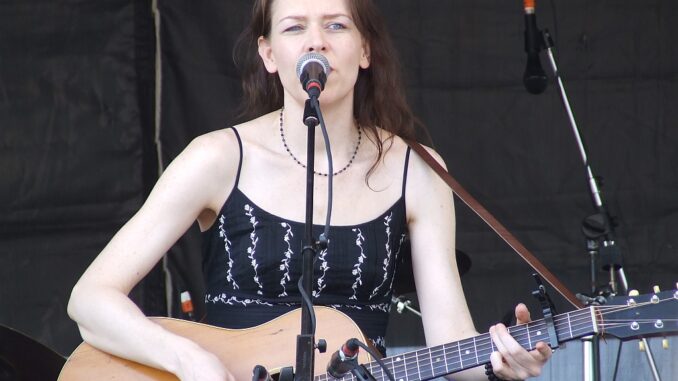
It’s hard to remember now, but there was a time in the early-00s when music piracy was the hot topic. At the turn of the millennium, Metallica member Lars Ulrich famously took the free file-sharing service Napster to court, an action that paid off when, in 2001, the court ruled in his favour and, in what became the beginning of the end for the company as we knew it, Napster was forced to terminate hundreds of thousands of accounts. It was in this very specific environment that Gillian Welch released ‘Everything Is Free’, her sad lament to the fact recorded music had lost all of its value.
Written by Welch with longtime collaborator David Rawlings and featured on her 2001 album “Time (The Revelator)”, ‘Everything Is Free’ is a quiet folk masterpiece that, like so many brilliant folk songs, perfectly captures the mood of the time. “Everything is free now / That’s what they say”, she opens with sweet melancholy against the accompanying jangling guitar, “Everything I ever done / Gonna give it away”. One of the most interesting aspects of the song is that Welch never considers angrily throwing in the towel and giving up music. “Someone hit the big score / They figured it out / That we’re gonna do it anyway / Even if it doesn’t pay”, she sings with wry sadness. Put simply, she knows that she will always be driven to create music, no matter the financial loss, although later in the song, she does find herself leaning into the selfishness that this potential future without payment for her art might breed, imagining she will just create for herself and that “If there’s something that you wanna hear / You can sing it yourself”.
It’s interesting to reflect back upon the fear that surrounded piracy now, as we live firmly in the age of streaming. Back in 2018, Josh Tillman – under his alias of Father John Misty – recorded a fairly faithful cover at none other than Spotify Studios in New York.
It would be easy to dismiss this as Tillman just showing appreciation for a song he clearly enjoys, but as any fan of his knows, he’s never one to miss out on the opportunity to point out some irony, and what’s more ironic than singing a song about musicians having to work for free in the New York headquarters of Spotify?
Because the thing is, almost a quarter of a decade after the big piracy scare, musicians still aren’t getting paid when people listen to their recordings. Sure, there are dedicated music fans out there buying vinyl, but the vast majority of people stream, which means all except the very biggest acts take home pennies in return for their catalogues being available for all. The only thing that’s changed in the last 25 years is that now Spotify and their advertisers get to make their profits while doing none of the creative work.
Welch may not have been referring to music streaming companies on ‘Everything Is Free’, but still, she managed to sum up the troubled relationship artists have with the media giants that control the music perfectly when she said, “Never minded working hard / It’s who I’m working for”.


Musicians actually getting paid for their recordings have always only been available to the few rather than the many. Since the first 78s were released in the early 1900s an income stream was mostly limited to public performances until many, many decades later when merch was introduced.
I believe Brian Epstein might have been the first manager to understand that, as he made certain to hold onto the publishing and control the licensing of the Beatle’s work. It was only after he died and the band fractured that things went off the rails. Note: Must give credit to Tom Parker for the concept and the high profit structure from merchandise.
Now in 2025, is everything still free as Gillian may have meant in her lyrics? Hardly. What has occurred in the past 24 years is the replication of streaming music with monthly subscription (or in the case of Spotify, listening to ads in return for free access) was only the beginning of a monstrous shift in this old fashioned idea of ownership. We now all live and will likely die with a long list of monthly charges. Nothing is free.
Sadly wherever there is money to be found there are middlemen leveraging their way into the space between creator and audience. Been reading how “found’ songs were copyrighted and monetised in the 1920s onwards while the propensity of organised crime to take publishing credits is well documented. Record companies used access to distribution and production to take the lion’s share of recording income while running bloated overheads and giving themselves fat salaries charging it to the artist’s account. Promoters used to have live music locked up before the likes of Peter Grant took back some measure of control. Now we have Live Nation and the streaming giants squeezing the customer and the producer. Not helped by the audiences’ own disposable income being eroded by the post 2008 economic order.
Napster stole everything which was their downfall – if they’d paid out a pittance instead they might still be there now.
But Gillian Welch is right that all the intermediaries in the world – even those armed now with AI – don’t create a thing and everywhere artists and audiences gather away from the mega $$$ events takes something back.