
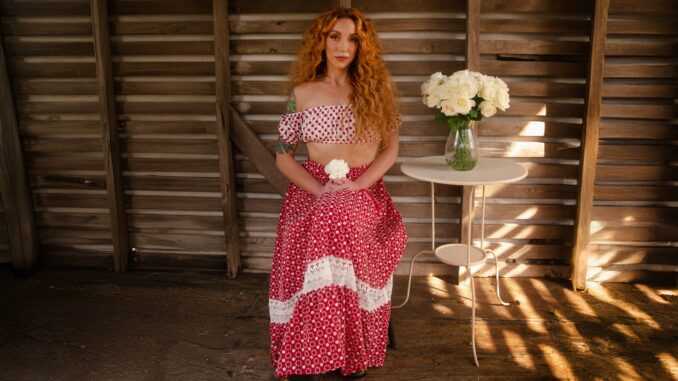
When you learn that Ashley Monroe was once part of a country supergroup – Pistol Annies with Miranda Lambert and Angaleena Presley – you figure right away she must be some kind of urban cowgirl, a sweetheart of fantasy, conjured by Nashville execs. In actuality, she is something else indeed, a fine recording artist with six albums under her own name to her credit, the latest one called “Tennessee Lightning,” which is a collection she put together like a patchwork quilt of fabrics saved in a drawer of her nightstand.
Yet, this is no exercise in make-believe, nostalgia or kitsch. It exists in her world in which the lives (open and secret) are not only recognised but allowed to interface dramatically with her own life. Monroe demonstrates that reality is a matter of perception, and that dreams don’t come true, dreams are true, some good, others not so much.
Her albums are an assortment like you would see in a vintage shop. Should you follow her into that shop, you would be amazed at both the extent of her recordings and the artistry with which they are displayed. Every album is teeming with treasure, even her debut, “Satisfied” (Columbia 2009), recorded in 2006 but only released digitally after being dropped by the label. Vince Gill produced her second album, “Like A Rose,” after she signed with Warner Brothers in 2013, as well as its follow-up, “The Blade”, two years later. The reviews came in and were positive. Billboard noted, “She sings these songs, many of which she co-wrote, with exquisite, bruised sensitivity.”
Gill appears on “Tennessee Lightning” and ‘My Favorite Movie,’ which he co-wrote with Monroe back when they first met in 2015. At the time, she was 15 and Gill was a Nashville star. He had heard one of her demos and was impressed, so he called and asked her to breakfast. “After we hung up,” she related, “I had to call him back and ask if he could come pick me up. I didn’t have a driver’s license.”
Life was good. She had married a pitcher with the Chicago White Sox baseball team, tweeting, “I said yes…. I’m engaged to my John Danks! Best night of my life!” The couple had a son. Then, in 2021, her world took a dark turn like the moon rotating away from the sun. She was diagnosed with a rare form of blood cancer two months after the release of “Rosegold” on Thirty Tigers. The treatments were debilitating, but she always held that in anything you face, there is a beginning and an end, and that helped her get through the illness.
There are nineteen songs she chose for “Tennessee Lightning.” Some are unusual, some familiar, some that have dominated her thoughts after the cancer strife, a time when she couldn’t even think about music, only getting through the day. They held onto her, though, as much as the director of a play is held by the various competing egos in his troupe. So, she interacted with her treasures (don’t call them knick-knacks); she was involved with them. Dissatisfied with letting them collect dust on a mantle, she selected them carefully and brought those that passed audition to the stage on her record. They all have stories. “I’m in touch with all the songs I write,” she confides. “They are all connected to my life or dreams and to my heart. They are my joys even when they are sad.”
Monroe comes across as the kind, enthusiastic songwriter she has been throughout her career. Stardom once held her in its grip, especially during the Pistol Annies period, but she has a wiser perspective from her experiences in both music and life, emerging from all of it like her song ‘Moth’ from a cocoon. “I feel like it’s kind of a bittersweet looking back and thinking, you must be worth the pain.”
People may look at the recording artist and think she has had it better than most of us, but of course, that is not always the case. The actress Diane Keaton once said, “Most of the time you will fail, but you will also occasionally succeed. Those occasional successes make all the hard work and sacrifice worthwhile.” Reminding ourselves of that is what keeps musicians like Ashley Monroe striving to do her best with the talents at her disposal to make music that is exceedingly worthwhile.
Americana UK: Hi, Ashley. Reading your bio, I discovered you were raised one town over from me, outside of Knoxville, Tennessee. Is that where the dream of being a singer began?
Ashley Monroe: You could say that. Of course, I sang in church, ‘Amazing Grace,’ but in front of other people that weren’t church people in Pigeon Forge. I was in a talent contest at this place called Eddie’s Heart and Soul, and I won second place, a hundred dollars, when I was 10. I got a job from that talent show at the Smoky Mountain Barn Theater on the Sevier County fairgrounds lot. It was like I got clogged and yodeled. It was a little variety show.
AUK: That is close to Dollywood and the Dixie Stampede, where you watch horse tricks and dine on fried chicken and biscuits with gravy.
AM: You will find that sort of thing going on around there. It’s fun.
AUK: It wasn’t too many years later when you went to Nashville.
AM: When I first moved here, all I had written was just some songs back in Knoxville and little demos of me playing piano and singing them. It hadn’t really sunk in all the way that I could be a full-on songwriter. But pretty soon after I got here, it hit me. I had enough life lived by 15. I lost my dad when I was 13 and got into some bad stuff with pills and all, so I feel like I had enough gone on in my soul that it helped me early on.
AUK: Not long ago, out in Grainger County, you couldn’t go far without tripping over a pain clinic. So many people have ruined their lives over oxy.
AM: Soon after losing my dad, my cousin, that was 10 years older than me and I looked up to so much, she was so pretty and cool, and she had them all the time. Her dad sold them to us. It was very dysfunctional, and people in my high school they had OxyContin back then. I can’t believe I didn’t die. That’s so strong. But I was so guarded before I went to a Christian school. Then I was homeschooled, but my dad died, and I went to public school. My dad was gone, and mom had ran off.
I would just take anything or do anything that my friends said to do. You kind of hone in and go, Oh, this is fun and it makes your heart hurt less. My therapist always said not to shame ourselves too bad when we go through those phases, even though it’s not the healthy way and it’s not how we should deal. Sometimes we got to do stuff in order to get through something that’s really hard. So, I learned to forgive myself for all that.
AUK: If I had to guess, your song ‘Risen Road’ may be about those times.
AM: I love that about East Tennessee. I don’t love pain pills anymore, but I love East Tennessee because the Risen Road always makes me think of where I’m from, and I like the people there so much for so many reasons. One is that there is an undertow of darkness and hardships, but the people have a dry sense of humor and, I don’t know, just a resiliency about it. I just always relate to, and I’m proud of coming from there.
AUK: What did you mean when you said more than anything, “Tennessee Lightning” is me. “It’s like a flash of light and for a second everything else goes away.”
AM: I feel like it was just a flash of looking back at my life from the beginning. I had seen it in these chapters. I saw in the beginning where I’m from, which is the song that starts the whole record. I wrote that in 2004 in the Smoky Mountains, the same writing trip that I wrote a song called ‘Used’ and a song called ‘Satisfied’ that was on my first record. Anyway, I wanted the first part to be where I’m from, and then I wanted to go into young love and innocence. After that, I wanted it to feel like grief, your first taste of loss. And then the last chapter to me was where I am now in a reflection. I feel like I’m not just one thing, and I’m not just one story. This shows all of it.
AUK: Vince Gill has been a significant part of your story. You met him while still a teenager.
AM: I go back a long way with him. Vince produced my “Like a Rose” record and also “The Blade,” but a good friend and amazing producer and engineer, Gina Johnson, did “Tennessee Lightning.”
AUK: I understand he has been a good friend through the years.
AM: Oh boy. He’s such a sweet person. One time, I was going through a really hard time, and I drove over to his and Amy’s (Grant) house and knocked on the door. He opened it, and I was just bawling, and he said, Amy, come here. We’ve got a broken bird. And that always just stood out in my mind. It was just so pure, and they just sat with me and prayed with me. It was just one of the sweetest, most genuine friendship moments of my life. And I’m always so humble that it’s those two people that I grew up idolizing.

AUK: Not to dwell on the cancer, but as a survivor myself, I found it strange that going through it, you don’t feel like doing any of the things that you normally would find pleasure in. Do you know what I mean?
AM: No, you totally get it. I could have all of the best snacks and these ginger chews to help nausea and blah blah blah, and then it’s like, ugh, nothing. I don’t want anything. Give me a bag of chips. Just anything to get the chemo taste out of my mouth. But yeah, I would put on healing frequencies, binaural beats, because I do think there’s something with tones that ease your cells.
Or sometimes my husband would put on Enya radio on the way to the treatments. Just very gentle noise to drown out the fear. But yeah, I would come home afterwards and just go to bed, and after a couple days of resting, I’d try to go move my body or take a walk or something just to get it pumping out of my body. The only other time that happened was when I was pregnant. When I was pregnant, all I could listen to was French music of all things. That was the only thing that would make me not feel nauseous, but I didn’t write any then or during the cancer. When I was sick with this lymphoma, I never heard a melody once; I didn’t write down one idea.
And then a couple months after my last treatment, I was starting to feel back to myself again. Melodies started coming in, and the same after I had my son. I think of music all the time. That’s all I’m thinking about. I can’t write down ideas enough, but I look at the two times when I didn’t, and both of them were times I guess I really needed to be in my body, you know what I mean? I had to be in my body and present and not in the sky.
AUK: After emerging from the ordeal, did it change your outlook or perspective towards life and career?
AM: It definitely did. And I know you would understand this, too. It probably sounds cliché, but it makes us not take for granted the times when we wake up feeling good about life and health. When I feel good now, I pay attention to it and thank God that I feel good and not try to find something to be stressed about. I try not focusing on things that are going to give me huge cortisol bursts. I’m very protective of my joy, and it’s not that I don’t know terrible things that go on, not that I don’t hurt and go through hardships, but I just try to be mindful when my body is given those cortisol bursts, at least the ones we can control. Life will bring you to your knees. You won’t have to do it to yourself. You’ll be on your knees if you need to be. So, I feel like in moments that are okay, and I’m breathing, and I’m healthy, and I got my family and my dogs, I really soak it up.

AUK: It seems your music had started to shift just prior to getting ill. There was the record “Rosegold,” which was decidedly different from your earlier work – tracks like ‘Siren’ and ‘Till It Breaks’ were, still are, formidable. What caused you to change direction and the way you were writing and looking at music?
AM: I always follow what feels good, honestly, at the moment. And I listen to and am inspired by so many different kinds of music that, as an artist, it’s just natural for me to ride a wave of what I’m feeling at the time. At that time, my son was little, and I was in this extreme newfound joy and love and thought, wouldn’t it be good to just have a thing that was only love and loving thoughts and feelings. And I still love ‘Until It Breaks’ and one of my favorite songs is ‘Silk.’ I mean, there’s a lot on there. If I could do those acoustic and nobody would ever know, that’s the power of a production and music in general. I like being creative and never putting myself in a box.
AUK: The collection that you have put together – “Tennessee Lightning” – is of songs that meant something special to you in one way or another?
AM: They all do. I love that I put ‘Jesus Hold My Hand’ on there. That was a hymn I used to sing when I was younger, when I would be afraid or if it’d be a bad storm, or some sort of issue, I would just sing that song to calm down. I hadn’t sung it in a long time, and one day over at Gina’s studio, I just picked up a guitar and started singing it. I don’t know why. There was actually a guy over at her studio that was doing some organ overdubs that day. So, we just recorded that live. But I felt it so deep, and I always say, I don’t like to sing about cancer or write any sort of cancer song. I feel like it’s taken enough of my life, and I’m not letting it have my music. But I will say that’s the only one that even had the slightest part of that experience in it because I’ve had my hand held recently, and so it had a deeper meaning to me than when I was singing it when I was a kid.
I love ‘My favorite Movie.’ Like I said, Vince and I wrote that in 2015, around the time of “The Blade,” and I don’t know why we didn’t record it. But like I said, he recorded it, and then it was just one that’s always haunted me. I love the scenery that I see in my mind when I’m singing it too, so I did my version.
AUK: ‘That’s No Way to Say Goodbye’ is such a great Leonard Cohen song. One lyric in particular: It’s just the way it changes like the shoreline in the sea. It brings you outside of yourself.
AM: I know, it kills me too. That song I’d heard obviously so many times in my life. I was going through something in my life a couple of years ago, and that song came on somewhere, and it’s like it just hit a different part of my soul. For a while, that’s all I could listen to. I mean, I would get in the car and I would listen to it. I would walk around the house, and I’d have it in my EarPods. I mean, it was the remedy for whatever I was going through. And I went to Gina’s house one day when we were working on this record, and I just picked up a guitar and said, Have you heard this song? She’s so good about capturing the moment. She knows if it’s inspiring me that probably she should put a mic in front of me and record it. Why not? Because inspirations, they are magic. We didn’t add anything to it. I never re-sang anything because how I was feeling about that song was in it. And honestly, I listened to that one the most when I have listened to “Tennessee Lightning.”
AUK: There are some places where some might say there are imperfections on the record, a random sound here, another there.
AM: Like the breaths and little clunks on my guitar and all that. I love the capturing of a moment. Just because I do sometimes slick things out doesn’t mean we always should because you listen to those old recordings, there’s so many mistakes, but it makes it what it is. We were really intentional about keeping it raw and letting my breaths be heard, and, like I said, my fingers clicking and all that. There was some on Marty’s (Stuart) song ‘The Touch,’ too. He had on these sleeves, and he’s playing, and you can hear it hit the guitar. You can see it in your mind when you hear it.

AUK: What about ‘Moth’? It is hard to decide if that is happy or sad.
AM: Well, I feel like ‘Moth’ to me is pleasant memories. It’s kind of bittersweet looking back to something about you, must be worth the pain. The videographer shot a clip of me petting a dog that was at the shoot, and that hit a whole new chord in me because I think it is all the things it doesn’t necessarily mean. Obviously, the verses were more about past love, but the chorus to me is a lot of things that are worth the pain. It’s a good thing. It’s a beautiful light that shines in.
AUK: What would be one thing that you know now that you wish you knew when you got started in music?
AM: I guess that it doesn’t always have to go like it is in your head, or it should in your head, for it to be a success. Because when I moved to Nashville, I’m like, I’ll get a bus, I’ll get a record deal, go on tour, basically be Shania Twain, a big star. Everybody kind of has that. The people I grew up thinking were so cool. But everybody’s success is different. I look back on my career now as a songwriter and in the Annie’s and as a solo artist, collaborator, and oh my gosh, this is making it to me. You know what I mean? I am so grateful that it went the way it did and trusted that it was supposed to. So yeah, probably just kind of go with it and don’t think that if it’s not what you thought, it’s not success. I feel like if your music touches one heart, then you’re doing your job. The rest will work itself out how it’s supposed to.
AUK: Tell our readers something that not many people know about you, that they haven’t found out from reading interviews.
AM: I’m chronically early. I’m a Virgo. I’m very Type A, so I will never be late. I just won’t be. When I travel with my friends, I’m always the one at the gate two hours early, and they’re at Starbucks and not in line while the plane’s boarding. What are you doing? I traveled recently with my friend Fancy, went to the UK, and he said that he would’ve always imagined that I would be the one that rolled in at the last minute. I was there way early.
AUK: What would you hope touches people listening to your album?
AM: I hope they just feel a piece of their story in it, that it makes them think of something that happened in their own life. That’s always my goal – it can give you chills or it can make you feel something in your heart.
AUK: What’s next for you?
AM: I don’t know. I hope some smooth sailing, but it probably won’t be. I do want to go back in the studio and do a honky-tonk record. I want to go to Memphis one day and do a record with strings. And what I’ve been obsessing with recently, the recording that I’m spinning out on right now, like I did with the Leonard Cohen song, is Ann Peebles’ version of ‘You Keep Me Hanging On.’ It’s the most perfect recording and delivery of a song; I just can’t get enough of it. I get in the car every day, and that’s what I put on. So yeah, I’m always inspired by making music, and creating, and releasing. So, I hope I can keep building my songwriting career and my music can get to more people.

