
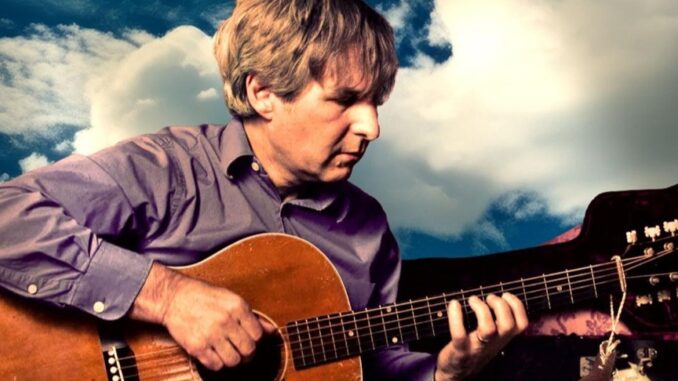
North Carolina singer-songwriter and producer Chris Stamey is an indie rock icon with a long and illustrious history, starting in the mid-70s with Mitch Easter in the band Sneakers, then co-founding the avant-pop band The dBs with fellow Carolinians Will Rigby, Gene Holder and Peter Holsapple, making standout albums such as “Stands for deciBels” and “Repercussion.” He also played with Alex Chilton in the ‘70s, the all-star smart-pop outfit The Salt Collective, and currently tours as a member of Jody Stephens’s Big Star Quintet, whose line-up includes Mike Mills (R.E.M.), Pat Sansone (Wilco) and Jon Auer (Posies).
Stamey has a new album out called “Anything is Possible,’ recorded in Los Angeles. “I’ve developed a grudging fondness for LA,” Stamey said over a Zoom call with a modicum of surprise in his voice. “There’s a community called Wild Honey, named after the Beach Boys song. Some of The Bangles are involved, and Probyn Gregory of The Brian Wilson Band, and there are a bunch of really good players. In fact, we’re doing a chamber music concert of the songs from the record.”
The album was shaped and completed over the course of a year at Stamey’s Modern Recording Studios in Chapel Hill, NC, near to where he once studied composition at UNC. “Well, I like a lot of cities, but it’s very nice here,” Stamey noted. “We have a house in the woods, and a little further back, I built a studio that has a very accurate control room so I can work confidently.”
To those who only remember Stamey from rock bands, the new record may come as a surprise, but it could be seen as new facing on existing kitchen cabinets. Before his latest, there was an album called “A Brand New Shade of Blue,” a two-album set, “New Songs for the 20th Century”, and his previous record, “The Great Escape.”
Stamey has a vocal quality that is the emotional anchor of “Anything is Possible.” You can trace the sights and sounds of thirty years’ worth of singer-songwriter, guitar rock and dream pop straight from its ten-song collage of aching, unfathomably crushing songs. “I learned a lot about the Beach Boys’ recording style from studio work with Alex Chilton, something else I have to thank him for,” Stamey avowed. “I consider the first Brian Wilson solo record to be “The Beach Boys Love You,” which I’m very fond of.”
He also developed an appreciation for The Lemon Twigs while doing shows with Jody Stephens, who intimated he wanted to invite them to play on a couple of songs. “I didn’t know anything about them really and was initially very suspicious,” Stamey remarked. “And then within about a minute, I was their biggest fan. I’ve played a bunch of shows with them, and they’re so accomplished and creative, living in a harmonic place where the melodies and the chords are not falling into the same boxes as everyone else seems to be doing. So, I felt a compositional camaraderie with them. And they’re great. I mean, I just don’t see why they’re not the biggest band in the world at this point.”
Asked which song he is most proud of during his close to 50-year career, Stamey responded slyly, ‘Anything is Possible,’ the new album’s title track, but that is only until he writes his next song. After some thought, he declared, “I’m proud of one song that I haven’t released called ‘One Blue Rose.’ There is also a song I wrote while in a state of delirium in Paris called ‘Something Came Over Me.’ It’s not the most perfect song, but it might be my best because of the way it works live and people respond to it well. I was reading Gérard de Nerval and Rimbaud and was really excited about being in Paris, and I wrote many, many verses over the course of a couple of weeks before cutting it back. But I think that one might be a contender.”
In the new album, the lyrics are simple but evocative: The words at times dissipate into soft harmonies, enveloping the listener like a weighted blanket. Stamey continues to age finely, providing a nostalgic capsule of well-crafted, sultry, pop anthems. “I began writing this record while listening regularly to the gentle, whimsical music of Harry Nilsson and Brian Wilson,” Stamey recalled. “It all changed when, in 2023, I played some shows with the Twigs. Their electric energy reminded me how much fun it was to plug in a guitar and crank it up. I asked Mitch Easter to play drums like he’d play back in high school when we listened constantly to 60s Brit hitmakers The Move. It was so much fun for me to play Roy Wood bass riffs once more against his Bev Bevan fills.”
Stamey knew he was onto something good once the soaring harmonies were added to the basic tracks. “This is an album that you can listen to more than once and always find new ramifications and layers in it,” he shared. “It rewards that kind of repeat listening and a sense of hope and optimism, even though some of it is melancholy.”
Behind the Songs
I’d Be Lost Without You: I think there was an expectation when I was growing up that musicians would change and evolve. It’s easy to pick on The Beatles, but you could color them guilty of this. Growing up, I liked a British band called The Move, which evolved into Electric Light Orchestra. So, I thought this was the path where you continue to try to climb another hill. Brian Wilson credits Gershwin and The Four Freshmen quite often, who are the vocal group that he grew up loving. One thing about The Four Freshmen was they often had four different notes, making the chords actually richer. I’ve also read that Todd Rundgren said he wanted the four-note chord palette, and that is something I am more and more drawn to these days. When I wrote it, I was thinking of a Jerome Kern song called ‘All the Things You Are,’ which modulates continually in the main A section. ‘I’d Be Lost Without You’ could easily be on the “Chet Baker Sings” record if you stripped it down to just the song.
Anything Is Possible: For a moment in 2023, it seemed as if room-temperature cold fusion power was within our reach. Alas, not yet! But still, sometimes science makes a leap and everything gets better (cars that don’t burn fossil fuels, cell phones), or worse (cell phones?). This one was one of the last songs written for the record, and I wrote it after I’d done some touring with my friend Mitch Easter, who I used to record with in high school. Mitch had a band called Let’s Active, and I was in Sneakers with him. I wanted to do a rocking song and record it like we used to record, which meant trying to sound like The Move, more or less. I asked Mitch to play drums like Bev Bevin, the British drummer from that band, and I played all the other instruments. So, it was different from the rest of the songs, which are mostly using other musicians.
After All this Time: Certainly, some debt is owed here to the mid-century modern torch-song champions of yesteryear. I was thinking Harold Arlen a little, but it’s a torch song, which was a definite box to work in harmonically. I would say it’s more late 50s in the way it modulates. This performance by The Fellow Travelers is from our one main day of ensemble tracking. After we cut the track, I arranged the strings and brass sweetening in the style, and added the weepy bottleneck Strat solo. Probyn plays flugelhorn.
Meet Me in Midtown: Tony Hatch wrote the classic ‘Downtown’ for Petula Clark from a hotel window in Times Square, mistaking these environs for the wilds of bohemian Greenwich Village. When I heard the song on AM radio as a child, I didn’t know any better, either. But living later in the real downtown, in the days of CBGB, Lydia Lunch, and the Mudd Club, I realized he’d missed the boat. I started to imagine the song he might have written if he’d cottoned on to where he was. In the end, I think it also evokes the seedy mystique of the bars around Wall Street, after the stockbrokers abscond for Connecticut each night, so maybe I also missed the boat, geographically. It’s got these slash cords in it, meaning 13th chords, a G flat with an A flat base, B flat with a C base. They’re often called Carol King chords, but that is a part of that Chicago horn writing. I wanted to do a saxophone soli section, meaning stacked saxes for the instrumental. And that didn’t happen. There were only two going at one point, but that sudden shift to big band, I just didn’t want to do another guitar solo. I mean, for me, it was more ‘Hernando’s Hideaway’ and ‘Downtown.’
Don’t Talk (Put Your Head on My Shoulder): A very minimal track in Brian Wilson’s original “Pet Sounds” version, but that ride cymbal mesmerized me in high school. Here, it’s arranged more as if it were a full-on Wrecking Crew adventure, with Jennifer Curtis playing a million string parts. Jason Foureman bowed and plucked acoustic bass, Josh Starmer played cello, with Rachel Kiel on flute, Wes on organ, and Dan Davis on drums (except at the end). Again, it’s Wes and the Lemon Twigs in the choir, singing parts that were arranged and recorded for the original version, then left on the cutting-room floor during its mixing. Darian Sahanaja, Wilson’s musical director, kindly sent the scores for these and the original string parts, from which we worked for this version.
One Day, When My Ship Comes In: I was thinking more Harold Arlen, but it is in the style of a World War II separation song – ‘I’ll be home for Christmas’ or ‘I’ll Be Seeing You’ – but it’s definitely like a World War II lullaby, and I think it’s still timely. My dad served in World War II, and when he came back, he liked to play some of the songs of the day that evoked the continental separation of couples and the brave-face uncertainty as to whether they’d ever really be reunited. But I think this feeling of being separated from loved ones, wondering if that ship will ever really come back to port, is something we all have experienced. We’re still being pulled into these wars. I mean, maybe they’ll be fought with drones, but I think there’s still going to be bodies on the line. And it’s horrible. I’m on piano on this one. Thanks to Probyn for crucial additions here – F horn, trombone, and guitar fills.
In a Lonely Place: The delicious noir film by the same name, with Humphrey Bogart and Gloria Grahame, didn’t need a theme song; it’s pretty much perfect as is. Nevertheless, I purloined some of Dixon Steele’s dialogue and imagined what a later, Roy Orbison-era theme for it might have been. I was definitely thinking of Roy Orbison, but I don’t know if we got a Roy Orbison take. I dealt with what came out of the studio. I would probably re-record it a little differently with just the Phil Spector beat. But I liked the version we got.
Once, on a Summer’s Day: My first single under my own name, back in 1977, was ‘The Summer Sun.’ I wrote this song because I remembered what it was like to be at the beach in the winter when everybody else had abandoned it. That’s the flavor I was trying to capture harmonically, evoking the way the beach feels in winter. But one thing I’m pleased about. A lot of my songs tend to start in one key in the verse and end up in a higher key or have some internal modulations. But there’s a point where it’s clearly ended in the key of B Major, and then it goes to F minor, which is a tritone leap. And I don’t understand why that works like it does, because you think of tritones as being associated with Black Sabbath and demon metal, and it feels natural to my ear, but it’s a moment I am really pleased with. Kelly Pratt played his trumpet into a batch of electronics, and Rachel added flute, but the seagull guitars are mine.
Done with Love: This is a song that (let’s be frank) lifts a line and an attitude of resignation from ‘As Tears Go By,’ the Marianne Faithful hit, and there might be a debt owed also to the kind of chord changes Grahame Gouldman used on Hollies hits, or so I remember thinking when I was writing this song. I thought up the chorus “sighs” later, though, as another idea for (and inspired by) The Lemon Twigs, but their touring schedule intervened, and Brett Harris, in the end, nailed these parts beautifully. I just love the way Charles’s organ solo wraps around the modulated changes here. Ben Robinson is on trumpet. I’m on drums on this one. I wanted a simplicity and a lack of finesse in that regard (and I think I found it!).
Au Revoir and Good-bye: This number, another performed by the core quartet of Charles/me/Dan/Jason, began visually more than musically. I imagined it as taking place at the Plaza in NYC, but also under the “Big Clock” of the Ray Milland film. Somehow, this brought me into an almost Richard Rodgers place, harmonically. But I wanted to mix it up a bit, give it a carefree, prohibition/flapper “easy come, easy go” attitude, so I put a waltz section into it, like something Michael Brown’s Left Banke might have done. Laura Thomas plays the violin solo therein, surrounded by Rachel on flute, Matt Douglas on clarinet, and Leah Gibson on cello.
Leaves in the Wind: The changes are taken from an instrumental composition of mine, ‘Un Autre Temps.’ I was fond of this as a piano piece, but thought there might be room for adding some words and melody. This is where it landed. It was the last song written for the record. I always think albums should have “something old, new, borrowed, blue,” you know. Jason Foureman’s acoustic bass playing brings a delicacy and a finesse to the changes here that I love. Probyn Gregory, who told me he wasn’t sure he could find any Chet Baker inside his horn – was he ever wrong!

