
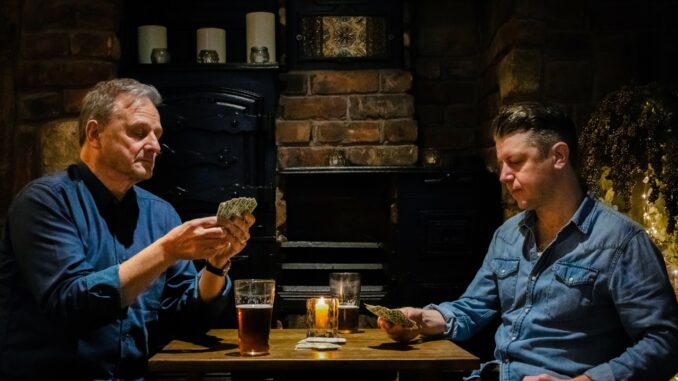
After a number of false starts, AUK finally managed to sit down for a chat with popular culture polymath (broadcaster, folk-pop/alt-country/electronic musician, author, comedic raconteur, dog whisperer) and all-round good-egg Mark Radcliffe. It might be a stretch to anoint him with ‘national treasure’ status just yet, though, as, despite his breadth of work, he is still perhaps a bit niche for that. His work may range across many categories and genres, but from our conversation, it is clear that americana-friendly activity is at its heart. At AUK, we have covered his labours with alt-country band Fine Lines and as a duo with Dave Boardman. We also designated him as ‘something of a cultural icon’ in the process of arranging the interview, so we were keen to get his views on a variety of subjects.
Our 40 minutes together managed to take in topics ranging from his efforts to avoid being “crippled by nostalgia”, making the personal universal and keeping his own opinions on the world out of his writing, to his love for the “incredible” Milk Carton Kids and the magnanimity of Yorkshire audiences. Throughout, he is natural, self-deprecating, gently funny, and full of bonhomie. He remains a friendly and engaging mix of straightforward Northern-ness and thoughtful, slightly introspective creativity. At one moment expanding on the impact of logistical challenges on his creative choices and the next extemporising on the ‘painterly-ness’ of making music (“I like to think I’m painting a little picture”) and the role of a ‘Turner-esque’ sky in bringing his songs to life.
We also learn that pubs and beer are a regular theme of his labours as he extolls the virtues of Sam’s Chop House (other pubs are available), explains the “two pint axis” and confesses that his beer of choice might well upset “people in the folk world“. Radcliffe is happy to share all these, and more, insights without giving too much away and remains naturally careful and clear with his expositions. He rarely retraces his steps to correct or contradict himself or to add to his thoughts. In short, then, professional to the core, just as one would hope… and expect.
The opening pleasantries included small, slightly awkward banter about how long and how many altered arrangements it took to set up the interview. A brief discussion of the glories, or otherwise, of the Piece Hall in Halifax, a venue that is increasingly popular with gig-goers rather more so than town centre traders and Mark’s growing preference for seeing gigs in a “small room with a comfy chair” rather than large venues, with shout outs to the Trades Club in Hebden Bridge (namecheck for ‘Chris the lights’) and the now sadly defunct Square Chapel.
We begin the ‘interview’ part of the interview by agreeing on a deadline, as Mark has to set off to York, where he is doing the first night of his mini “Et tu, Cavapoo?” book tour. We spend a few minutes discussing this and clearing up just what kind of event it is. The slightly confusing muddle of book tour, ‘evening with’ comedy show, travelogue and real-time canine psychoanalysis may serve as a handy metaphor for Radcliffe’s wide-ranging ‘portfolio’ career as a whole and his more recent forays into music performance in particular, all of which we touch upon during the interview.
Mark explains he has to be finished “by half-past” because he has to be in York for a book talk this evening…
Oh, okay. Is this the thing you’re doing with your dog? What’s that all about then? Tell me about that.
Well, it’s a book called “Et Tu, Cavapoo?“ and last year, myself, my wife, Bella and our dog Arlo, went to live in Rome for three months. It’s something we’ve always wanted to do, so we drove down to Rome with the dog. Arlo was there, just walking around Rome. I was thinking, “Well, what does this look like to a dog, eight inches off the ground?” So he would be thinking, “Well, today was rubbish, because we just passed a load of old stones.” And I said, well, yeah, but this is the remains of the forum, you know? And so I started writing that as a kind of diary between me and him when I was there. And then I came back, wrote it up, and Bella did some lovely drawings. And so my agent circulated it and Little Brown (publishers) picked it up, and so that’s published on Thursday, and we’re doing a talk in York Tonight and then in Leeds at the Old Woollen tomorrow, our hometown of Knutsford on Thursday and then in Manchester on Friday. So me and Arlo are off on tour, just the two of us, me and the dog.
You’re taking Arlo with you. What’s his role in the show, then?
He’s very well behaved, he’s very mellow, but he does have a look of slight disdain, you know. He seems to kind of have a lofty demeanour, that he’s somehow above it all, you know. So his role is to keep me firmly in my place, I think. And he’ll stop me getting carried away with myself, yeah.
And he’s very good at taking the approbation of most of the crowd, I would imagine.
Yeah, yeah. Well, he’s cute. I mean, it’s like even if people are sort of disappointed and bored with me droning on and on, he’s got a cute face, you can’t resist him, you know. So I’m hoping that he’ll engender lots of goodwill, should there be any unwarranted hostility towards me.
So if we go back to the record, just tell me a little bit about you and Dave and how you got together. I know the story is that you met in the pub.
Yeah, true, but we were playing together in Fine Lines, which was Dave’s band. So, when I moved to Knutsford 11 years ago now, I met Dave, and he had this band, Fine Lines, and they needed a drummer. I sort of said, well, I can play the drums for you if you like, you know, just for something to do. And so after having met him in the pub, he sort of explained that he wrote a lot of songs, but he found the words difficult. And I said, I wrote a lot of songs, but I found the music more difficult. And so we started putting that together, writing, you know. Americana UK had been very kind with their coverage of Fine Lines and the records. So me and Dave have sort of written two albums together for Fine Lines, and in lockdown, we carried on writing. But you couldn’t get a band together. So we’d just sit together with two acoustic guitars and sing, and we found that we had a kind of natural two-part harmony. This was one of those really lucky things. We started doing that, and we thought we were just doing it to work out songs for the band. But then we thought, I don’t know, is there something more in this? And then, rather than taking a seven-piece band and drum kits and keyboards and backline round, you take two acoustics? And so that was how it started, really. And the Fine Lines is still going, but I’m not in it. I’m still writing songs for that with Dave, but I’m not playing the drums for them anymore. I had too much to do. And so for me, the duo has sort of taken over from that, and it’s been really lovely, you know, it’s been something that we’ve really enjoyed,
Are the songs different?
Yeah, well, the first album, we did a first album which didn’t get a proper release, just to sell at gigs. And we were doing some new songs, but we did some Fine Lines songs and some old songs of mine. But this recent album is all new songs. So in a sense, it’s the debut album because it’s the first one that’s all brand new songs for the duo.
But are they musically, stylistically different?
There are our songs, and they probably still have an americana flavour from time to time, but I think there is more Englishness to them as well. I think that when I was writing the words, I was very conscious of the fact that when I write, I write very sort of personal stuff and there are certain words and certain things that I would say. But I was aware that when Dave was singing them, and Zoe, who was the singer in Fine Lines at that point, they sounded odd coming out of their mouths. So I kind of made it more… (searching for the correct expression)… I don’t know, perhaps a little more… a little less wordy when they were singing it. So I suppose that’s the thing I’ve got free rein to write what I like and I like to write. I like to put kind of humdrum local references. I don’t like it to be too kind of airy-fairy. I like it to be rooted in the world that I know and make them sound like things that I would say, even though… Technically, in the duo Dave’s, most of the time, the lead singer and I’m the harmony singer, really, that’s the way it works best for us. But yeah, so they are different in that sense, definitely. I would send Dave a song, I said, Oh, this is one for Fine Lines or this is one for the duo. And then he will get cracking on the music.
The thing that struck me about the record, which I’ve not seen mentioned a lot, so maybe I’m kind of way off beam, but it seems kind of melancholy to me. It has that sort of wistful nature to it. Is that something that you could relate to, or am I just miles off?
No, I think it probably is… reflective. There is a song on there called ‘Down the Steps’ that says, “I’m not crippled by nostalgia” among other words, and I don’t want to be crippled by nostalgia, you know? It’s like, as you get older, you don’t want to be completely hankering on about the past. But obviously, there are things that have happened to you down the years that have influenced you. Some things… I think they are just reflective, really, like ‘Merchant City Driving Rain’ was literally very simple. It’s just about being caught in a storm in Glasgow. And obviously, that’s not a euphoric exp… well, it is sort of euphoric in a way! And ‘Steal the Sea’ was about the Manchester Ship Canal and things. And so, there is definitely some… and like the ‘Bar San Calisto’, so you know there is some quite upbeat stuff on there. But definitely, there are some melancholic and reflective tracks. Yeah, I hope they’re not depressing. As I say, I hope they’re reflective and thought-provoking rather than depressing, but who knows?
Like you say, a lot of that writing is reflective; it tells stories from your life, and you don’t want to get too nostalgic about that. But are they just about you, or do you try to make those stories say broader things that we can all relate to?
Hopefully that, you know. I mean, we all live the same sort of lives, don’t we? We all go places; we all have favourite pubs; we all have favourite places we like to go. We all have memories of people in the past, maybe, that we’ve lost and things. And so, you know, I hope there is some universality to them. I don’t tend to write very much about big issues. I mean, the last song on the record, the ‘Not so Grand Hotel’, is about the migrants being attacked in a hotel, and there’s one we’re working on the next record now that’s about the Post Office. But I don’t really do that very much because I have my opinions, but I don’t think they are any more valuable or informed than anyone else’s. So I don’t particularly feel it’s for me to stand on stage and tell people how or what to think about these issues. You know, I don’t really feel qualified to do that. And so there are a couple of songs in that vein, like ‘The Not-So Grand Hotel’, which are more issues-based, but it’s not something that I go for massively. I like to kind of think I’m painting a little picture of a scene, but you know what it’s like. Dave’s a painter as well, and we talk about painting quite a lot, really. And if you see a scene of a couple of children in a painting or a corner of a city or something… it’s not somewhere you might have been, but it will somehow touch a nerve or connect with you in some way, you know? We all have… our lives are different, but in many ways the same.
I think if you can sense the emotion or the effect in something that somebody’s writing, then that’s what makes it universal in a way.
Yes. And ‘this is something I’ve done’, or ‘this is something I remember’, or ‘this is somebody who was special to me in the past’, you know, all those experiences will hopefully chime with you, you know, but within your particular sphere or locality or memory.
Yeah, yeah, absolutely. And one of the ones that most chimes with me, you mentioned, was the whole theme of your favourite pub or bar, and that whole thing seems to be a theme that crops up quite a bit in your writing.
Yeah, yeah, yeah. Well, reflecting about being in the pub… I mean, ‘Down the Steps’ on the record is, musically, very much a tribute to John Martyn and Danny Thompson, on the bass, you know. And that’s about a bar in Manchester called Sam’s Chop House, and it is a restaurant, too. You can still get Barnsley chop and corned beef hash, and steak pudding. And it’s down a little doorway, on a corner, so if you didn’t know about it, you’d pass it by. But down there, Lowry used to go when he was a rent collector in Manchester. He used to go for a pint and a corned beef hash after he’d done his rounds, and there’s a bronze statue of Lowry sitting at the bar. So it’s an amazing place to go. And it is just about me thinking like ‘how many other people have sat in here and collected their thoughts at one of these tables down 200 years’? And also it was a gift, really, because it’s on an alleyway in Manchester called Backpool Fold, which is a kind of poetic game for somewhere. I’m always really fascinated by words and always looking for words that sound interesting and different and not clichéd, but not pretentious. You know, that’s the line you’re trying to find all the time, really.
Yeah. I’m familiar with Sam’s, but I must say I’m more familiar with Tom’s. I don’t know if they’re related?
Mr. Thomas’s… I don’t know whether they’re owned… but I like… Sam’s is my favourite bar. Thomas’s has just got a bar. You can stand at the bar in front; it’s much narrower. I like Sam’s better, but yeah, but Thom’s is good too.
So, do you have a favourite beer for when you’re playing and thinking and drinking about music?
Do you know what, I’ve changed with beer, really, I used to, but I don’t drink all that much anymore. We have this thing we call the two-pint axis, you know, I love that feeling of walking into a pub and it was like, if you have two pints, the world tilts on its axis. So, if you’re feeling happy, then you feel a bit happier, and if you’re feeling sad, you still feel a bit happier, or things seem a bit easier. You know, it’s just that two pints, that just gives the world a little different flavour. I used to really like the real ales and everything, but my tastes have changed, really. I don’t know, but some people in the folk world might find this a bit offensive, really, but I like the craft IPAs now.
Oh, excellent, good man.
I like things like the neck oil and stuff like that, you know. I always look for something local-ish when I get to somewhere, you know, but I do, I do like those beers that are like IPAs that are halfway between a kind of an old-fashioned pint and a lager. Although my favourite beer in Knutsford is actually a lager, but it’s Kronenberg 1664 Blanc, which is a bit citrusy and it comes in its own special blue, stemmed glass… it’s expensive, but the thing is I only drink about three pints a week, so it doesn’t really matter. I’m not having 10 pints, if I had 10 pints I’d be in hospital. But I mean it’s… I really do love, and I never go on… when Dave and I got together, he’s very, very attentive to his voice. He doesn’t eat dairy; he uses a steamer and things like that, and he does vocal warm-ups. And he said, What do you do? I said a couple of pints and hope for the best, really. But now he has a pint to take the edge off, which he didn’t do before. And he’s made me, instead of chatting away in the bar or in the venue before we go on, he’s made me sit in the dressing room to save my voice, because it’s actually quite a strain on the voice. We did two hours, and I do a lot of talking, and it’s two-part harmony, so there’s quite a lot of for your voice to do. And of course, I had throat cancer, and so my voice is not as resilient as it was. So, we’ve had a good effect on each other, I think.
How many shows do you play a year? Coz’ you’ve still got Une as well, haven’t you?
We’ve got Une. We’ve got a new album, actually, which is just coming out called “Last”. And we’re not doing very many gigs with Une, really. We’re trying to decide with Une what it is and what we’re going to do with it, really. And I think it will actually become more of a kind of DJ set thing, but with pictures that. And I mean, I’ve been doing Mark and Lard gigs as well. So we’ve had a reunion of that. And me and Dave, I mean, Dave works, we can’t tour, really. Yeah. But Dave, Dave teaches music. So he works Tuesday, Wednesday, Thursday, and I work Saturday, Sunday (both laughing)…
So your window’s quite small.
Thursdays are good!! But we can get some time. We just played three gigs in Devon and Cornwall in the last month. So, you know, we’re probably paying about twenty times a year or something like that. But it’s great if we do, you know, because it is very portable.
Do you both have the same kind of attitude to it? Do you both want the same things out of it?
Yeah, yeah, I mean, you know, obviously, it’s kind of difficult. You keep putting music out, and you keep hoping that you’ll go up a level. But I mean, we do it for ourselves. We’re happy doing the small venues; we get decent numbers. You know, we do okay. We make some money. There’s only two of us. People seem to like it. You know, we do okay. I mean, you’d always wish you were filling, you know, always wish you could fill the Piece Hall, don’t you. But not for the money, just for the.. because you think that what you’re doing is good and you want the maximum number of people to appreciate it.
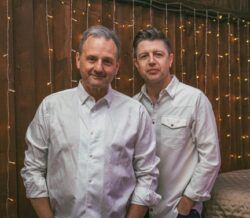
Would that be your ideal, to be able to do the music as your main thing?
Yeah, really. I mean, I love doing the radio. I’ve always loved doing the radio. And, you know, when I fill venues like York Opera House and things with Mark and Lard and the Lowry, that’s fantastic. But it’s talking about something that I did twenty-odd years ago. So I’d like to be able to fill those theatres, doing the stuff that I do now. Of course I would, but I mean, it doesn’t matter. I know it’s not going to happen. And we are happy doing what we’re doing. As long as someone comes and enjoys it, that’s great. You know, I tell you one thing that’s odd. I don’t know whether it’s odd or not. The place.. I’m not just saying this.. the place that me and Dave do better numbers, almost twice as much as anywhere else, is in Yorkshire! And he’s a Geordie and I’m a Lancastrian. How does that work?
Maybe people have not worked that out yet?
(Laughing) I don’t think I’ve kept my roots secret! So it’s.. we go to Otley Courthouse and we storm it. It’s great. So yeah, we do very well, thank you, Yorkshire.
You’re welcome. We’re just showing our magnanimity, obviously.
Well, yeah, clearly, yeah, yeah.
So you and Dave have got a new record on the go at the moment, then?
I just started. I had a bit of a spurt of writing. Dave holidays to Spain every year and he likes to write when he’s there. Because he’s you know, got time. And so I’ve sent him three things while he’s been there this last two weeks that I’ve been working on. So that’s a bit of a spurt! And we’ve got a couple of things that we’ve worked on before. So I think we’ve got, I think we’ve probably got seven or eight songs at the moment in various states of disrepair. I mean, we’ve no plans to record for another year, but, you know, we’re still working this record, which we’re very happy with. So there’s absolutely no rush. But Talking Elephant, the label, have said that they want to do another one with us, and they’ve been great, you know, and got loads of publicity and reviews, and it’s been great. It’s been great. So everybody seems happy with that relationship. So yeah, so it will go on, yeah.
What’s your kind of creative process when you’re writing you and Dave? How does that work?
We work entirely separately. I write the words and he writes the music. And so basically, I will I’ll get an idea and sometimes it comes very quickly, or sometimes I’ll make notes and scribble and cross things out and everything. And so I’ll work and work and work, and I’ll frustrate Dave because I’ll send him the words and then I’ll change them all again. So he gets annoyed with me. So, I will do the words and I’ll send them to Dave, and then he’ll live with them and he will put some music to them. And quite often I tend to write too much. He’s very good at editing words, and he’ll say, I didn’t think that verse is as good as the other. I’m like, yeah, you’re probably right, you know. So he edits the words, and then when he comes back, sometimes I’ll add a little bit, like quite often a little instrumental or a middle eight, I’ll sort of break up his verses and choruses. But basically, I’m the words and he’s the music. Right. And so the first time I’ll hear it, he’ll do a demo on his own of the song and send it back to me, with the chords and the music and then I’ll start trying to find my harmonies and bits over the top of it, and eventually we’ll sit down together and play it.
Do you ever get anything back where you think, wow, that’s not how I heard it…
…sometimes, sometimes… absolutely…
I thought that was a happy song, and it’s come back different?
That has happened, that has happened, yes. And I’m like, “Well, that’s interesting!”. And I also think that I make him work a bit quicker than he would in the studio and things. Again, we kind of have an effect on each other. We go in the studio, I just think, I get bored really quickly. I’m like, we’ll do the song once or twice. And I’m like, “That’s all right, innit?” They’re like, oh, yeah, you know, we could make it better by doing this, this, this and this. Occasionally, I go to the studio with the dog and go for a walk while him and Jake go down a rabbit hole doing something. Jake’s the producer and engineer we work with. And I come back and they’re right, you know, it is better. But I also keep my foot to the floor and say, “Well, come on, that’s fine. We don’t need to waste… not waste… but we don’t need to spend any more time on that little detail. Again, it’s a painterly thing, really. I think… if you’re thinking of a picture, when the figures are in the foreground, I think it’s finished, and Dave and Jacob are saying, yeah, what about the Turner-esque sky we could put behind this, and I’m like, yeah, okay, okay.
All right, I’ll listen for the Turner-esque sky next time I put the record on.
Yeah, yeah, yeah. But the detail.. you know ‘the devil’s in the detail’. Sometimes it is nice to have a bit of time to play around. You know, with this one, we got some friends to play a bit of fiddle and harmonica and piano and stuff, and that adds quite a lot. We’re not trying to make a band-sounding album. We’re trying to make it… ‘duo plus’ if you like.
Do the records come just song by song? Do you have a sort of vision, a kind of idea of what the record’s like or about, or do you just kind of put a bunch of songs together?
Really, yeah. You know Une is very much more sort of conceptual and thematic than the duo. In the duo, we have the freedom to do what we want. I think it hangs together because really, we’ve basically got four instruments. We’ve got two guitars and two voices, and that’s at the heart of everything. So I think that there’s a unified sound to it. There’s one track on the record called ‘Moon Fishermen’, which sounds a bit different, maybe. But other than that, you know, we kind of just put it together. We kind of think about it, and we think sometimes that maybe we need a couple more upbeat ones… you’re right, I suppose we do write kind of reflective and mellow things. So we haven’t got any disco bangers, really…
Thank goodness…
… sometimes we think we’d better do something a bit more upbeat, perhaps. And also, we occasionally think we don’t want everything to be a duet, so we think, “What would be good for me to sing?” Like the ‘On Euston Road’ one is very personal. So that seemed to be something that I could sing.
Yeah, I love that song. I love the idea that the traffic is one of the things that you really liked about being in London. I know exactly what you mean by that.
Yeah. Yeah, well, it was exciting, coz we didn’t have that, you know. And so that felt like one and ‘Down the Steps’, which we talked about, about Sam’s. I mean, actually, that again was very personal, but Dave sings that. So, we want to put some variety in it.
Obviously, you’re still a fan. You can tell that when you’re playing records on the Saturday morning, when there’s something that you’ve not heard before, or you’ve not heard for a while, and it really kind of impacts you like it does the rest of us. Does that impact on your creating of music? Do you think, oh, this could sound a bit like X, or do you try to put all that experience to one side?
Well, I’m at that age where a lot of things remind me of things because you’ve listened to fifty years of music and you’ve heard… not most things, but you’ve heard a lot of stuff, you know, and so people say, have you heard this new band? And I said, Oh, yeah, that’s interesting. It sounds a bit like Television, doesn’t it or something like that. But a lot of the people, the kids in that band are playing to their audience, you know, so they may not have heard of Television, and that’s fine. But I try not to get too hung up on that, really, I just try and sort of listen to new things with an open mind. It’s pretty simple, really. Do I like it? Is it good, is it bad, you know? I just pick things that I like, really. And I don’t think any of them would particularly influence what we are doing. What we’re doing is pretty traditional, our influences for the duo. Some of the more reflective things of Nick Drake and John Martyn, for sure, but actually just sort of classic duet singing like Simon & Garfunkel and the Everly Brothers. We’re not saying we’re as good as any of those people. Someone who Americana UK aficionados would know, like Gillian Welch and David Rawlings. We love them, really love them. And the Milk Carton Kids. We really love them. And so they were kind of prime influences. Milk Carton Kids, they’re astonishing live, you know, it’s incredible. And so we were very much kind of, “well, could we do something like that”? Again, we know we’ll never be as good. But I mean, they were a big influence. So it’s almost like those things that seem so simple… deceptively so. Because we all know that if you’ve only got two guitars and two voices, then they’ve all got to be pretty good because there’s nowhere to hide. And so I suppose in terms of influences, those people who took something simple and classic, but sort of put a contemporary stamp on it. I suppose that was sort of in our minds.
So, in terms of all the stuff that you do, how do you balance all that out? How do you decide what the priorities are?
Well, I don’t really (in a resigned tone of voice!). I kind of take on too much. I’m supposed to be semi-retired, really, and my wife’s always saying, you’ve got too much going on. It’s a lovely time of life, really, because I’m not building a career. I only do things I like doing. But there seem to be quite a lot of things I like doing this year! But with the book and the Mark and Lard thing all coming at the same time, it’s been a bit too hectic, really. So next year I’m planning to do less. I still love being on the radio. I love doing the folk show, and I still want to carry on. I have no plans to completely retire. I’m 67 now and, you know, I can’t see any reason (to retire). I still like doing it. People are still listening to it. BBC seem quite happy with me doing it. So I can’t see that I will be doing anything different. I think I like the duo because it’s kind of… age-appropriate, really. I’m not trying to front a rock band or anything, and looking a bit tragic, you know. I put a plain white shirt on. I have a nice acoustic guitar, and that feels lovely. And so we’ll carry on doing that. But I suppose next year it’s just really, I think I’ll prioritise the duo and keep doing the radio. We’ve got a few Mark and Lard things, but I’ve only counted about half a dozen scattered throughout the year. So I’m certainly not looking for more. That’s one of the reasons that I didn’t play drums with Fine Lines anymore, and one of the reasons that we sort of backed off from doing Une live, really. It’s just too much. So yeah, continuing to write these songs and perform these with David, and being on the radio, those are the priorities.
Because you were going to be doing Kendal Calling with Une…
Yeah, yeah, but I just got too busy and too tired. It’s not in Kendal. It’s way north of Kendal. It takes us a while to get there, and I had the weekend radio show, and we were only going to do half an hour, and I just said to Paul, “I can’t do that”. It was the same with Dave with Fine Lines, when they were doing the Ragged Bear Festival in Nuneaton, and they I’d done the Saturday morning show, and it meant coming off the radio, getting home, getting a drum kit, driving to Nuneaton, playing for 45 minutes, coming back and doing the show on Sunday. I said to Dave, “I’m really sorry, Dave. I can’t face it.” You know I have to look after myself a bit better than that these days. And so my wife will tell you differently, coz she says I’ve always got too much on. I get bought easily. I don’t like having nothing to do, but I have had a bit too much to do this year. So I’ll slow down a bit next year.
And on that appropriately wistful yet optimistic note, we call it a day and say our goodbyes, with Mark promising to email AUK with a list of some of his favourite americana songs.



Kendall?
Just listened to Mark’s UNE, hmm, Kraftwerk have nowt to worry about!
BUT! I do like his albums with David Boardman and I’ve bought them.