
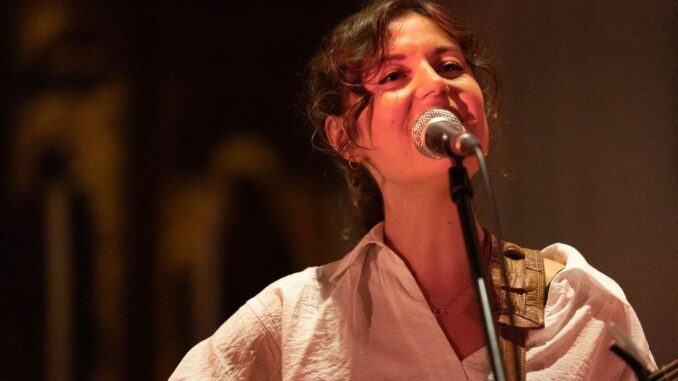
The shortening autumnal hours mean the dark night sky is showing through the church windows well before showtime at this Victorian church, just a block away from the London bases of some of the world’s biggest tech companies.
The most arresting songs of Tessa Rose Jackson’s repertoire showcase sinewy guitars and her finely honed voice, powerful yet sometimes hushed and understated, wandering off in unpredictable yet melodic and compelling directions. Her latest output, the reworked seven tracks of The Lighthouse, has been promoted as an EP but value-for-money purchasers of physical content should be pleased to know it clocks in at 33 minutes, so it is in bona fide full-album territory. And stopwatches aside, the quality is a fine thing, with all seven songs peppered across the set tonight. Anyone who rejoices in early Lanterns On The Lake music will find rich pleasure here.
Lighthouse is a glorious opener, arguably a folk song but just a superb piece of music beyond genre. It has an intriguing intro of disparate keyboards, percussion and strings teasing the listener to find a pattern before the guitar and vocal come in to draw it all together, with the titular lighthouse evoking the singer’s memories.
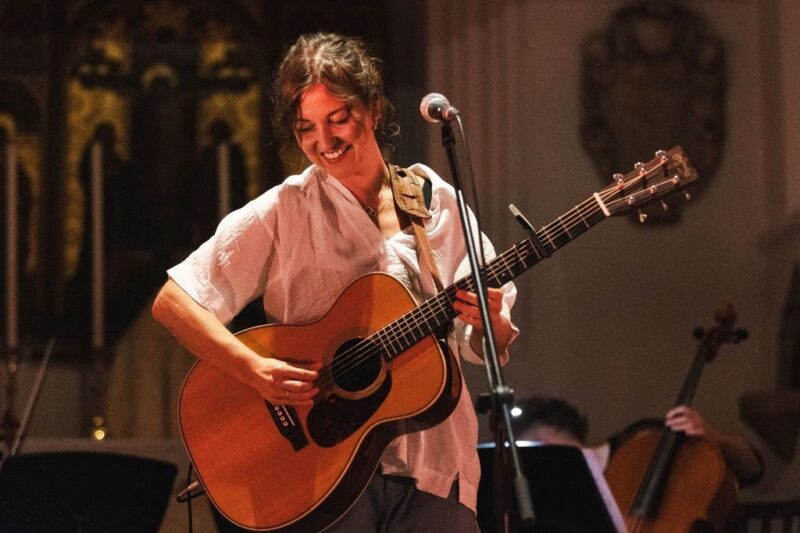
Her quintet (‘band’ seems too down-at-heel for their classical set-up and style) sits in a semi-circle behind her in centre stage. They are Darius Timmer – Wurlitzer, Vocals; Sam Rowe – cello; Phoebe Snelling – violin; Camille Buitenhuis – violin; and Rebecca Breen – viola.
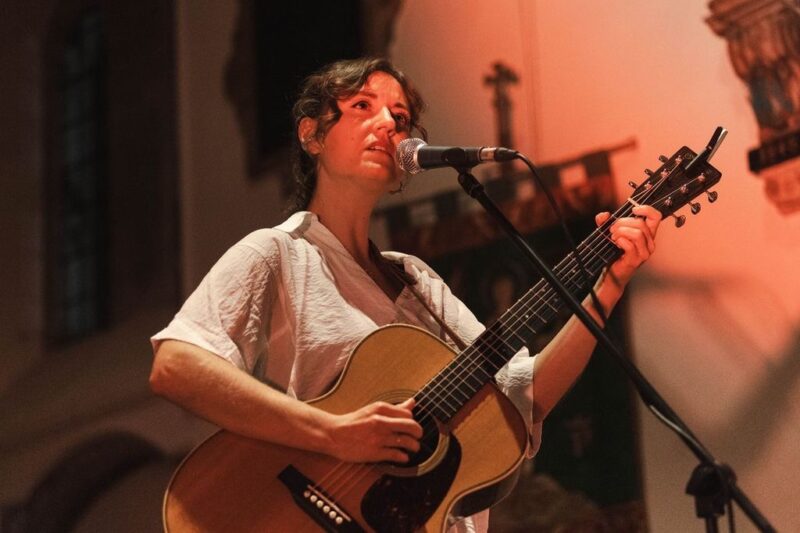
The Man Who Wasn’t There is one of several songs that give her rich acoustic guitar the chance to flourish either combined with or independent of the masterful layered instrumentation behind her, while The Bricks That Make The Building addresses ancestry in the wider sense beyond simply genealogy, embracing activists and cultural predecessors. It’s one of the sparser songs, just acoustic guitar plus Wurlitzer.
Anti-hero has the narrator struggling with the protocols of modern dating, with the church’s 9 o’clock bell chiming providing an impromptu addition to the 1st verse, which is followed by When Your Time Comes, that describes mortality and is embellished with “body percussion” – knees slapping and feet tapping to a staccato rhythm and swooping vocals out of the Jesca Hoop playbook. Gently Now is introduced as her “haunting song” and is a poignant imagining of meeting up again with the spirit of her mother, who passed away whilst Jackson was very young, with “so much more to say… what would you say to her/let it linger….”
Strange World is a COVID-era song and draws us in with her snippets of half-sung, half-spoken lyrics, with the band at full throttle, before By Morning narrates an inter-spouse argument where the singer realises that they are presenting a losing case. Such a scenario was the trigger for the song’s creation, and the upbeat tone reflects how this process provided the conflict resolution in real time. Wild Geese is a longer and lyrically full song, and is one of the set’s highlights. It relates to her missed mother, who, as a Minnesota native, she imagines as a bird flying over Lake Superior with the freedom that the confines of life constrained. It serves as a crescendo as the new album’s closing piece.
She explains her non-negotiable no-encore policy, which she describes as “peek-a-boo for adults”. And she insists “no haggling” on this approach. The penultimate song Built To Collide is a brief, punchier song that flowed from the difficult process of writing the last album, before she closed with Prize Fighter about getting rid of “the bully inside your head”, a quirky theme to end on and in line with Jackson’s approach to doing things on her terms.
Support is a real bonus in the form of Chloe Foy, hailing from Western England, a regular on this genre’s musical circuit and now touring on the back of her second album Complete Fool. It’s been given a super review on this website, and the songs she offers up tonight are broadly in that indie/folk/pop blend that doesn’t necessarily preclude its relevance to AUK. Accompanied by violinist Charlie Sharp, who also provides backing vocals, the songs are tinged with Foy’s melancholic singing tone, and “hitting you with heartbreak “, as she declares, which is a fair summary. The set includes several not-yet-released songs. I Tried So Hard To Disappear is a pacier new one, and compelling it is too. Sonically and vocally, it could be a first cousin of Alela Diane. The songs mainly home in on the fraught moments of relationships and are often set in specific domestic places: doorways, kitchens, and tables. Her seven-song set is much appreciated by the full house of close to 200.

