
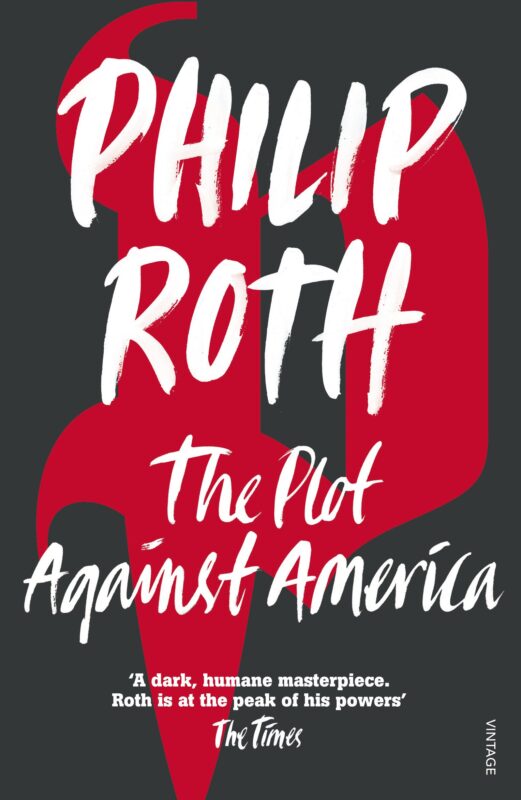
 Where America Might Go Next Part 3. Paperback Riders has definitely disappeared down a rabbit hole of speculative fiction this year. Philip Roth’s 2004 novel ‘The Plot Against America’ is particularly unsettling not because it ventures into fantastical realms, but precisely because it feels so unnervingly plausible. Roth constructs an alternate history where Charles Lindbergh defeats Franklin Roosevelt in the 1940 presidential election, leading America down a path of isolationism and creeping antisemitism that threatens to tear apart Jewish-American life.
The novel is grounded in what is otherwise a sweeping historical speculation in the experiences of one family. The slow, insidious creep of fascism and anti-Semitism is observed through the eyes of a young Jewish boy named Philip Roth and his family in Newark, New Jersey.
Roth’s prose, always precise and evocative, traces the tensions within the Roth household as political pressures begin to break up the family. Herman Roth emerges as a particularly interesting figure, a man whose fundamental faith in American democracy slowly erodes as he watches the systematic erosion of Jewish security. The author’s portrayal of his father’s struggle between patriotism and self-preservation resonates with profound emotional authenticity.
The novel’s historical framework is highly convincing. Roth draws upon actual antisemitic sentiments that existed in 1940s America, reflecting them through Lindbergh’s celebrity and isolationist politics. The period’s social dynamics are captured perfectly, and Roth creates a believable alternate timeline where existing prejudices gain institutional support. Rabbi Lionel Bengelsdorf’s collaboration with the Lindbergh administration particularly illustrates how quickly moral compromises can normalise authoritarian politics and looks very similar to the Catholic church’s concessions to Mussolini in Italy at the same time.
Roth doesn’t present clear-cut heroes or villains. Even sympathetic characters make questionable choices under pressure, whilst the more obvious antagonists retain clearly human motivations. This moral complexity shifts his narrative beyond being a simple cautionary tale into a very sophisticated psychological study of people’s reactions to a regime that is clearly not working in their best interest.
Roth’s exploration of how democratic institutions can be undermined from within, how propaganda can reshape public perception, and how quickly minority communities can find themselves marginalised speaks directly to some contemporary political anxieties, in the US and elsewhere. The author demonstrates how fascism need not arrive through dramatic coups but can instead emerge through seemingly legitimate electoral processes. Using his childhood self as the key narrator sets it apart from other similar stories by focusing on “ordinary” people’s concerns and reactions rather than just observing life in the seat of power. Young Roth’s confusion mirrors the reader’s own disorientation as familiar American symbols and traditions become twisted into instruments of exclusion.
The book suffers a bit from Roth’s tendency towards writing in exhaustive detail, particularly in the sections where the politics sometimes overwhelms the narrative. However, these slower passages do establish the suffocating atmosphere of a society slowly abandoning its principles.
‘The Plot Against America’ works as both historical speculation and family drama. Reading it in 2025, you can see how Roth has built a world which feels both specific to its 1940s setting and scarily contemporary, demonstrating how quickly democratic societies can slide towards authoritarianism when citizens abandon vigilance. Democracy really is that fragile, it seems.
The HBO miniseries of 2020 did some tinkering with the plot and names (the Roths become the Levins). The New York Times said that the show was “more than a thought exercise in ‘Here’s what might have happened then and thank God it didn’t.’ Instead, it’s: ‘Here’s what could happen at any time. Here’s what does happen all the time. Why should we think we’re so special?’” I wonder what they think in 2025. Interestingly, it’s not currently available to watch in the USA. In the UK, it’s on Prime TV.



A totally different book but with a similar topic is It Can’t Happen Here by Sinclair Lewis, published in 1935. Lewis was awake to the potential for the emerging fascism in Europe to infect America.
Coincidentally I’ve just reread this and it’s startlingly prescient. Take out the modern social media influence and it’s like a playbook for the current malign USA freakshow.
It absolutely is David.
Thanks Paul I’ll search that out…