
For 2023’s festive ‘Paperback Riders‘, we looked at ‘A Christmas Carol‘ and why it is the best-loved seasonal book in the USA, despite being so quintessentially English. Maybe it’s Charles Dickens’s ghosts and redemption themes, or perhaps it’s the kind of treacly, homespun sentimentality that clogs the Hallmark Channel come December, which scores so highly. There are, however, some American writers who have used the forced cheer of Christmas to highlight the awkward truth that the “festive season” is often about isolation, commercialisation and many other problems which are as much a part of Christmas as Yo-ho-ho. Unsurprisingly, many of those writers are from the Deep South.
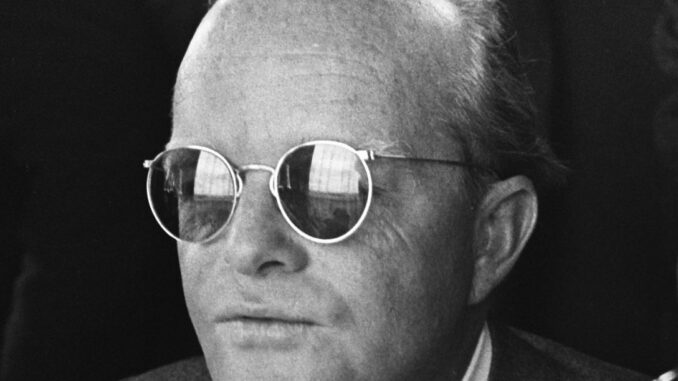
Truman Capote’s ‘A Christmas Memory’ is the angel at the top of this Southern Christmas tree. Published in 1956, it shows the preparations of a young boy and his much older, but still childlike, cousin in rural Alabama as they make fruitcakes for a scattered list of acquaintances. The reason it still resonates lies in its refusal to sugarcoat the central poverty and marginalisation. The pair are eccentrics living on the margins of their family, their only true solace found in one another and their yearly ritual. When the story inevitably closes on themes of separation and death, Christmas serves as a marker of time’s cruelty rather than being a source of joy. Capote shows that for many people, the holidays don’t cure loneliness; they amplify it.
Eudora Welty is a writer who is less widely celebrated than Capote, especially outside the USA. We must cover her novel ‘The Optimist’s Daughter’ soon. Welty was always best at picking apart how Mississippi communities formed “subtle, yet rigid, hierarchies of belonging.” Her holiday tales often focus on the figures left outside those circles. Her real skill lay in capturing the Southern vernacular and the minutiae of small-town existence, where a Christmas gathering could be both a chance for connection and a time for harsh exclusion. Her characters struggle with the gap between the season’s promised joy and the bleak reality of their circumstances. We are discovering that is one of the central themes of the Southern Christmas story.
While not best known for Christmas stories, William Faulkner wove the holiday into his stories of decay and generational breakdown within his fictional Yoknapatawpha County in Mississippi. For Faulkner, Christmas frequently appears as just another occasion for his characters’ moral and emotional failings to rise to the surface. The holiday simply serves as a backdrop for confrontations, disappointments, and the unforgiving, grinding passage of time. His approach is relentlessly unsentimental, stripping away the seasonal glitz to expose Christmas as just another moment when human nature can be shown wanting.
What connects these authors, writing in the post-Second World War boom, when commercialism reshaped the American Christmas, is their stubborn resistance to the era’s mass-market cheerfulness. They insisted on depicting Christmas as it was lived by those who fell outside the aspirational middle-class ideal: the poor, the isolated, the eccentric, and the forgotten. Their stories reflect the fact that not everyone has a lavish family gathering to attend, presents to exchange, or any reason at all for celebration.
The Southern Gothic tradition, with its focus on the grotesque, social decay, and outcasts, is ideally suited to prodding the Christmas mythology. These writers showed that the season’s emphasis on family and material abundance could be deeply wounding to those who possessed neither. Their stories are characterised by makeshift families, modest or absent gifts, and celebrations defined more by what is missing than what is present.
By refusing to look away from poverty, ageing, isolation, and loss at the year’s most commercialised time, Capote, Welty, Faulkner, and others built a counter-tradition in American literature. Their stories endure because they tell truths that the sentimental fluff avoids, reminding readers that Christmas, like life itself, contains multitudes.
If there’s a musical equivalent to these stories of the other Christmas, then it must be from Tom Waits…


