
In his second solo album, and his first on John Prine’s Oh Boy Records, Downing draws natural parallels to Prine, echoing the late legend’s relatable storytelling and humble working-class roots.
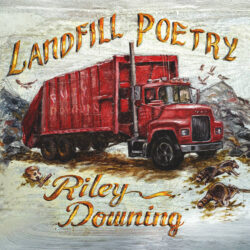 Landfill Poetry definitely strikes a chord with the common man. A relatable set of songs about blue-collar work; memories of grandparents and singing on the front porch. It is the second solo album from the former Deslondes guitarist and vocalist Riley Downing, who, in moving forward, begins to look into and draw on songs from the past. Downing hails from Missouri, but after an early career move to New Orleans, his music is very much rooted in the South, in the traditions of folk music and storytelling. That’s what Riley Downing does on this album: he tells stories. He transports you into the setting at the heart of the song, whether that’s on the back of a garbage truck or in his grandparents’ home, and brings you along. Released on John Prine’s Oh Boy Records, this album echoes some of the elements that made Prine who he was, hitting the same sweet spot between a deep exposure of personal subject matter and an ever-present, playful, tongue-in-cheek approach. Life is serious, but never to be taken too seriously. In outer-Chicago, Prine posted the mail, and Downing collected the garbage.
The album opens with the title track Landfill Poetry, which begins with a beautiful groove; a driving beat; combining drums and a shaker. A few bars and it’s all in with guitar, bass and harmonica, head bopping. In the artwork and music video, Downing is in his work attire. He works as a trashman while telling us, “Really what it is is I’m a guitar picker”. This sets the tone for the whole album. Songs about working hard and playing hard. His deep and weathered voice is a selling point of his and is often cited. If this is your first time hearing him, you will understand why. We hear him repeat the phrase “this business stinks, but it’s picking up“; in one verse referring to being a refuse collector, and the other referring to the fact that he hears “a lot of trash on the radio” while touring as a musician. Whichever lifestyle he’s living, it’s not all roses.
The album ticks along with momentum and thudding drums until we get to the middle of the album, where we get a shift in momentum and a definite standout track: Helen and Gene. A slow and very sentimental track, dedicated to the memory of his grandparents. He picks out elements of love that feel now lost or very rare in our current world. He, the strong silent type, and her “red in the face” with embarrassment at crashing the car or being asked to dance. He delivers the memories as visions, which seems very apt knowing that he wrote a lot of these songs in their now empty home. The listener can picture Downing looking around the house and remembering things happening as apparitions in the actual place that they happened. We hear a distant lap steel that seems to mirror the theme of the song; it is placed distant in the mix, as a haunting echo of the past.
The penultimate song on this album is Porch Song, and although that particular song has a lazy Sunday reclining with a bajo vibe, the whole album gives off a jamming-on-the-porch kind of feel. A lot of stomping, kicking around, and smiling with friends. Banging boots on floorboards with harmonicas and Violins intentionally recorded with a live feel to them. It sounds very purposefully both amateur and professional, relaxed but with a professionalism that tells you it’s a decision to be given a rougher, unpolished effect, while at the same time you know it is the work of someone who has mastered his craft.
The lyrics on this album feel like they come from a man who is rediscovering his past, and what his life was like before music. Picking at half-finished songs and memories. He has gone back to something long left behind. He sounds comfortable being back home. He is coming back to earth after a large amount of time away with The Deslondes; contributing to that project; and touring. On this album, Downing lets you sit beside him in a simpler time and recall what is really important, as he tells you what it is about life that he loves and values.


