
Every writer faced with distilling the entire history of music into the Top 10 Americana Songs of All Time is faced with a need to place some boundaries around the task in order to get some sense of perspective on the subject. Leaving aside the “what is americana?” mug’s game, I was thinking about what a greatest of all time meant – is it the intrinsic value of a single piece performance, or is it a song that transcends the performance and somehow epitomises a facet of americana in a way which connects across performers and audiences. In the spirit of seeing both sides of the argument, I’ve decided to split it in two. In the rarefied atmosphere of a top 10 of all time, ranking is an even more futile exercise than normal, so I’ve ranked them in alphabetical order of the song title.
Number 10. Patty Hurst Shifter ‘Acetylene’ from “Too Crowded On The Losing End” (2006)
A long time ago in an americana music community far, far away, I put forward this song as the ultimate alt-country song. Patty Hurst Shifter, a five-piece band from North Carolina’s legendary Triangle, released a couple of albums, one of which, “Too Crowded On The Losing End” (2006), contained the mighty 9-minute 56-second ‘Acetylene’ which, as the title implies, burns brightly while exhibiting a shimmering cool.
The song opens with a crisp beat, then an acoustic guitar figure, then a pedal steel as the vocal slides in; the electric guitar and bass join. As the song progresses in waves between verse and chorus, the bass drops in with a distinctive line. The instrumental break sears in a lo-fi way, snaking around the room. It’s a song that should be heard through speakers in a room – preferably a big one – at a good volume.
‘Acetylene’ is an epic song which could easily extend well over the 10-minute mark without ever losing the listener’s attention.
Number 9. John Prine ‘Angel From Montgomery’ from “John Prine” (1971)
Pretty much everyone with even a passing interest in americana music is familiar with this song. Written by the late great John Prine and one of several classics on his 1971 self-titled debut, it was made famous by legend Bonnie Raitt, who covered it on “Streetlights” (1974) and has played it at pretty much every show since. Prine’s classic takes as its narrator an older woman looking back on her life and contrasting it with the present, imagining a way to escape from humdrum reality. Beautifully observed and set to a simple but beautiful melody, it’s easy to see why ‘Angel From Montgomery’ has resonated with so many.
SecondHandSongs lists almost 100 versions, many of which have arisen over the last 25 years. The song turns up regularly as a favoured cover in artists’ sets and is often played as an encore.
Number 8. The Rolling Stones ‘Dead Flowers’ from “Sticky Fingers” (1971)
The Jagger/Richards country rocker, which first appeared on “Sticky Fingers” (1971), is an example of American music being loved by musicians in Britain and then reflected back to its origins.
Musically, ‘Dead Flowers’ is a straight-ahead country rock song, but lyrically it leans into the darker side of country through the Stones’ urban lens. As often when the Stones approach country, there is an element of humour, including a nod to a contemporary Interflora ad in the final chorus.
The song’s versatility is clearly demonstrated by contrasting Townes van Zandt’s slower, folkier take and GG Allin’s slow grunge punk cover. The New Riders of the Purple Sage, with some special pedal steel from Buddy Cage, set the country rock bar high in 1974, while more recently, Maren Morris’ straighter country take is well worth a listen.
SecondHandSongs estimates just under 70 versions of ‘Dead Flowers’ have been recorded, although the likelihood is many more. ‘Dead Flowers‘ is another song which turns up a lot in encores from a wide range of acts.
You can see a performance from Jim Lauderdale and the Comatose Brothers below, which moves the song into string band territory.
Number 7. Gretchen Peters ‘Five Minutes’ from “Hello Cruel World” (2012)
Gretchen Peters’ ‘Five Minutes’ is an astounding piece of songwriting. It lasts the five minutes of the title, the same length of time as Peters’ character’s break from her job as a waitress, as well as the interval from ignition to extinction of the character’s cigarette.
Peters’ story, though, is that of a single mother thinking of her own life, bringing up her 17-year-old daughter while working a tough job providing survival wages, which leaves her exhausted at the end of the shift. She also finds herself thinking of her past lover – likely the one true love of her life – and the father of her daughter, and seeing the parallels of the daughter’s rebelliousness with her own. There is also tenderness, both in terms of the daughter slipping a blanket over her sleeping parent and the café owner offering to take care of the waitress (not in a creepy way). Peters’ waitress’s heart, though, belongs to her lost love.
The verse narratives swirl in their own tight twists like the plumes of smoke from the cigarette, returning to the progress of the smoke break. As well as being a superb example of the songwriter’s craft, ‘Five Minutes’ is incredibly poignant, leaving the listener with sympathetic but nuanced pictures of the various protagonists.
It’s the centrepiece of Peters’ 2012 “Hello Cruel World” album with accompaniment from Barry Walsh on keys, Viktor Krauss on bass and Will Kimbrough on guitar, amongst others. This and subsequent live versions are highlights of any set; that first hearing, though, will forever remain unique.
Number 6. Gillian Welch ‘I Dream A Highway’ from“Time (The Revelator)” (2001)
It is a truism that all songs are better listened to than written about, and in many ways, the closing track from Gillian Welch’s “Time (The Revelator)” demonstrates that perfectly. In terms of its length – which is 20 seconds short of 15 minutes – it is closer to the jamband universe than what is normally understood by americana. However, it’s a song with little by way of instrumental breaks.
Opening with the chorus, followed by three four-line verses in the first section. Meanwhile, the second section has two four-line verses followed by a five-line one – we get two sets of these. The third section has two verses before the song closes with two choruses. Each verse finishes with the first line of the chorus, which creates a picture of continuity throughout the song. This is mirrored in the chorus with the two lines, “A winding ribbon with a band of gold / A silver vision convalesced my soul”.
Welch has described ‘I Deam A Highway’ as a song that encompasses all the themes of the album but ultimately acts as a coda to it (ie the album stands on its own without it). Musically, the song is quite sparse; all we hear are Welch’s and Rawlings’ guitars. Vocally, Welch takes the lead with Rawlings adding a second, almost inaudibly at times. The whole performance is a tour de force.
Unsurprisingly, there have been almost no covers. An exception is Bria, who tackled the song on her “Cuntry Covers Vol 2” (2023). Performed in a goth country style, Bria selects a number of verses not always in the same order as the original. This reworking only goes to underline the strength of ‘I Dream A Highway’ as a song.
Number 5. Jolie Holland ‘Mexican Blue’ from “Springtime Can Kill You” (2006)
The final track on Jolie Holland’s third album, “Springtime Can Kill You”, and a big live favourite, ‘Mexican Blue’, is six and a half minutes of sublime playing and a truly great vocal performance. The song is dedicated to sometimes bandmate Samantha Parton. It begins and ends softly with the same verse celebrating natural beauty and resilience akin to the eponymous tree. But over the intervening minutes, it becomes increasingly stronger and eventually tempestuous, building both instrumentally and vocally. Lyrically, it’s an outstanding piece of writing: “There’s a mockingbird behind my house / Who is a magician of the highest degree / And I swear I heard him rip the world apart / And sew it back again with his fiery melody, melody”
And: “When the moon is as clear as an opal / And the amethyst river sings a song / I’ll remember all your dreams and the mysteries / You have borne in your crystalline soul”
It’s a celebration and a love letter, personal and universal and suffused throughout with a blend of melody, dynamics, and musicianship that is truly exceptional. And the voice: warm, natural, enveloping; mixing birdsong with honey. Mexican Blue’ is a song which, when it’s over, requires a quiet moment of reflection before either rapturous applause or playing it again.
Number 4. Mark Olson & The Creekdippers ‘Nerstrand Woods’ from “December’s Child” (2002)
In 2002, Mark Olson released “December’s Child”, credited to Mark Olson & The Creekdippers. Olson had formed The Original Harmony Ridge Creekdippers with his then-partner, Victoria Williams, after leaving The Jayhawks. He put out two ‘solo’ albums credited to him and the Creekdippers, of which “December’s Child” is the second.
‘Nerstrand Woods’ is the sixth track on the album and would likely have been a Side 1 closer on vinyl. It has a mesmerising percussion track and some intimate instrumentation, which has an almost hypnotic effect on the listener.
The song starts with a two-line verse before a pre-chorus (or verse part two) where Williams adds a gorgeous vocal part, before we head into the third section, where Olson adds a sense of longing, before returning to the Nerstrand Woods.
The combination of the music, lyrics and performance create a series of pictures in the listener’s mind.
Number 3. Chuck Berry ‘Promised Land’ from “St Louis To Liverpool” (1964)
Adapted by Chuck Berry from the old-time classic ‘Wabash Cannonball’, ‘Promised Land’ is a coast-to-coast journey across the US, which also touches on values of family and friendship. The road is, of course, a major theme in the imagery of americana. This one, though, combines bus, train and aeroplane as the story alternately has its disasters, barriers and high spots.
Berry’s trip is also rooted into the American move the west in search of a better life. When he reaches his destination, he phones home from the Golden State to his home on the East coast, telling them “this is the promised land calling and the poor boy’s on the line”.
‘Promised Land’ has been covered by performers across the musical spectrum. It was a highlight of Elvis Presley’s sets. SecondHandSongs tallies just under a hundred versions. AUK’s Clint West wrote a Classic Clips feature on Johnnie Allen’s Louisiana take on the song. There are recorded versions from The Band, The Grateful Dead and Dave Edmunds, amongst many others, which each bring out their own slant on the song. A brief search on YouTube reveals plenty of live performances as well.
The version below is from the Grateful Dead’s legendary Springfield Creamery Benefit show in Veneta, Oregon, in August 1972.
Number 2. Little Feat ‘Willin’ from “Little Feat” (1971)
The road and freight have always been central to americana, and the trucker has tended to be seen as something of an iconic figure. Lowell George penned ‘Willin’, which is a short but perfectly formed song comprising snapshots of life on the highways at the wheel of a truck. Oddly enough, the first recorded version of ‘Willin’ is by Johnny Darrell, but this was quickly followed by the one on Little Feat’s debut album. The performance emphasises the simplicity of the song with just George on acoustic guitar and Ry Cooder on slide. By the time we get to Little Feat’s second album, “Sailin’ Shoes”, the song has a full band arrangement with Bill Payne’s piano prominent, along with guest Sneaky Pete Kleinow’s pedal steel.
AUK’s Rick Bayles penned a ‘Versions’ on the song, which you can find here. ‘Willin’ has been covered many times, notably by Linda Ronstadt on “Heart Like A Wheel” (1974), Gene Parsons on “Kindling” (1973) and The Byrds (the expanded “Untitled”). In 1970, Seatrain performed a rocked-up version on their self-titled record, which changes the whole feel of the song. And of course, it is played by Little Feat at pretty much every show.
In its economy and its construction ‘Willin’ stands with the very best country songs and in its totality captures the very essence of americana.
Number 1. The Band ‘The Weight’ from “Music From Big Pink” (1968)
‘The Weight’ is something of a cornerstone within americana music with its ability to cross genres and generate excellent versions from many performers. It’s also a perfect ensemble piece, allowing for multiple vocalists with everyone coming together on the chorus (as well as in many cases the final verse), and this is one reason why it’s a favoured encore for many performers. Originally recorded on The Band’s debut “Music From Big Pink” (1968), it soon led to the first of almost 150 cover versions, including the stunning performance from Aretha Franklin at Muscle Shoals with Duane Allman.
The Staples Singers recorded their own version on their album “Soul Folk In Action” (1968) and reprised it with The Band on a studio set released as part of “The Last Waltz” (1978). The song also formed part of the repertoire of the Joe Cocker/Leon Russell-led Mad Dogs & Englishmen tour in the 1970s, although we had to wait until the deluxe version of the tour album released in 2005 to hear it on record.
‘The Weight’ takes the listener by a whole list of characters described in Robbie Robertson’s lyrics. They can be read as a series of independent stories or a carnivalesque cast. Either way, the imagery is compelling,
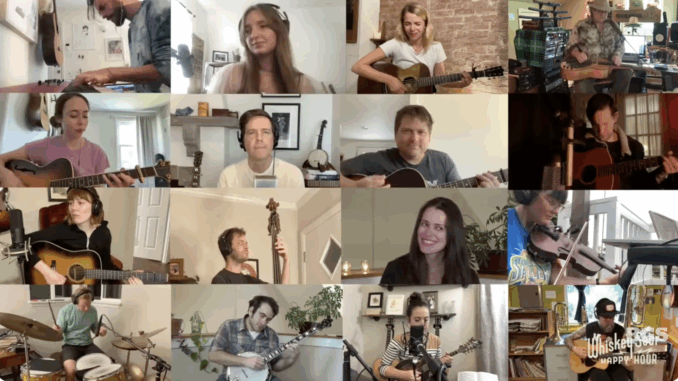
The song is also spiritually uplifting, one reason why it’s so popular as an encore. In the early days of the Covid pandemic, when live music had shut down and many people were locked down at home, the Bluegrass Situation launched their Whisky Sour Happy Hour series of streamed shows which conclude with what they called the “Superjam”, a star-studded performance of ‘The Weight’ streamed from acts’ homes and put together into a life affirming whole.



Thanks for Jolie Holland though I’d have gone for Damn Shame. I’ve always thought the Tanyas were underrated and it’s been good to see some of them enjoying the acclaim they deserve
Understood – when I did my ten best Jolie songs I said in the preamble it could just have easily been another ten – apart from Mexican blue..
Brilliant selection, especially the lesser known songs and classics performed artists unknown to me
Thanks 🙂
Nice list Richard – very impressive. Good to see Gretchen Peters in there – most under-rated talent. Thanks, Patrick
She really doesn’t get the credit she’s due IMO. Never sure whether it’s a cross genre thing.