
Slow-burning and beautifully crafted, The Whispering Tree’s new album is a journey through memory and renewal, full of luminous songwriting and elegant, emotionally resonant arrangements.
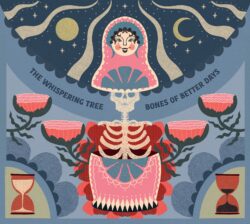 Duo El Kleiner and Elie Brangbour – known as The Whispering Tree – bring some brilliant musicianship and fabulous songwriting to a record that explores ideas of nostalgia, connection, politics and identity. The album draws the listener in immediately. The opening lines of the eponymous first song – “Oh, the past is a spectre/A hungry ghost, a debt collector/You’ve paid your dues but you can’t escape/Not from the bones of better days” – are dark, prophetic, and disturbing. There is clear warning here about the dangers of the past. A strong bass line and shimmering guitars drive the song forward. The pace never feels rushed, but the arrangement adds to its menacing atmosphere. Kleiner’s vocals are also pitch-perfect: such a wonderful voice, which manages to have real clarity as well as being emotionally expressive. Brangbour’s voice is softer but provides some excellent counterpoint and backing. The song goes on to warn of the dangers of nostalgia – “You’ve got a feeling/Your best times have passed/You’ve eaten all the meat” – and ends with the unsettling conclusion that the future will also be a place of nostalgia. But again, when we look back, we’ll only be left with the bones: the flesh will have been devoured by greed – “This whole world has been bought and sold” – and environmental disaster – “The weather’s getting warmer”.
A sense of nostalgia also permeates the second track, ‘Atlantic City’, but this time in a far more personal way. This is a song which looks back at an old relationship and has the plaintive cry, “Would you still meet in Atlantic City?” – an ache that has no reply. The protagonist is prompted in thinking about the past after seeing a photo of an ex-lover in which “You still stand the same way/Hold your hands the same way” – a powerful and jolting reminder of what has been lost. This is a lower-tempo song, which has some beautiful instrumentation, including a magical, evocative, Gilmour-esque guitar solo. The past also casts a shadow on ‘By My Side’ – a reflection on a friendship that was once so strong but has somehow drifted apart. “There was an old song we sang…we didn’t know the words/Only the beginning and the end/But it felt right” captures the innocence and joy of youth. This is a simple, slow song with delicate piano and guitar accompanying the vocals, and it does end with some hope. “Maybe moments are not/Beads on a string/And everything that’s happening is still happening” is the conclusion: a hope that even time cannot sever a connection, as it remains part of us.
There is a political voice in “Bones of Better Days” too. ‘Find a Man’, an upbeat bluesy number with some exquisite double bass, feels like a Sixties Feminist critique of Marxism. The listener is encouraged to “Find a man who clears the table/Find a man who sweeps the floor” while recognising that she may “be earning less and working more”. The song doesn’t make it clear as to whether there is irony here: the requirements of a man are unbelievably modest – why not find a man who cooks the meal? – but it does provide a springboard for thinking about how far the world has or hasn’t come. ‘Bleeding Out in Hollywood’ follows and is a cynical take on the American dream. It is the tale of someone who has “talent/Intelligence and merit” who was “sold a dream” that “If you work real hard, you can be anything”, but ends up failing. Musically, the song is up-tempo and even has a rousing sing-along ending – “We are all bleeding out in Hollywood”.
The album finishes with three songs that pose, and sometimes even answer, existential questions about what it means to be living. ‘Nesting Dolls’ – and the title itself is a wonderful metaphor – explores the idea of identity. Is the singer like “a funhouse mirror/The same thing going on forever”, and maybe can never be found hidden in layer after layer of dolls? Or if the inner doll is found, might it be just a “tiny, hard nub”? Musically, the song flows with delicate piano and some fabulous strings, which swirl and unite with the song; some pizzicato even gives a nod to the East. In an album of wonderful musicianship, this number still stands out. And behind the worries of disappearing, there is hope: maybe the singer is getting larger, “taking up space/with a lacquered smile on my face”, ready to take on the world as there is an “army” of dolls inside them.
‘Letting Myself Go’ is another piano-based ballad that builds and builds, again with some great strings and guitar work. It is a song about acceptance and being able to be content with who you are – “Letting myself go/Like a flag unfurled/A fist uncurled” – and as a listener, it might prove a cathartic contemplation. The album ends with ‘Born Again’, which leans heavily into country and is an upbeat way to finish. The song explores how to find a way to be positive despite existential dread: “I don’t wanna be born again”, as the knowledge of death is enough to do something good now. And the conclusion has both clarity and profundity – “No gods, no masters/No life ever after/Only here and now/And the life we are living somehow”.
“Bones of Better Days” is an album of rare intimacy, and whilst songs shimmer with sadness, ultimately hope remains. It showcases the band’s evolution and each track carries the weight of lived experience, yet there is a pulse of renewal beneath the surface. Each note seems carefully selected, and every echo and harmony appears to be searching for new light. It’s an album to sit with, to return to, and to let work its quiet magic – and maybe discover some light.

