
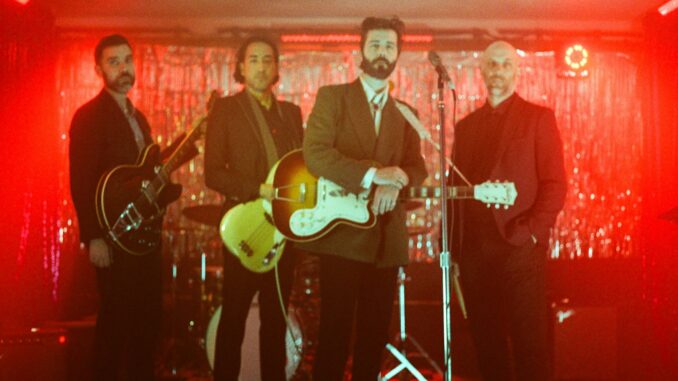
Americana UK recently sat down with Ben Schneider, the creative force and lead singer of Lord Huron, before their headline show at London’s Hammersmith Apollo. Known for weaving cinematic landscapes into his music, Schneider’s work on “The Cosmic Selector Vol. 1” is both introspective and expansive, balancing intimate reflections with the vastness of the universe.
In this in-depth conversation, Schneider opens up about the philosophical threads that run through the album, from contemplating fate and predetermination to exploring the tension between existential dread and moments of unexpected beauty. He discusses the genesis of the mystical jukebox that frames the album’s concept, the meticulous process of translating visual ideas into sound and the emotional resonance that comes from working with long-time collaborators and new voices, including Kristen Stewart.
Schneider reflects on the passage of time, the choices that shape our lives, and the cosmic cost of trying to control our own destiny, framing these ideas through stories, songs and the immersive worlds he constructs in his music. He also touches on loneliness, the profound connection between music and catharsis, and the joy of seeing how fans engage with the stories told in his songs.
Throughout the interview, Schneider offers a rare glimpse into his creative mind, blending philosophy, storytelling and performance. Whether discussing the open-ended mysteries of ‘Is There Anybody Out There?’ or celebrating the strangeness and beauty of life in ‘Life is Strange’, he invites listeners to ponder the vastness of their own existence, all the while grounding the experience in deeply human emotion.
The result is a conversation as thoughtful, reflective and cosmic as the music itself – a journey through sound, story and the uncharted territories of the human heart.
Americana UK: It’s lovely to meet you here at the Hammersmith Apollo. This is such an incredibly iconic performance space, so I wonder what it feels like to be performing here tonight?
Ben Schneider: Thanks for coming by. I mean it’s already sort of novel and feels impressive to us, just the fact that we can even come over here and play a show anywhere in London – in a foreign country it’s always a striking thing still to this day. To be able to go somewhere so far from home and have people show up and know the lyrics and all that. And we kind of started at the Old Blue Last or wherever we did our first show here in London, some tiny, tiny clubs. Every time we’ve come, it’s been a step up and this is a place that you’ve heard so much about – the Apollo. Yeah, it’s pretty good.
AUK: It feels like it is almost reflective of your own development. If we think about your recent album, it’s a major evolution in your work. It’s both intimate and vast. There’s a lot of quiet reflection in it, but it’s set against this kind of cosmic backdrop. I’m wondering what sparked the record and where were you emotionally and creatively when you were writing it?
BS: Because I’m getting older, I’m sort of reaching a, not necessarily a crossroads, but a moment of reflection in my life where I just had my head down doing this band for fifteen years kind of nonstop. And I recently had some time off the road to reflect on everything that’s transpired over the past fifteen years for the first time. I’m getting to that age where I’m starting to think about my life and realising, I don’t have unlimited time. I think when I was younger, I had this sense that I’d have time to do everything that was on my list of things to do. Of course, I’ll live on a farm in France or whatever. Of course, I’ll have time to direct a movie or whatever. And as you get older, you just realise that there’s certain doors that close over the course of a life that can never be opened again. And that’s kind of what the record’s about – choosing your path, your fate, and how it’s never quite what you imagined. And if you could change it, would you? And what would be the cost of being able to control your own fate? I don’t think it would come without some cosmic cost. And it’s kind of like a “Twilight Zone” episode or something. That’s the way I thought about this record, the jukebox where you can choose your fate.
AUK: That’s interesting. Because you mentioned the “Twilight Zone”. Is it a deliberate link to that type of world?
BS: Yeah, I’m really into that sort of vintage sci-fi and fantasy stuff – old pulp magazines and novels. I think they were thinking about some really interesting stuff and you’re seeing it really come to pass nowadays. A lot of that stuff was predicted in those old novels.
AUK: One of the songs, ‘Is There Anybody Out There’, almost has the theme tune as a musical motif. Was that deliberate?
BS: Yeah, it is. Using the Theremin, and instruments like that, kind of helps to evoke that feeling. But I love that feeling of sort of wonder and mystery that those shows had and those books had. It’s kind of an awe, standing in awe of the universe.
AUK: Yes, you manage to make your albums, particularly this one, very cinematic. It’s dreamlike and immersive. And obviously there’s that link to your background as a visual artist, but I wonder if you think about the music visually. Is that part of the process?
BS: Yeah, very much so. I tend to think about everything visually. I think that’s just the way my brain is wired. So a lot of the time, my challenge in the studio is to translate things I see, or the way things I see make me feel, and try to turn that into something sonic. Try to translate that into music and see if it’s even possible. And usually, it’s not a fully successful exercise. It’s usually just an exploration. I’ll find that it’ll become something else that I intended. But there’ll be new meaning in this new thing that it becomes.
AUK: Yeah, I’m kind of wondering about that because the whole concept of the album – this sort of mystical jukebox, which might direct or misdirect you and keep the listener in a particular time – is brilliant. It’s a piece of art in itself. Did it come before the writing, part of the writing, or was it a product of the songs as they came together?
BS: I think it was the product of themes I’ve been thinking about for many years. And the character of this jukebox actually appeared in some of our previous videos years ago. I kind of had the idea of it, though not fully formed. But it was there five years ago. And I hadn’t fully developed the idea yet, but a lot of times the way I come up with the concept is just collecting fragments of things I’m interested in and then seeing when I put them together, what picture they create. So that was very true with this one where I had a lot of different ideas that I was really drawn to and knew I found interesting, but I didn’t exactly know what they were until I put them all together in the songs.
AUK: Yes and tracks like ‘Bag of Bones’ and ‘Is There Anybody Out There’ feel huge and spacious, like they stretch to the edges of the universe. How do you build that sense of infinite space in the studio?
BS: A lot of trial and error. This record in particular took a lot longer to record than any of the other ones. I spent a lot of time in different studios trying to figure out what I was seeing in my head, sonically, like we were talking about before. And it took a lot longer this time. But it was a really enjoyable process exploring all that. Finding the right producer who could understand me and help translate. It’s the first time I’ve worked with an outside producer. Generally, I’ve been able to sort of conjure those things myself, but this time I just felt like my skill set was somehow falling short, so I had to reach out to other people to help with the process.
AUK: And you’ve been working with Tom, Mark, and Miguel for a long time now. How did those long-term friendships bring something to the sound of this record?
BS: I think I’m very idiosyncratic in the way I work and think. I think we’ve had such a long relationship that they’re able to just jump into it with me. Whereas trying to get someone on the same page with me sometimes is very hard. So, I’ve been trying to do more writing with new people, writing sessions and things like this in Nashville. And I’m finding it’s very hard for me to connect on a creative level with people in a short amount of time. The way they do it in Nashville, you show up at a session. By the end of the day, you’ve got a finished song, you can take it and play it on the radio – which is a very foreign concept to me. I like to take my time and listen to things for months before I know if it’s right.
AUK: There’s a couple of very interesting collaborations on “The Cosmic Selector”. Kristen Stewart’s spoken delivery is just superb, isn’t it? It’s magical – and I wonder what you think her voice brings to the song.
BS: That song started as just a piece of written prose, basically a short story. I thought it would be really interesting to set it to music, so I tried that, and I did it with my voice at first, but I always saw it from a female point of view. I thought it was much more interesting that way. And at the time I was watching some movies she’s in that she did with Olivier Assayas, this French director. Of course, I knew who she was, but I wasn’t that familiar with her acting until I saw those movies and she’s just like phenomenal in them and her voice is so monotone and has an edge and attitude to it that I think is really particular. And I kept hearing her voice when I was working on the song. I didn’t know her or anything, but we were able to get in touch, and it turns out she knew who we were and was a fan of our stuff. So, we met up and hit it off talking about books and music and stuff and she came down to the studio for a day and we just tracked it. She had great ideas and tried reading it a bunch of different ways and had all these cool takes on it. So, it was very collaborative and she’s a very creative person, too. She had a lot of ideas while we were recording, and she was throwing out ideas for the video, about what she thought the video could be. And I thought there’s no way she’d actually be in it, but she wanted to be in it.
AUK: And she was.
BS: Yeah. I think I’m pretty shy, creatively, and I don’t tend to reach out to people. I still feel like I’m proving myself or something. And with this album, I did a lot more of that reaching out to people and just seeing if they’d be willing to work with me. And the results were really encouraging.
AUK: So, is that maybe a direction for your future work? A bit more collaboration.
BS: Yeah, especially honestly, because my own voice, I’m very happy with my voice, but it has certain limitations. I’m really interested in working with others, especially with female vocalists, just because there’s a whole other world of story and everything that presents. So, yeah, I think it did open up a new lane for me to try.
AUK: Would you say that was a way of continuing to expand and evolve the sound?
BS: Yes. I see everything I’ve done creatively in my life is kind of a continuum – or really like the pursuit of the same idea, which is just sort of pondering the mysteries of the universe. If that’s not pretentious.
AUK: No, there’s a lot of philosophy or philosophical thinking, isn’t there, on the album? I mean, in ‘Looking Back’, you talk about paying a cosmic debt. And I wonder what does that mean to you? Is it about karma? Is it about redemption? Is it something more personal?
BS: On some level, it’s almost purely physical. Just the fact that we are all made of the same thing and there’s a limited number of particles in the universe. And in some ways when you die, you kind of pay those particles back. And that’s kind of where the idea started from was just this very physical, literal interpretation.
AUK: Dust to dust.
BS: Yeah, dust to dust. You know, the more they find out about the way the universe works, the more it really just seems like there’s a limited amount of material. And it’s all started at this one place and there’s kind of a set way it’s going to unfold, and nobody knows exactly how that’s going to be. But that got me thinking about fate and predetermination, timelines – and the idea, wondering if it’s even possible to veer from that timeline. And if so, what does that mean? Is there a cost to that?
AUK: Yes, and a number of songs deal with the idea of time looping like ‘Used to Know’ and ‘It All Comes Back’. So what is your answer? Are we determined, or do we have agency in this world? Or is that the puzzle that you want us to try and hold?
BS: Yeah, I don’t ever consider myself as someone with answers. I’m just a very curious person who likes to ask big questions and explore them in a very human way – and try to put them into a story that people can relate to and understand and insert themselves into. That’s the kind of writing that’s always spoken to me the most is sort of simple: pastoral, down-to-earth stories that have philosophy smuggled in, kind of under the surface, which comes naturally. That’s why I love Westerns, they’re like these very simple stories that have very deep philosophy, usually somewhere buried in them. And English novels too. Thomas Hardy is a master of that. It’s just beautiful, seemingly simple, pastoral, often love stories that have so much incredible philosophy, smuggled in there. I love that. It’s so cosmic.
AUK: I wonder if that’s true of some songs. ‘Is There Anybody Out There’ feels like half plea, half prayer. Is that somehow a way of reaching out for someone near the end of the line?
BS: Yeah, I think it’s interesting to think about loneliness. It is something I think a lot about and not because I’m particularly lonely. I’m surrounded with people I love, but even so, I think it’s hard when you do start pondering those bigger ideas not to feel lonely in some way. Just because it’s so vast and we’re so small. And there’s a weird mixture of feelings for me in that. It’s comforting in a way just to know that nothing I do matters. But there’s also an extreme loneliness in that. And finding that it might not matter in a cosmic sense, but it does to individual people. Or in the case of the band, us being able to reach so many people, you actually do make a difference in people’s lives.
AUK: Do people get in contact with their stories?
BS: Yeah a lot, and especially when we’re on tour. Here in Europe, where we don’t get to visit very often, we’re meeting people for the first time who have waited a long time to see us. And they have some story about something they went through, good or bad, where we were there with them through it.
AUK: And it’s been six years since you last toured Europe, isn’t it?
BS: Yeah, and some of these places are new. We played in Warsaw for the first time ever. We’ve played places in the Netherlands or in Germany that we’d never played. So, for those people it’s the first time they’ve had a chance to see us in some cases, and they’ve been waiting ten years to tell me, you helped me get through this, or whatever, or you were here at that special day. And that’s really arresting – it’s very emotional when we get to hear those kind of stories.
AUK: It seems like you have great sense of responsibility as you know your music affects people and helps them.
BS: It’s a heavy responsibility sometimes, especially when people are meeting me for the first time and have expected me to be something or have expectations about how I should act. And I’m just a guy, you know.
AUK: And thinking about the album again, I have a very simple question. I was fascinated by ‘Is There Anybody Out There’ as it just suddenly stops. And you’re just left puzzling, aren’t you? Is it because there isn’t an answer to the question? Is it the answer the question? Or is it signifying the cosmic selector and the track is changing?
BS: I had a very specific idea in my head for the ending of that song where it was very open-ended like that. And the sound of it that we created with that little kind of suctioning of the sound. I like thinking one of these things happened. Either, they turned off their radio transmitter that they’re using to transmit, or somehow they lost power because the weather got so bad. Or they were abducted by aliens. Some people have really taken that song to be literally about trying to talk to aliens. It is something I had kind of in the back of my mind writing it, but the UFO buffs have really gotten into that one. I wanted the ending to feel very open-ended, and you don’t know if this was a good ending, a bad ending or a neutral one.
AUK: I think it’s a delicate and wonderful ambiguity. I really enjoyed it. Suddenly, hang on it’s gone. I’m wondering if there’s much that’s actually autobiographical in the work. Because I’m now thinking about ‘The Comedian,’ which has that inner monologue of someone who’s tasted fame.
BS: Yeah, there is. I feel like in order for a song to ring true, there needs to be some level of real experience embedded in it, and that doesn’t mean it’s literally something that happened to somebody, but that they’ve gone through something that’s emotionally adjacent or similar in some way. But I would say that this album in particular, I think there’s more of me in it than any of the past albums. Just because so much of it came from, like I was saying, that sort of reflecting on my own life. And in some cases, that’s abstract, how it’s me, but it’s me looking at or considering other ways my life could have very easily been different. I thought a lot of times back to moments where a crucial decision was made and how different things could be if I had chosen something else. Even times when you didn’t know the choice was crucial. So yes, ‘The Comedian’ is about having had a taste of success and fame and imagining a potential future where you’re sort of washed up – or lonely, whether that loneliness is self-imposed or not. But I thought it was more interesting to put it in the eyes of a comedian because I think that’s such a symbolic type of performer.
AUK: So, you could end up farming in France on your own?
BS: Yes, maybe washed up! But comedy is so interesting because it’s similar to music in a lot of ways because of the performance aspect. But it’s just you. And unlike polite applause that you might get at a music concert, laughter is pretty much impossible to fake. So, you know if you’re bombing. It’s just the most visceral type of performance.
AUK: And what a lot of comedians are doing is covering up some internal pain, like a lot of music artists.
BS: I think every artist has an aspect of that. At least all the good ones.
AUK: You’ve mentioned quite a few philosophical ideas already. The one I felt on the album was a tension between existential dread – lyrics like “nothing lasts and no one stays” – and strange comfort, as you said, “in the end we all turn to dust”. How do you balance darkness and light when you write – is that a conscious choice or just how you see the world?
BS: I think it’s the way I see the world and the way I see beauty. Beauty, mystery and sadness to me are really, closely intertwined. And I think sadness is such a big part of beauty because it’s the clearest way that we see how deep our inner world goes. And joy is also a very profound emotion, but there’s not as much depth as you can see in your own sadness. I think there’s strange beauty and a hope to sadness, and that’s why people love sad music: it’s a window into the profundity that our inner worlds contain.
AUK: And so, is there a deliberate attempt to help us have catharsis through your music?
BS: Yes, absolutely. I guess I don’t know if I think about it as therapeutic or anything like that, but I think about it from a personal point of view where I know what’s meant a lot to me and what’s helped me through things in my life. And it’s so often music that’s sad or contemplative. And if you get contemplative, it will be sad eventually. It’s just the way it is. If you think hard enough about anything, it’ll be at least tinged with sadness. And I don’t think that’s something to shy away from. I don’t understand it. I don’t know what it means about humans or about the universe, but it’s real. I’m facing it. I think it’s valuable and incredibly rich.
AUK: I don’t want to get too philosophical, but sadness is often seen as part of integrating yourself. It’s a necessary stage you have to go through in terms of development. Perhaps we should all embrace it a little bit more and accept it. So, do you worry that society is, whether it’s here or in America, sanitising sadness?
BS: I do get the feeling of being sanitised. I think there’s a real inclination to say things aren’t going well, or to say that everything is good, when it’s not. And it’s almost like what you have to do to exist in society is pretend like everything’s fine. I really have always appreciated and really love people who right off the bat are not all sunshine and roses and just kind of tell you, it’s not so great. Not necessarily in a complaining way, but just in an honest way. I love that. I always know the people I’m going to get on with because of that.
AUK: Like a sadness radar.
BS: Yes.
AUK: Coming back to the album, it’s interesting with ‘Life is Strange’, which feels a very communal song, like a toast to life, despite all of its many strangenesses, was the last song. Was it important for you to end an album like that?
BS: Yes, that was one of the first songs I wrote, and I kind of always knew it would be the last song. I think it’s not only a celebration of life in spite of the strangeness, but because of the strangeness. I think it’s like something that, again, people often vary about themselves, and I think it’s one of the most beautiful and valuable parts of a person is their strangeness. That’s where all the interesting things in the world come from. And people who are able to just live comfortably with their strangeness are really inspiring to me and are really important in the world. I think they keep the world going. I was thinking a lot about that when David Lynch passed because he’s such a perfect example of that, someone who wore their strangeness on their sleeve and almost all of his work was an absolute celebration of it in a way that was so unapologetic but very deep and meaningful. You shouldn’t be afraid to show that stuff to the world because you’d be surprised how many people, surprisingly, can relate and know exactly what you’re talking about – even if it’s like the weirdest thing that came out. So, that’s what that song is about; it’s raising a glass to those kinds of people and celebrating them.
AUK: Good, because I think I’m one of those. An obvious question I guess, but you’ve called this album volume 1. Do you have a vision for volume 2? You’ve referred already to more collaboration, is that a possibility?
BS: Yes. The reason it’s called volume one is that I had a lot of material for it. Lots of material that feels like it’s part of the same concept but didn’t quite fit on this collection of songs. So, I’ve set them aside. I don’t know if it’ll be the next thing I do. But I think it’d be interesting in a few years to kind of revisit the concept and see if the idea I have about those songs still holds – and where my fate or my timeline has taken me since then. It’d be interesting to see if I’d change them, or maybe even reassess that whole concept.
AUK: So, it’s almost like you’re doing an experiment with the cosmic selector itself, aren’t you? Whether you would still choose those songs in the future.
BS: Exactly. I’m almost trying to manifest the concept into my real life and see if it produces anything of worth. I hope so. Because I like the idea that it’ll come back, it almost has to come back someday.
AUK: What do the songs feel like to play live? What can someone expect when they come and see you?
BS: They actually came together really easily compared to other records we’ve done. Sometimes in the studio, you get carried away with sounds and it’s not always easy to figure out how to translate them to live. And we’re okay with that, and we like to let the live show be its own thing and have its own life and its own version of the songs. But these ones do sound different live, but something about it was just really natural, the way we kind of sunk right into playing them – almost to the point where I wanted to play all the songs. We tried all of them and they all felt good. But we didn’t want to glut our set with stuff that people might not be familiar with yet. We’re sort of slowly integrating stuff in. But it’s a joy to play them, honestly. It’s always nice to have fresh stuff to play, and some of it’s very tender and sort of gentle, which is a challenge to play, but very satisfying. I just like really leaning into tones and tenderness. It’s really fun.
AUK: So, what is it like playing in a different place night after night? Is there a worry that the sound is not going to be quite the same?
BS: We have a really top tier front of house engineer who can work in any space and make it sound good. It is interesting over here in particular because we’re playing very different venues every night. I mean, from clubs to big theatres to the amazing Hammersmith Apollo. And because everybody’s wanting to get out and see the places we’re visiting, we’ve been skipping sound checks too. But our front house engineer is so good he can sound check. So some nights I’ll not have seen the venue until I walk on the stage, which has been really fun actually. Because I have no idea what to expect from this room. I had to look today! This is such a legendary place. I’ve been so excited to get here – just all the legendary stuff that’s happened here. There’s a picture outside the dressing room of John Lennon leaving this room which is pretty cool.
AUK: Can I ask about the ‘The Night We Met’? Because I’m wondering if this song’s still your friend.
BS: Oh God. That’s such a good question. And I can happily say yes. I mean, I’ve heard horror stories of one hit wonder bands or not even one hit wonder bands, but bands like Radiohead who hate playing ‘Creep’ or whatever. And I’m relieved that I don’t have to go through that because I love the song. I think it’s a good song. I don’t think it’s our best song. It’s only been a good thing that’s happened because I see it as an invitation for people to check out more of our catalogue, and I think very quickly they’ll be very into the other stuff we’ve done. And if they come see us live because of that song, I think they’re going to be equally impressed and hopefully become lifelong fans. But yes, it’s been such a strange thing to watch over the past ten years. Releasing that song, the last song on our second record, it’s just kind of a quiet moment to end the record, and it’s become its own thing.
AUK: Okay, so with the tour ongoing, the album out, what’s the one feeling or message you hope audiences take away with them?
BS: I guess it is just that idea of looking closely and examining the strangeness and vastness of the self, and everything that means for your life and for the lives of those around you. That sounds crazy, but yeah, that’s it.


Lord Huron reminds me of a cross between the Everly Brothers and The Doors – sublime but disturbing.
He’s kind of like the American Robert Smith