
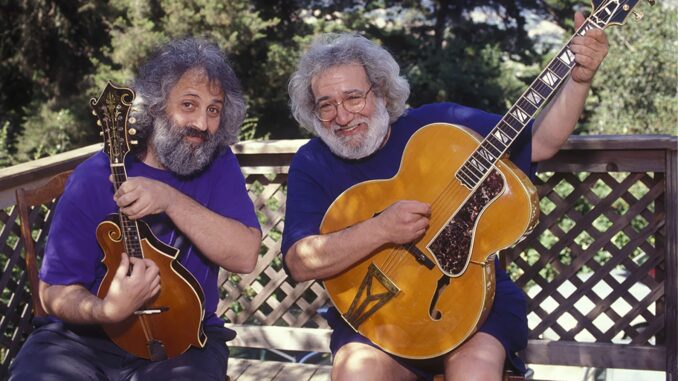
The “Garcia/Grisman” album was recorded in 1991, and chances are you never heard these two master musicians sound as good as they did on this record. Jerry Garcia’s tasteful picking on this album is inspired and timely. As for David Grisman, his soloing on ‘Friend of the Devil’ is fabulous; it’s the best version of the song, slower and more longing. Garcia’s vocals on that one and throughout the whole album are yearning and soulful. This album is composed of an eclectic mix of songs that includes: Irving Berlin, Hoagy Carmichael, blues, celtic, the Dead, southern bluegrass, Russian and Spanish music, and original compositions. Somehow it all fits together seamlessly. Grisman and Garcia sound like they are reading each other’s minds because they are totally synchronous. The album is 58 minutes of pure acoustic bliss.
David Grisman was inducted into the Bluegrass Music Hall of Fame in 2023, hailed for his distinctive and influential mandolin playing, his visionary advances in string band music, and the creation and cultivation of an offshoot of bluegrass so particular that Jerry Garcia dubbed it “Dawg Music.” At age 80, he lives in Washington state, where he spends time in his studio working on projects, some of which will be released on his Acoustic Disc label. He built the studio in 1990 when his quintet recorded the “Dawg ’90” album.
In 1964, the two met at Sunset Park in West Grove, Pennsylvania, where bluegrass shows were held in the fifties and sixties. Both were there to hear Bill Monroe, hit it off and stayed in touch. “He (Garcia) was in California, and I had never been to California,” Grisman said. “The following summer, I made a pilgrimage out there, and we hung out. They weren’t quite the Grateful Dead back then; they were called the Warlocks.”
This was the summer of ’65. There was a house in Palo Alto where Grisman’s friend Eric Thompson, David Nelson, and Phil Lesh were all living. Garcia was already married and had a young daughter. “These guys, they were dropping acid, and they were playing swimming pool parties and little gigs with their band,” Grisman recalled. At the time, he was working for Israel Young, who ran the Folklore Center in Greenwich Village and also wrote a column for “Sing Out” magazine called ‘Frets and Frails.’ In the October ’65 issue, he wrote: “Dave Grisman just came back from California, and he discovered this band called The Warlocks that were combining rock and roll and bluegrass.”
Grisman joined Peter Rowan in forming the band Earth Opera, but he and Garcia kept in touch. In 1969, Earth Opera played its last gig. Grisman went to Berkeley for a few days and heard that the Grateful Dead and Jefferson Airplane were playing a softball game in Fairfax, California. “So, I dropped by and saw Jerry, and he said we’re making this record. Can you come down and put some mandolin parts on? That turned out to be “American Beauty.”
Garcia, Grisman and Rowan formed Old & in the Way, but the band broke up after about a year. The Grateful Dead were hitting their stride. Grisman and Garcia hadn’t seen each other for twelve years, and then they ran into each other at a recording session and reconnected. “One day, Jerry called me up, and I invited him over to play some music,” Grisman said. “Sure enough, doorbell rang. It was Jerry, and he walked in and immediately said, I know what we should do. We should make a record that’ll give us an excuse to get together. So, I said, cool, man. I just built a recording studio in my basement, and I just started a record company, and he said, great. And that was the easiest record deal I ever made. We went downstairs, and we got right into it.”
String Theory
Americana UK: It must have been great to see Garcia when he showed up.
David Grisman: I mean, the truth is that the Grateful Dead gave me a monetary award. Every year, they gave this award, like an endowment or something, called the Ralph J. Gleason Award, who was a music critic for the “San Francisco Chronicle.” Actually, I opened the mailbox one day and found this big check. So, I called Jerry to thank him and said, hey, we ought to play some music. So, then he walked in, and we went downstairs, and I set up two microphones and recorded the first thing that we played, which I still have.
AUK: Were those sessions what ultimately resulted in the groundbreaking “Jerry Garcia/David Grisman” album?
DG: Well, the two of us started just going through songs, did maybe six or eight sessions. I don’t know if it was the first one, but I wrote that ‘Dawg’s Waltz’ right on the spot, and we wrote ‘Grateful Dawg’ together as we started developing our little repertoire. Then we thought maybe we should add a rhythm section. I had in mind Jim Kerwin, the bass player, and Joe Craven, who played percussion and also played fiddle. I invited those guys over one day to record. By that time, I had figured we needed an engineer. There was a young kid named Dave Dennison, who had moved out from Pennsylvania. I think he had met my son, Monroe. He was looking for a job as a recording engineer and heard I had built a studio. I called him up and said, Dave, I got a guitar player over here, and we want to make a tape. Can you come over? And when he walked in, he just about fainted because Jerry and I were his two biggest musical heroes. It was kind of a freeform arrangement. Jerry would just call me up out of the blue, say what are you doing? It was kind of informal, formal. He liked to record. We never really practised, just worked it out while we were recording. I got kind of looser. You would expect Jerry to be the loose one, and I’d be the control freak, but we kind of reversed roles a bit.
AUK: The take on BB King’s ‘The Thrill Is Gone’ is something else to hear. Did you ever see BB play that?
DG: Yeah, I think we both had. Jerry and I were both into a lot of the same music, and it was cool because we were kind of revisiting our musical childhood, so to speak. Of course, ‘The Thrill Was Gone’ had been a big hit. We’d just think of songs and start doing ’em. It was very spontaneous.
AUK: Garcia’s vocal is really sweet on that.
DG: Maybe on that cut, he overdubbed the vocal, but that might have been the only time he ever did that. A few years back, I put out an alternate version of that album as a download on Acoustic Oasis. An alternate take of every song. It’s called “Garcia Grisman Alternate.”
AUK: It’s obviously not the exact way that BB King played it. Did you have to work on it, or did you just start playing it and it came out like that?
DG: That was the first couple of sessions we had Jim and Joe on. I don’t know if we did that song before they showed up or not, but we were thinking of songs that use a rhythm section. I think most of these things sort of came together the way they were. I mean, we didn’t labor over arranging ’em. We’d say, hey, why don’t we take two solos? Often, we’d take double solos. We just viewed it as having fun doing what we liked to do, and we didn’t have anybody telling us what it should be.
AUK: Which one of you chose the music and arrangements, or was it all collaborative?
DG: I was trying to let Jerry run it. That was always our relationship in Old & in the Way. I kind of viewed him as the leader, and he viewed me as a leader. I mean, how could you be in a band with Jerry Garcia and not consider him the boss? But he was a really sweet guy, very democratic, and I guess he liked the way I played, and I liked the way he played and sang. We’d think of songs, and invariably, we both knew the song, and we just started playing it.
AUK: ‘Grateful Dawg’ is a terrific song. Did anybody ever cover it?
DG: I did with my sextet. It’s funny. Jerry never played it the same way. I mean, there is no real melody. It’s whatever he played. He wrote the first part, and I wrote the second. It was recorded in a garage, and Jerry was over in the far corner and right behind me was the window into the control room. I’d be looking at Jerry, and he’d be looking at me.
AUK: On some of the Dead songs, he plays the acoustic plugged in. Hearing him play with just an acoustic tone on this record is very nice.
DG: Well, I’ll tell you a little secret. The first few sessions, he had this Alvarez cutaway acoustic, but he could plug it in, and so I’d have two mics on him and the plugin. Every night when he’d go home. I’d erase that. Plugged in just really sounded off, forgive me, Jerry. I wanted to make sure, in case we keeled over, that it wouldn’t be on that tape.
AUK: What guitar did he play mostly?
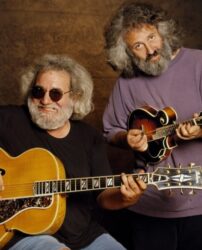
DG: He brought over a lot of his own guitars. He had an old Gibson L-5 Premier blonde cutaway, and he had a Martin 42, D28, and a Takamine with light-gauge strings. And I had some acoustic guitars that he used every once in a while. Most of the time, I’d get him to record with a better guitar, and I even got him to try going total acoustic on a gig, but didn’t make it past the soundcheck. I did get him to move from extra-light gauge strings to light gauge strings. I couldn’t get him to go to medium. You’ve got to be comfortable.
AUK: On ‘Walking Boss’, who came up with the ‘Cluck Old Hen’ melody? Didn’t The Stanley Brothers sing that one?
DG: That was on old-time music at Clarence Ashley’s, one of those first two volumes of that, and then Doc Watson recorded it too. It’s an interesting story. We assumed this was a folk song in the public domain, so we copyrighted our arrangement of it. Sometime after that was released, my manager got a call from Doc Watson’s manager, Mitch Greenhill, who said, we see you recorded ‘Walking Boss.’ Doc has got a copyright on that from 1972 or something, and I said, well, I’ll talk to David about that. My manager called me up and asked where’d you learn that song? I said, I learned it from Clarence Ashley. He did some research and found that Clarence Ashley had copywritten that song by 1960. He called up Mitch and told him that, and Mitch said, well, we won’t tell anybody if you don’t.
AUK: Okay, we’ll pretend that question never happened.
DG: I figured we had more of an arrangement. In fact, later I recorded that with the Bluegrass Experience. We did a whole album of music from Clarence Ashley and Doc Watson called “Muddy Roads.” We did this more or less similar arrangement. I had three-part harmony on it, but then I did that little trade part. I did that with Sam Bush with the mandolin and Snuffy Smith on bass.
AUK: Both of you guys were really excellent with the fill-in licks while someone else is soloing. Can you talk a little bit about how you do that? Is that something that you naturally do?
DG: I’m just trying to look for a space and not trying to step on anybody, but usually there’s in between, the verses are in between the lyrics. I try not to detract from anything, but I guess I hear little things to put in there, and sometimes it works out. Sometimes it probably doesn’t. I’m just hanging out. I just want to earn my keep.
AUK: You’re pretty much winging it each time because I don’t think I’ve ever heard you do the same thing twice on any of those songs.
DG: Well, I guess I never found anything good enough to repeat
AUK: Jerry’s timing was impeccable, how he felt his way through a set of changes.
DG: He didn’t really. He played a lot of different kinds of things, never really just straight rhythm. There is a lot of counterpoint, it seems, when I listen to when he’s playing a part, and I’m playing another part. They go together, but they’re not the same part. I guess we drank from the same musical well, and then we had a couple of decades for that to steep before revisiting. It was just really a lot of fun.
AUK: Did you make up ‘Dawg’s Waltz’ during the sessions?
DG: In fact, I think ‘Grateful Dawg,’ ‘Dawg’s Waltz, ‘ and even ‘Arabia,’ the last tune on this album, all were at the same session. They all were made up right on the spot.
AUK: That’s incredible. ‘Arabia’ is an elaborate piece. It must have been challenging.
DG: Yeah, it’s kind of a different tune every time it goes to the four chord, then it goes to the seven chord. There’s a descending chromatic bit on the melody part.
AUK: What mandolin did you play on this record?
DG: That’s probably Crusher (1922 Gibson L-5), but I occasionally use different mandolins for different tracks.
AUK: What guitar was Jerry playing?
DG: That was his blonde cutaway L-5. Also, our friend Dexter Johnson had a cool Gibson Super 400 that really had a lush sound. I think there’s a picture of Jerry playing that, and he maybe bought that from him. I’m not sure if he did or not, but he used an archtop guitar in a lot of things.
AUK: Did y’all play very many shows together?
DG: We did a number of runs at the Warfield Theater. Our first public appearance was for a fellow named John Goddard, who owned Village Music in Mill Valley. It’s a great record store, and we would hang there. Goddard would have a Christmas party at the Sweetwater Club every year and invite his friends to play. He would film these things, and there’s a performance from that very first gig.
AUK: From looking on the Internet sites, it seems most of the time y’all played in and around San Francisco?
DG: We only played one show outside of San Francisco, which was in Lake Tahoe, a three-day event, and we played there on one of those days. Béla Fleck and his band were there, and I think he sat in with us on a number or two on that show. It was very windy. There are some photographs from that show.
AUK: Were any of them ever recorded?
DG: There’s a bunch of live albums. I’ve had a six-CD live set of one from, I think, three successive nights at the Warfield Theater.
AUK: Were you filling the house on those performances?
DG: Jerry could just book a gig and fill it up. Even with Old & in the Way, we played smaller places, but they were always packed. We did an East Coast tour, but this band never made it out of San Francisco, except for that one time.
AUK: But you recorded a lot that you’ve released intermittently?
DG: Yeah, we recorded a lot, and there is still some hanging around that maybe I’ll get to.


Lovely interview, Dean. The Dawg and Spud Boy made great music together, and it was beautifully recorded to boot.
Marvellous. Thanks. The USA should treat the DAWG as a national treasure. The videos of his 80th birthday concert were a treat, and his Acoustic Disc site is essential browsing.
Oh, we do!