
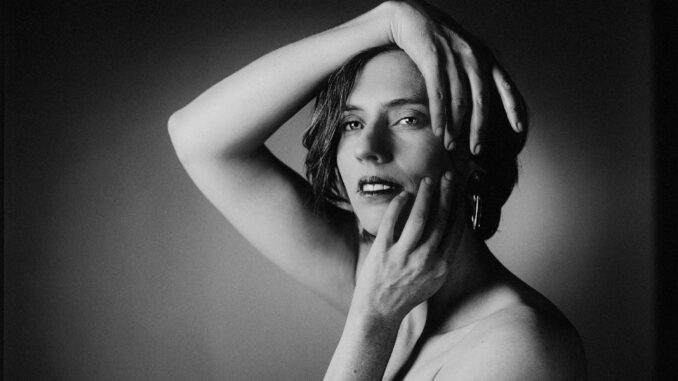
Connection was the emotional mood North Carolina’s Melanie Ida Chopko was looking for on her second album, “Never Had a Love Like This” (2025). But it is a personal form of that sentiment, and the intimate images her resistance-melting voice and tender chords are painting aren’t sepia-tinged but so vivid you can almost touch them. “I mean, I view this record as having a really clear theme, which is, it’s for anyone that’s longing for more connection alongside the loneliness of modern society and the complete agony of modern dating, trying to reach across the chasm to one another and build some emotional intimacy in a world that’s so much about distraction, so much about isolation.”
It’s rare that a songwriter truly tries to sift through the grey areas of quotidian romance in search of meaning. Chopko does just that: absorbing influences from over the course of her life and filtering them through the generational songwriting ability she’s honed, scrutinising our collective need for intimacy and romance without judgment or harshness.
She wants the fireworks and the chemistry; Chopko announced on the jazz-inflected title track: “I’m pretty much a human sparkler, golden like a summer’s kiss, I know you want to lay in the warmth of my sun”. ‘Shake the Dust’ hums with unapologetic hedonism, positioning her hunger for a cute stranger’s attention as righteous. “Come shake the dust off of me, I want to feel what my body is for, down my neck and down to my feet”. ‘Restless’ is offered over gentle, ostinato piano and comes off as similarly desirous: “How could I not just want to press myself against you, feel sap within me rising?”
Elsewhere, her record kind of swings around and then settles into a much more reflective, quieter, singer-songwriter genre. “I think part of my personality is I can be big and loud, and then I can also just be crying on the floor,” Chopko reveals. “The multiplicity is also part of me as a person.”
The album was made over 18 months after a successful

“Never Had a Love Like This” offers introspective self-portraits whose sound calls back to Chopko’s youth and stories rich with the kind of empathy that’s only gained over time. She grew up in a conservative religious household, and there wasn’t a lot of music around that wasn’t church music. But Stevie Wonder’s “Songs in The Key of Life” was in the house, and she was allowed to check out the Beatles’ “White Album” from the library. “Those are some of the titans of songwriters I was listening to early,” she recalled. “And then I also had a real love of Brazilian music. Then I started writing more formally, studying Jobim and Gilberto, who had their way with melody. Even the Great American Songbook itself gave me ideas for crafting a melody in a more compositional way versus a folk music way.”
On her original demo for the title track, she looped a section of Benny Goodman’s famous trombone piece, ‘Sing, Sing, Sing (With a Swing)‘, and wrote over that. “Something I enjoy doing is writing with the groove as the first thing in the bedrock of the song”, she said with a grin that could paint a sunrise over the Smoky Mountains. “I think of that song as kind of this online dating ad for like, hey, you’ve never had a love like this one. Give me a try – swipe right, swipe, swipe, keep maybe. Relationships bring up our biggest stuff, and it’s in relationships where, speaking for myself, I grow the most, where I change the most, where I am confronted with the things I’m still working on. Part of that song is saying: I’ve done a lot of that work, so it’s going to be a different experience to hang out with me. But part of the song is snarky too. It’s like, come on, get your shit together”.
All this affords her songs excellent contrasts as they meander on from 1 to 10; you can hear several different styles. On the aforementioned ‘Shake the Dust’, she was just trying to write a blues with a break. The overall mood of the song is not blue as the hairdo of the kooky congresswoman from Connecticut, but she confesses to be rootless and restless, “running in from being stuck inside my freedom”.
There are echoes of women singer-songwriters of the late ’90s and early ’00s throughout the record: her lilting voice at times echoes Alanis Morissette or a slinky swagger that evokes Tori Amos. But the album is certainly not a throwback; Chopko has a distinctive voice, and her songs are grounded in the present. The DNA of her childhood favourites are evident in her songcraft, like seeing a picture of your mom when she was your age and realizing how similar you look.
She also drew inspiration from her confidant, Anna Tivel, with whom she has had several conversations. “I remember her once saying to me, ‘ The world is so noisy, and I’m doing something really quiet and reflecting. It takes time to build, kind of like mycelia mushrooms, building soil in a world that’s excited about Bad Bunny and all of these high-energy performers.’ But I’m up to something different. I do have some spunkier stuff on this album”.
“I want to feel you look at me”, she declares in ‘On the Fritz,’ a faux punk-ish critique of Zoom: “I want to sit here knocking knees”. You feel a little like laughing and a little like weeping. “During the pandemic,” she put forth, “there were all of these events happening on Zoom, because the request was that we not hang out in person. But my experience of the last five years is that there’s still quite a lot of reticence to gather. It’s like we never shifted out of this online activity space. In some ways, with the online workshops, online classes, it’s cool that I can learn from people all around the world, but there’s something missing in that process. Socializing across a screen is not the same. I want to feel you look at me and feel the impact of me speaking and see you respond in person.”
Chopko does some of her co-writing with kids. Her day job is as a music teacher, and she wrote with 9 to 11-year-olds. “These songs are totally amazing, so genuine and earnest.” She remembers during her own childhood getting in trouble for singing out loud in class or wearing a large vinyl star in a Christmas play. “There are all these videos of me performing in front of the camera and wanting to be the center of attention. I started by focusing on singing because, like most human beings, it brings me a lot of joy.”
But it’s not all roses throughout the album. She’s guiding her mind back from depression in one of the most affecting songs, ‘Chant (Come with Me to Higher Ground)’. The trauma of her internal clock ticking is a topic that might sound stuffy or morose, but Chopko’s take is not inconsolable on ‘Throw Me’- “You keep sending endings, dark nights of the soul, each one like another miscarriage, I’m starting to hear the clang of that clock”. “That is one of the few songs that came out fully formed,” said the woman who does a lot of drafting and re-drafting. “People really connect with that song. It was written from a really personal, visceral place. I didn’t think I could ever perform it without getting too emotional.”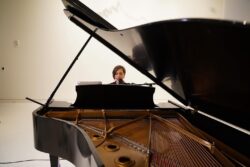
Chopko considers her lyrics with a sense of cultivated perspective, writing not always from the scalding heart of emotion but from a slightly calmer, wiser distance. On ‘Today We Talked,’ she admits that a romance might be healthiest when it doesn’t feel like an emotional rollercoaster, even if that means some of the thrill has worn off. Through heartbreak, the song shines like a diamond necklace ripped from the neck of a socialite. “Everything felt new in the uncharted magic of lying next to you” sounds so devastatingly romantic, though the relationship comes to a screeching halt. Still, there is hope for the hopeless as it epitomises this quiet belief that a little time and a little space heals: “I wondered what’s possible for me if I choose people who choose me”.
“I felt pretty self-conscious when I realized that this record was about my journey of looking for love and telling the story of that,” she admitted. “It felt so vulnerable to realize that. Maybe one of my hopes is that I’ll meet my beloved partner/husband through this process. Who knows?”
Chopko finds it easier to express in music what you can’t in everyday life. “I think that the musical realm has space for the entirety of the human experience. But something like a song can more accurately reflect 360 degrees of our human experience, and it is also a place to act out conversations or interactions that I wouldn’t necessarily have in real life.”
It’s easy, after a relationship falls apart, to believe we are the aggrieved instead of attempting to make a grey area appear black and white. Culpability is always messy. But Chopko is not after an explosive kiss-off or a plea for reconnection, rather, a promise that’s subtler but perhaps ultimately more freeing days are ahead if you simply choose to stay in motion.
“That’s kind of where my writing has gone in the last few years, using songwriting as a way to understand or get my hands on something I can’t change in my own life, what I desire, what I fear. I love that Joan Didion quote, ‘I write to find out, hold on.’ I have a version of that in one of my artist statements, but it’s so classic. You should quote Joan Didion instead of me.”
Not a chance, because Joan Didion can’t sing and write songs like Melanie Ida Chopko.
Find out everything you need to know about Melanie Ida Chopko’s music here.