
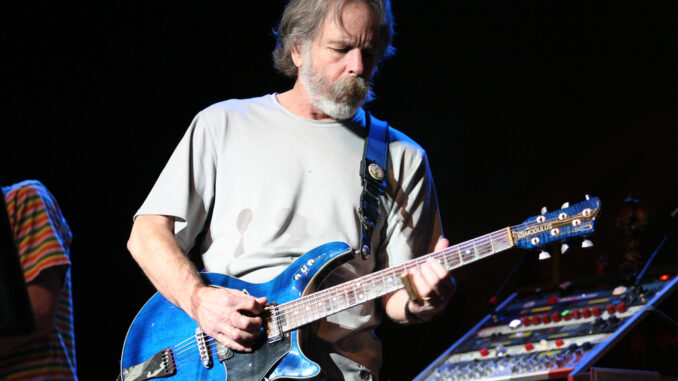
“The Kid” who helped define the music of the Grateful Dead and maintained its relevance
The world lost Grateful Dead founding member Bob Weir on January 10th, 2026, due to underlying lung issues following his recent successful battle with cancer. He was only sixteen when he started playing with Jerry Garcia and Ron “Pigpen” McKernan in Mother McCree’s Uptown Jug Champions, who, with the addition of Phil Lesh and Bill Kreutzmann, morphed into the Warlocks and ultimately the Grateful Dead. The Grateful Dead were just at the start of their thirty-year trip, and Garcia and Lesh, who were older than Weir, were the dominant musical forces. In 1968, Garcia and Lesh decided that Weir’s guitar playing was not up to scratch and attempted to remove him from the band, but Weir doggedly refused to leave. However, from this moment on, Weir worked on his guitar skills so that his rhythm guitar became integral to the band’s sound, as did his later slide playing, becoming in the process one of the leading rhythm players in the world. Also, as the band became more professional, it became impossible for Garcia to be the sole lead singer for their mammoth concerts that tracked the dynamics of an LSD trip, and he encouraged Weir to step up to sharing the lead singer role. Weir’s vocals proved ideal for the rock and roll and “cowboy songs” the band started to include in their concerts. At the same time, Weir’s songwriting moved up a gear, so much so that his first solo album, “Ace”, included such Grateful Dead perennial favourites as ‘Playing In The Band’, ‘Almost Saturday Night’, ‘Black Throated Wind’, and the ‘Greatest Story Ever Told’, and is now viewed as part of a trilogy with the Grateful Dead’s ‘Workingman’s Dead” and “American Beauty”.
Bob Weir was born on October 16th,1947, in San Francisco, a city he became indelibly associated with, and he grew up in Atherton, California, with his adoptive parents. He had a difficult childhood due to his undiagnosed dyslexia and was expelled from multiple schools. However, he did make a lifelong friend of John Perry Barlow, who became his preferred lyricist and co-writer while at school. While the Grateful Dead became the epitome of a West Coast psychedelic band and were the house band for Ken Kesey’s Acid Tests, Bob Weir said he stopped taking LSD in 1966 because it had by then taught him everything it could. The open-mindedness that permeated the Grateful Dead provided a nurturing musical environment for Bob Weir to find his feet as a musician and songwriter. It was a truly symbiotic relationship where Weir would not have developed his idiosyncratic style without the Grateful Dead, and the Grateful Dead’s sound and catalogue would be noticeably different without Weir’s input.
Like Jerry Garcia, Bob Weir maintained a solo career during his time with the Grateful Dead. His second solo album, ‘Heaven Help The Fool’, found him taking his country rock tendencies and aligning them to a slick West Coast sound in 1978, and while this album didn’t find much favour with Grateful Dead fans and it proved too idiosyncratic for mainstream listeners, it did include songs he continued to revisit in his solo career and with the Grateful Dead. Weir worked with two bands during his time with the Grateful Dead, Kingfish in the ‘70s and Bobby and the Midnites in the ‘80s, which mixed his country, jazz and pop influences. Indeed, Bobby and the Midnites, which included jazz musicians Billy Cobbam and Alphonso Johnson, Little Feat bassist Kenny Gradney, and Grateful Dead keyboardist Brent Mydland, were an attempt to break Weir as a leading rock artist.
Like the rest of the band, Weir was at a loss when Jerry Garcia died in 1995 and the Grateful Dead disbanded. It is to his credit that he was able to continue to develop as an artist while at the same time being the most active of the ex-Grateful Dead members in maintaining the band’s catalogue either through his solo shows or with various combinations of Grateful Dead members touring as the Dead, the Other Ones, Further, and Fare Thee Well. RatDog became Bob Weir’s band of choice for twenty years after the demise of the Grateful Dead, and their repertoire included Grateful Dead songs, Weir solo songs and various covers. The band occupied a similar musical space as the Grateful Dead and released one studio album, “Evening Moods”, and a live album, “Live At Roseland”. In 2016, Weir released his third solo album, “Blue Mountain”, which was the subject of much critical praise, and was said by many to echo “Workingman’s Dead” and “American Beauty”, In 2018, Bob Weir formed Bob Weir & Wolf Bros with Don Was, and the band again played a mix of Grateful Dead songs, Weir’s solo songs, and roots rock covers. Also, Wolf Bros toured with a horn and a string section and a revolving cast of musicians, and occasionally played with full orchestras, including London’s Royal Albert Hall.
The explosion of ideas and the changes in social attitudes in the ‘60s, together with the specifics of the local environment of San Francisco, enabled the Grateful Dead to come into existence. The band themselves embodied the more positive attitudes of the ‘60s, which allowed them to develop their sound long after most of their contemporaries had got off the bus. In a way, and probably because he was the youngest member of the band, Bob Weir came to represent the best characteristics of the band, and therefore the ’60s, in his willingness to keep driving himself forward musically and with his various charitable works. He also brought his own unique and goofy sense of humour to everything he did. In recent interviews, he had explained he wasn’t frightened of death, and while he didn’t know what came after death, if anything, he believed death was just part of the ongoing trip. “The Kid” did well, as evidenced by the mountain of tributes from everyone from Bob Dylan and Ron Carter to Margo Price, Brandi Carlile, to Billy Strings.

Great appraisal of Weir, Martin. Evening Moods is an album which doesn’t get enough attention. 2 Djinn would have been a great song for the Dead live…
Thanks, Tim. Weir was that rarest of musicians who continue to develop throughout the careers , including to the very end.