
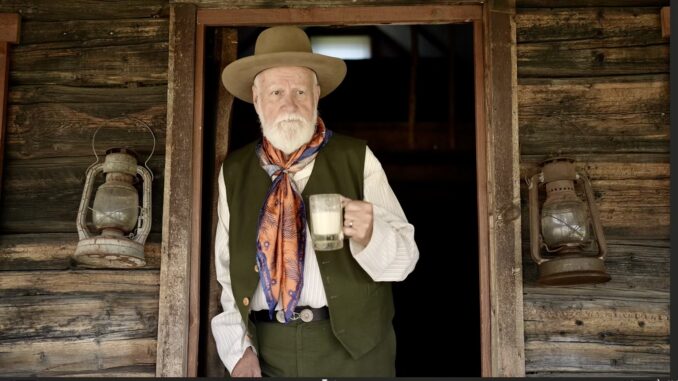
For Hal Cannon, life should be very simple – love the place you live, love the ones you know, if you’re needy, why not give, then see if you’re still low. Words to live by, extracted from his eponymous first of three albums, recorded in 2011 in Utah. Cannon is 76 and doesn’t want to waste his time on frivolous projects, and his third album (Cowboy Sutra, 2025) is not to be taken lightly. Listening to these songs, you think back to the old West, campfires, trail drives, isolation, the feeling that the world has accomplished little except the slow suffocation of time. It contains no impervious tunes to skip past; instead, you could sort them from least intense to most intense.
Infused into these songs is the pain of impermanence and the quest to find solid footing, though this is hardly a new direction in his recorded output. The title track from his second album (Nothin’ Lastin’, 2022) is all the evidence you need. As Cannon remarks, “The common thread for me in this album is that all of these songs turn out to be cautionary tales.”
Cannon sees himself as a curator of folk music, particularly of horse culture, cattle tending and livestock. And he has played and collected music in Mongolia, Turkmenistan, Kyrgyzstan, Argentina, India, basically all over the world. He has made numerous documentaries for National Public Radio. Beyond his work as a musician, he has served as the founding director of the Western Folklife Center and its annual National Cowboy Poetry Gathering in Elko, Nevada. “I’ve been a folklorist, an explorer, all of my life,” he stated.
You hear his fascination with cowboy poetry in “Hitting the Trail Tonight” on the first album. “That’s an old poem that I set to music, written by a wonderful cowboy poet named Bruce Kiskaddon. He was a cowboy originally from Pennsylvania, but his family moved to Colorado, and he was a working cowboy. And then in 1925, he went to Hollywood to be a stunt rider in the original Ben Hur, drove a chariot, and then he stayed in Hollywood and became a bellhop and would sit in the lobby and write cowboy poetry and then publish it in the Western magazine there in LA at the Stockyards.”
While a young man, Cannon became hooked on folk music and soaking up its rich history from listening to Rosalie Sorrels and Utah Phillips in Salt Lake City. He has put in time with the Rhode Island Mudflaps and the Deseret String Band, besides being one-third of the 3hattrio, which has released several fine albums. Lord of the Desert is a good place to start. Cannon describes it as “pure peyote delirium enveloped in a haze of banjo, guitar, bass, with fiddle lines and bass drum dancing around like the indigenous desert animal spirits.”
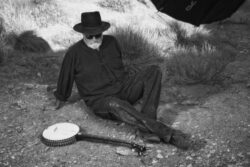
The image on the Cowboy Sutra album cover shows him sitting in a meditative position in the desert with a wreath of antlers behind him. Cannon had a hip replacement a while back, however, which restricts his flexibility. “My wife is a meditator; she’s a Buddhist chaplain, but I couldn’t assume that position,” he said. “I’ve started going to Tai Chi a couple of times a week, and I find that quite meditative.”
Cannon would like listeners to get a feeling of calm, a feeling of openness. “As much as I’ve studied the lyrics and the background of all the songs, I don’t care if it’s an academic appreciation of rather more the feeling of the songs and the music that I want people to come away with a positive feeling about.”
He injects a customary mixture of pathos, empathy and humor into his songs about the way the American West once was and, in some respects, still is, though population creep is inching towards the open spaces, as in the song “Fast Horses.” Then we’ll ride no more fast horses, and our saddles will be gone. Oh, the country’s chocked with fences.” Cannon wears his passion for the West on his sleeve. “I bare my soul, a territory balancing near the precipice. I only ask you to listen to my songs with an open heart.”
Americana UK: Where are you these days, Hal – Nevada, Utah?
Hal Cannon: Actually, we live on a floating home near Portland, Oregon. It’s a tributary of the Columbia River called the Moltnomah Channel. We moved up here about a year ago from the desert in Utah, and where I’m from. My wife is a resident chaplain at a hospital here, so that’s why we moved up. I understand you have four horses.
AUK: That’s right: two Quarter Horses and two Haflingers.
HC: When we lived in Nevada, we had a little ranch, and my wife came from a large ranch in Wyoming up by Cheyenne, and so she grew up on horseback. I had horses growing up, but I wouldn’t consider myself much of a horseman.
AUK: I’m interested in your upbringing. There’s a Mormon aspect to it: your parents were Mormons. Tell me a little about it.
HC: On my father’s side, we’re from the Isle of Man originally, and probably before that, Ireland. But my great-great-grandparents joined the Mormon church when there was this big missionary effort going on during a very poor economy in Europe. A lot of people were trying to find new ways of doing things, and Mormonism and the American dream were pretty tied together. It’s very much an American religion. My great-great-grandfather was Brigham Young, so I do go back aways.
AUK: It was Joseph Smith who started the church. Wasn’t he ostracised?
HC: Well, he was a dramatic, spiritual guy who had this vision of the Kingdom of God on Earth. So, he started this city called Nauvoo on the banks of the Mississippi, and he incurred the ire of a lot of neighbors who finally murdered him. That was, I think, in 1844. And then my great-great-grandfather, who was a real organizer kind of a guy, organized the Mormons to move out to Utah, so they’d be a long ways away from any mobs that could murder them. I’m not an active Mormon, though everyone is in my family.
AUK: When did you become interested in the folk music of the West?
HC: There’s actually a lot of wonderful folk music that came out of the Mormon pioneering experience. The first record I ever put out was my band doing all these old Utah folk songs back in 1972, a group called the Deseret String Band that we had going for about 30 years. We were very interested in Mormon folk music, cowboys’ songs and western music and also smitten by old-time music from Appalachia, bluegrass music and ballad singing. That was far away and sort of exotic to even think about because we were just young kids, but there was an interesting folk music scene when I was a teenager in Salt Lake City, and you didn’t have to dig deep to go underground in Utah. My teachers were Rosalie and Jim Sorrels, and my other guitar teacher was Utah Phillips when I was about 14. There were some extraordinary mentors both in music and also in folklore. Utah was one of the early places to have folklore teaching at the university, so I got to be around some of the early collectors of western folk music.
AUK: You are involved, I understand, in the national cowboy poetry gathering in Elko, Nevada.
HC: I found cowboy poetry early on, and it went hand in hand with the cowboy music, cowboy songs. John Lomax recorded the cowboy songs and published his books on cowboy music. He collected a lot of poetry. In my band, even in the seventies, I recited poems along with cowboy songs. There’s something about pastoral poetry that’s gone back a long ways. And the poetic life of horse people exists in many cultures. You might not think of American cowboys as being poetic, but they come from this world tradition that goes back to Beowulf and to Chaucer, even to the Bible. I mean, Shakespeare talks about horses a lot, and there’s so many references in the metaphors of fatted lambs and the agricultural life, which was how 90% of people in the world survived, on agriculture. It’s very different now. It’s probably less pertinent now that only 2% of Americans are involved in agriculture, but back in the 1800s, it was 98% of Americans who survived with an agricultural life, and all the horsepower was horses, as you know.
AUK: When you talk about cowboys, I think of old John Ford movies, Spaghetti Westerns or Yellowstone on TV. Never heard anyone reciting poetry on those shows. Do you think it has something to do with cattle herding trail rides, where they’re out in the elements for long periods of time?
HC: I think that’s part of it, living a life with a lot of boring time coupled with terrifying and dangerous situations is sort of a right place to make stories and cautionary tales to keep things interesting. These were thoughtful people who came from many different backgrounds, particularly on the trail drives just after the Civil War. I mean, America was in such turmoil after the Civil War, trying to find a new identity. There were lots of displaced people, lots of immigrants coming from all over the place, freed slaves, veterans from the Civil War, and a lot of these guys got jobs as cowboys. Roosevelt tried to find a new identity for America with the cowboy image and his Rough Rider image, and the guys like Cody who started the Wild West shows, pulp fiction novels about cowboys and romance. Everything sort of conspired to make the cowboy a pretty potent mythical character.
AUK: Would you say your music evolved from this cowboy poetry?
HC: Absolutely. I’ve just spent a lot of time around ranching people and cowboys, and I don’t consider myself a cowboy. But my wife grew up on a ranch in Wyoming, and we were talking to some people about this just the other day, after one of the elders from the ranching community had passed away. My wife was talking to her daughter about how much fun they had at brandings, and I realized that when I rewrote one of these songs on the new album, I really wanted to capture that idea of how work should be fun. And so, I changed the song around a little bit and didn’t realize it comes from little lessons I’ve learned. I wanted to make a contribution to the evolution of these old cowboy songs, and that was my main impetus in creating this last album, Cowboy Sutra.
AUK: Were guitars a popular instrument on the trail?
HC: I think Jimmy Rogers probably had as much to do with cowboys taking up the guitar as them using guitars out on the trail. I mean, that’s an element of the popularization of cowboy singers on movies. Those guys are mostly singing songs unaccompanied out there. I mean, somebody may have had a mouth harp, probably not a fiddle. I really wanted to capture that more contemplative and meditative quality of cowboy music that I hear in these songs.
AUK: Sutras are aphorisms in a way. The word comes from the Sanskrit, wisdoms from the past. So Cowboy Sutra is a play on the Kama Sutra?
HC: I was more interested in the whole idea of a sutra being a string, a string of wisdom. And alliteration always works.
AUK: What do the horns on the album cover represent?
HC: That was something the artist came up with. I said I wanted something of a cowboy sitting cross-legged, and I found all these old photographs of cowboys sitting cross-legged, eating at the chuckwagon. He adapted one of those, and I wanted it to look iconoclastic, so I sent him photographs of all sorts of religious iconography. He came up with the antlers. It’s very fanciful.
AUK: It sounds like doing the research is one of the best parts of writing these songs.
HC: I take these songs out and sing them, and I find that the more I know about them, I understand them better. So yeah, I like researching them, but then I like to forget the research and just sing them too.
AUK: Your first album came out in 2011, and it took over ten years for the next. What were you doing while not recording your own music?
HC: I got really involved in this band, the 3hattrio, and over a decade we’ve recorded eight albums, so we were busy writing music and touring, more in Europe than anywhere else. I didn’t have much time to further my solo career. I had moved to this small town and found these musicians, one was into reggae.
AUK: That must be your bass player, Greg Istock, with the long dreadlocks.
HC: Incredible bass player and wonderful musician. Then we met a young kid who was 16 at the time, who was a classical violinist, though we agreed that we weren’t going to play any one of our genres. We decided to come up with something new, which we called American Desert Music. We tried to write songs about living in the desert. We all lived near Zion National Park, down in southern Utah, and it was an interesting experiment.
AUK: “Old Paint Old Pain” is a variation on “Goodbye Old Paint,” which was in the movie The Adventures of Mark Twain. Tex Ritter sung it, but Charlie Willis wrote the song. He was a black cowboy, which I always assumed was a confection of Hollywood.
HC: There were a lot of slaves that were cowboys. That was the work they did. So, it was natural when the trail drive started that now that they were former slaves, they would take on those jobs. A lot of the great cowboy music comes from black cowboys. Actually, Hollywood worked against the idea that there were black cowboys. There were some black cowboys in the movies, but it was quite rare.
AUK: The new album feels like a departure from your other two. Could you explain that?
HC: I’ve been in an experimental mode for quite a long time. I come from a background of plain old traditional music, and I’ve just always wanted to do an album where I could interpret old cowboy songs in the way that they resonate best with me. It seemed like it was a blank spot in what I wanted to accomplish. All three albums are different, which was probably not the smartest thing to do. But that was secondary to expressing what was important to me at the time.