
Maximiano’s second release is an open-hearted, intimate reflection on suffering and change in a divided nation.
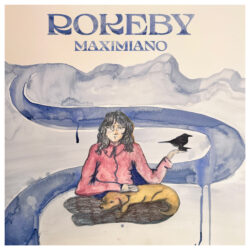 Out of a ten-day dog-sitting stint in the countryside came Milwaukee-based singer-songwriter Maximiano’s second release: Rokeby. Rokeby is the name of a historic district in upstate New York, along the Hudson Valley River. It happens to be where Maximiano crafted these songs, but it is also a place named after Sir Walter Scott’s Rokeby, an epic poem set during the English Civil War, a time of chaos and division.
There are a few things at work here. The rural aspect comes through the album’s folkier cuts and arrangements. As far as Scott is concerned, the songs in Rokeby reflect a literary streak to the singer-songwriter, with lyrics referencing Rilke, Max Porter, Dickinson and Highsmith; but thematically, they also express the existential meditations of an individual in a torn, divided nation. The result is a grounded, introspective piece, written in a period of change that is guided by Maximiano’s own descriptive question: “How do we discover the tenderness on the other side of suffering?”
Sonically, Rokeby is a slight departure from Maximiano’s first album, which was rooted in tradition but lavishly produced. This release is stylistically split in two: a polished first half that reflects a quasi-pop sensibility and presents Maximiano’s voice in a hi-fi Sufjan Stevens whisper, and a second half that is almost jarringly stripped down and showcases much more of an intimate aesthetic.
The album’s singles, Countryside and I Will Not Abandon the River, are both in the first vein: polished meditations on returning, belonging and impermanence, tastefully arranged and punctuated by sparse, but to-the-point instrumentation. “I will not abandon the river/just because it makes me feel”. Countryside provides a to-the-point statement: “There’s no hope for the country now/Besides the folks that you’re around/The only answer that I’ve found/Is use your heart and serve the ground”
Far from wide-eyed optimism, there’s a sense of a guarded hope throughout: one that does not dismiss nuance, complexity, or responsibility. Instead, it reaches into the heartland, even stylistically, with the country-folk styling of songs like Puppers (Bandit’s Song), to achieve some sort of mending of the gap. Maximiano fluctuates between group and individual, humour and despair, but ultimately arrives at a place of tangible peace: the one you find in serving what and those you love.
Maximiano’s voice is perhaps at its best in Let Go, where it is vulnerable and mournful, but not saccharine, in ruing a lost love. And in a similar vein, in Caterpillar/Rilke, the theme of life as a river, of America as a river, a body in constant change, returns: “At the crossroads of my senses/I remember I’m the sea/And the waves are just a little part of me”
But if there’s a song that offers the simplest, most convincing argument for hope in the face of devastation, it’s the folky, dog-loving Puppers (Bandit’s Song): “There are thousands of reasons why the world’s brutal and broken/But there’s millions of dogs so I’m keeping my heart open/Well there’s at least one dog so I’m keeping my heart open“
All in all, it’s an album for the times that, slim chances or not, insists on hoping for better times: heart open, flowing as the river flows.


