
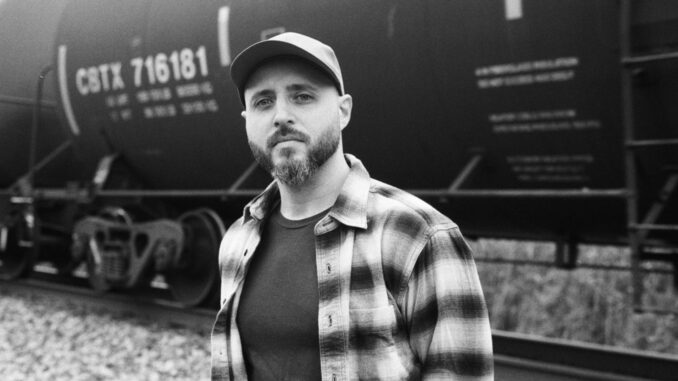
The songs on Thin Lear’s sophomore album Many Disappeared are tied to each other not in their locale or their cast of characters, but instead in strange tragedies that have taken place, some many years ago. Current citizens may rest easy; his story-songs are not predictive. Sometimes, New Jersey musician Matt Longo writes songs about a fictional town full of people plagued by life’s dark moments. People die at the hands of nature and their fellow man. Others are of a personal nature. Hope slips through the fingers of anyone who dares reach for it. There is even a supernatural pull towards his ends. Getting away from a bad situation is sometimes fraught with peril, opening up a space where darkness sets in to fill. “I’ve always gravitated to bizarre tales to access my own grief and pain,” says Longo.
The scene is set with the bizarre opener, Silver Bridge. Detailing a period (1967) when a bridge collapsed, which connected Point Pleasant, West Virginia, to Kanauga, Ohio, resulting in the deaths of 46 people in the freezing Ohio River, one of the deadliest bridge disasters in US history. Longo tells the story of a man who just lost his brother, but the chilling tale was mainly inspired by The Mothman, a large winged creature that was sighted by many residents just before the catastrophe.
“I need something supernatural to wrestle with, just to understand my own earthly troubles,” he says. “I write to access a feeling and get past it.” There is no lack of such happenings further along in this album. Colorado, particularly the San Luis Valley, is a major hub for UFO sightings and alleged alien activity. The area is known as a “cosmic highway” with numerous reports of strange lights, craft, and cattle mutilations. It has been dubbed the Bermuda Triangle of the West. An acquaintance of Longo from that region told him of an alien visitation, becoming the basis for the song, The Visit.
It must be a peculiar thing, listening to an album with a song about a town that has the same name as the place where you live. Upon coming to the track named Mattoon, a quick Wiki check revealed in 1917, the Illinois town was devastated by an F4 tornado, which killed 101 people. It’s also the Bagel Capital of the World, but instead Longo’s song was inspired by the “Mad Gasser” mass hysteria which gripped Mattoon in the 1940s.
Mournful and gloomy though some of the songs may be, their real or imagined lore is legendary and reverberates throughout to stick with you days later. The melodies are soothing and delivered with a genuine voice. He has a knack for bringing these subjects to life with tiny, strange details that break your heart, sung over soft music that lingers like a melancholy track at the end of karaoke night. This is really good. I wasn’t exactly wonderstruck, but definitely and undeniably captivated, though horrified, hearing about the cat run over on the road as two young boys watched it die. “Now I feel the strangest love, it hurts like hell, sittin’ there inside my chest like a sentinel, as powerless and frightened as I’ve ever felt.” Imagine how the cat felt seconds before a car left tyre treads on its body. But perhaps this record is about working through your fears and coming out the other side, not unscathed necessarily, but with a greater understanding of life’s vagaries. A chance encounter with an animal bringing closure to human relationships, as if there’s some cosmic machination at work.
With that subtle element of the supernatural in the world of Thin Lear comes a quiet, Lynchian edge. It simmers just underneath the surface of Longo’s small-town stories, and sometimes, it bubbles over, an externalised version of dream interpretation. The ghosts attached to the place might confront you a little too, and you might find yourself forgiving them.
Below, Longo takes us on a trip through these songs, providing their genesis and inspirations. You can check out Many Disappeared along with his first album and two EPs on Longo’s Bandcamp page.
Silver Bridge: The Mothman legend has fascinated me since I was a kid (look it up if you’ve never read about it). This idea that there’s an entity out there that knows of future calamity, then tells you about it, but you can’t actually do anything to stop it. It’s the perfect monster for someone with anxiety. Just hilariously spot on, and perhaps that’s why I was drawn to it. I have a vivid memory of attempting to convince my high school friends to take a trip down to Point Pleasant, West Virginia, for the annual Mothman Festival, so I could embrace a community of other weirdos. Shockingly, there were no takers.
But I did think it was strange that the story came back to me in the form of this song, decades after my initial interest in the topic. I’m always trying to find new ways of accessing my emotions, as directness has never been my strong suit. And for some reason, when thinking about the nature of grief (Does it ever really leave? What do you do when you have no spiritual infrastructure?), this story song arrived to me, fully formed, and the potentially made-up winged creature was suddenly a part of my life again.
Harmony & Gold: The recording process for this album was an organic, one-room affair; all these musicians I admire got together in a big space in Memphis (at Sam Phillips Recording Service), and we’d work through a song all day, and hit record in the evening. We did this for a few weeks; it was exhausting and wonderful. This song arrived at the end of a long session. We’d just nailed the take, and the producer, Matt Ross-Spang, got the idea for a real swell of acoustic guitar flutterings, so everyone sat in a big circle for a communal overdub of acoustics. Still one of my fondest recording memories – just being a bit silly, with the pressure of the day falling away. Years ago, I used to record vocals in the bathtub for the reverb, and I probably will again, but this album is a totally different thing.
Witness: The very first time I played this song was at a gig at City Winery in Manhattan. I was opening for a folk hero, Charlie Parr, and workshopping a whole lot of new material. I played it in the set and thought it went okay, but as I was gathering up my gear, one of the women in the front row walked over and said, “I really enjoyed the songs, but that one about the dying cat is so upsetting.” She was very kind, but it was almost like a warning – like I was chasing people away with this one. It initially made me laugh, but I kept thinking about it, the way you do when you know someone is right with a critique. The song used to be a bit more maudlin in its vibe, and the combination of subject matter (confrontations with mortality) and sonic vibe was maybe a bit much.
So when it came time to record, we worked up an arrangement that had a bounce to it. I’ve always loved the way people like Karen Dalton or Harry Nilsson will package a devastating sentiment with a melody you can whistle and a beat you can nod along with. That was maybe the goal here, and I’m grateful to that concertgoer from City Winery a few years back for helping me get there.
A Cherished Man: I tried to write a novel when I was 21. It was a humbling experience, and it was ultimately a failed experiment (I did finish it, but it was, in hindsight, not the greatest). But it taught me about my work ethic and the level of focus I could achieve when I found a narrative arc that inspired me. And after that process, my songwriting changed; I channelled the storytelling into the music, for better or worse.
This song is truly a character study of three worried souls at the edge of society who will do just about anything to feel like they’re part of someone’s world. I empathize with each of them. And I realized just the other day that it mirrors exactly how I feel about music. With social media and streaming, and the daily prayers to the gods of the algorithm, you really do end up feeling degraded by the whole process. Maybe it’s just me and the folks I associate with, but there’s really nothing I get out of it; it ends up being a self-flagellation, humiliation ritual kind of thing, and you get stuck in it to push the art out there. I’m not saying this for sympathy; I make the choice to do it. But I do think this song reflects that feeling I have of, “Please look at me!” That desperation that’s infused in every post and internet offering.
Mattoon: I think I’ve already established that I’m vaguely obsessed with incidents of mass hysteria (e.g., the Mothman sightings). You can learn so much about people, about a whole culture, by researching their monsters, their cryptids, their ghosts. It’s endlessly fascinating. And it has nothing to do with them being real or not; that’s secondary to what the folklore tells us about the human brain.
I had read about this “Mad Gasser of Mattoon” situation years ago, wherein a community in Illinois thought they were under a chemical attack in the 1940s. Authorities couldn’t tell if it was real or not, but it swept through a city, kind of like the dancing plague. People got worked up into a frenzy. It’s another one, like Mothman, that just found its way into a song. I envisioned a new mother, acclimating to parenthood, experiencing daily challenges, and then this whole situation is going on in the background. I love pairing the mundane with the insane, the extraordinary, in song. It just always feels right.
The Haunt: The Haunt is the first song we recorded for this album, and it was such a delicate tune. I think I started with it because I wanted to see if this was really the right environment for these songs, the right group of musicians to record with. We did a few hushed takes, then Matt Ross-Spang came out of the booth, and we all just huddled and discussed. I could feel everyone leaning in emotionally, and the rest of the sessions just flowed wonderfully out of that early morning experience.
This is one of the many songs on this record that initially came out of a dream. I had encountered my deceased grandfather as a young man, and we had a long and beautiful conversation that I don’t remember at all. But I did wake up feeling like I hadn’t been alone inside my own head. That’s the kind of supernatural activity I seek to chronicle in song; the kind where it doesn’t matter if it’s real or not, but it tells you about your hopes and fears all the same.
Heavy Dreams: Sometimes I think I write and record merely as an act of exerting control over at least one aspect of my life. I don’t know what will happen tomorrow; I don’t know what will happen to the people I love, but I can certainly EQ that tambourine! It’s where I put all my obsessiveness. Mostly it’s a healthy practice, but sometimes the obsession overflows, and then it’s not fun anymore. And I have to walk it back.
This song came from one of those periods when the act of writing and releasing music just got a little too important, a little too heavy, and it nearly crushed me. When that happens, I either write a song that saves me and brings me back to myself, or I hear someone else’s song that has the same effect. The music takes away, but then it gives back.
Buddy: I’ve been doing this embarrassing thing for years, wherein I think I’m writing a song about a friend, finish it, and then realize it’s actually about me. Surprise! It’s always humbling and embarrassing. Songwriting is often me talking myself through something; I’ve never been much of a life coach for myself, except in this one way.
This was written during a period of intense self-doubt, and my brain felt the need to call me back in from the cold. I am sometimes merciful to myself in that way; I wish I were always that gentle and kind on the inside.
The Visit: When we recorded this one, inspired by a firsthand account from a passing acquaintance in Colorado of an alien visitation, it was really done in a ramshackle first or second take. But then we kept going at it for the rest of the afternoon, until someone realized that we were just chasing that messy, chaotic sound we had captured at the very start of the session. As sadistic/masochistic as it sounds, I kind of love when that happens in the studio. When you go too far, and then walk all the way back to the beginning. It’s always a tremendous learning opportunity about the nature of perfection and what it is you’re really after…which is not perfection, but intention and clarity of emotion.
Healing Alone: There’s a version of this song that has like eight verses, and it was turning into a “Desolation Row” situation until I edited it down to the essentials. It was a no-brainer to end the album, as there’s such finality to the climax. Beyond the fingerpicking, I didn’t want any other instrument to remain too steady throughout. I wanted the accompaniment to drift past the listener, sometimes barely within reach, before floating off, to mirror the meditation on the loss of a family member.
It’s often difficult for me to listen back to my music after it’s completed; I just hear what I might’ve done differently. But with this album, and this song in particular, I do accept it for what it is. That’s kind of what I agreed to when we decided to do it to tape, which was done to contribute to the fleeting nature of the subject matter. It’s honest and is there for you at face value, whether you dig it or not.

