

A minute’s walk from the Highbury and Islington station is a two-storey venue where concerts take place almost daily. In front is a rambunctious queue, whose comments in Italian identify those awaiting as fans of the extravagant TonyPitony. However, it’s not at The Garage, on the ground floor, but just above in what’s known as The Grace, where Jonny Morgan & The Moral Support are playing. The promotional tour for their new album ‘The Hope That Kills You’, is well underway, and for their sixth show they’re welcomed by an eager London crowd.
Under a constellation of disco balls hanging from the ceiling, and with the added allure of the haziness of a smoke machine, Vic Allen gets the night rolling with a solo set in which her percussive guitar thumps like a heartbeat throughout. Several of the songs are new, she explains, and charms the audience with brief introductory stories that offer glimpses into their varied origins. Driven by a pop energy that leans into country-folk storytelling, in a quick thirty-minute set, she manages to set a cheerful tone to start the night.
Following a brief interlude, the crowd gathers around the stage once more, just as Led Zeppelin’s ‘While the Levee Breaks’ starts playing through the speakers. The band mounts the raised platform, as the song fades into a narration—Bill Nighy’s voice speaking one of his unhinged lines from Love Actually (apparently a running joke with the band during the making of the album): “Wouldn’t it be great if number one this Christmas wasn’t some smug teenager but an old ex-heroin addict searching for a comeback at any price?”
After a quick instrument check, the band is ready and Morgan turns to the audience with clear enthusiasm. “Who’s ready for the best night of their lives?” he asks with a swagger that doesn’t come off as arrogant, his comment met with cheers.
The set begins with an extended instrumental intro that leads into one of the album’s singles, Another Heartache, rock and roll with a soulful twist. As with Growing Up Slowly, up next, the sound is rawer than in the recording, bolstered by the unique energy of a live performance and the intensity of the amplified instruments. Watching the band members playing off each other is a great sight and adds to the night’s palpable excitement. “This is one we wrote on the way here” announces Morgan as they get ready for the next song. The band looks at him with a conspiratorial look before breaking into a rendition of Bob Dylan’s ‘Subterranean Homesick Blues’. If the audience was already enthusiastic, this takes them to a different level, because as Morgan himself alludes to in his song ‘Play Us One We Know’, for upcoming artists, knowing how to balance the set list with widely known songs can make a big difference in the audience’s reaction. The band’s version has the added value of remaining faithful to the original without devolving into a caricature. Quite the opposite, it retains the original energy while having a sound of its own. “We’re not sure, it needs a bit of work,” shrugs Morgan as they come to an end.
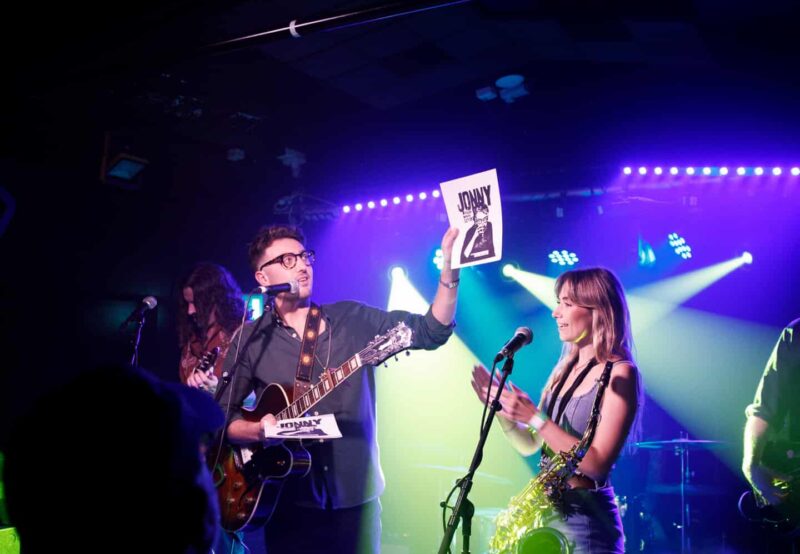
It’s striking to observe the clear synergy between the performers and the audience, who are digging the jokes and laughing heartily at the singer’s remarks, which Morgan pulls off with inspired wit. The atmosphere is lively at this point and full of positive energy. “Who has a copy of The Hope That Kills You?” A considerable part of the audience cheers. “Who doesn’t?” A couple of people are prompted into brief, confused clapping. “Bastards…!” “You’re a young Bruce Springsteen,” comes a shout from within the audience. “Yes,” agrees Morgan sardonically, before adding “without the money or fame.”
The show shifts in dynamics with ‘Deleting Pictures of You’, an emotive ballad in which things slow down to touch upon themes of heartbreak and longing. It’s a timely break in intensity that shows the planning put into the set list, a thoughtful journey across different styles and moods. ‘Lonely in Soho’, a callback to their debut EP, appropriately named ‘A Brief Introduction’, prolongs the momentary calm before getting things back into gear. “That’s the sensitive part of the show. Now let’s have some fun.”
The band put their foot on the accelerator with ‘Jumpin’’, a fun blues that gets the audience straight back where they wanted, and soon they’re singing along to every “Hey, hey, hey!” with the high spirits you might find at a party, not least of all on stage. It’s reminiscent of the energy seen in old all-star concerts in which great musicians knew how to have fun while they gave a stellar performance. And sure enough, by this point, people are pulling out their phones to record key moments of the show. After a masterful solo, one of several since the start of the gig, Morgan has to acknowledge the chops displayed by his lead guitarist, Joe Coombs.’“He looks like Jesus and plays guitar like him too.”’“Praise the Lord!” hollers someone.
The show continues with ‘Don’t Come Around’, described as “the pop one”, or in other words, the most radio-friendly track on the new album. And then, again, it’s time to give the audience something more familiar with a cover. But before this, Morgan takes a moment to mention the financial strain many musicians face to get their music out into the world, describing his situation as that of “an unskilled worker who can only play six chords”. The industry is certainly becoming an increasingly elitist place, and it’s edifying to hear how some financial obstacles may be overcome by playing cover gigs. With this refreshingly honest introduction, the band dives into the aptly chosen ‘Walk of Life’.
In the last stretch, the saxophone becomes more prominent after a somewhat diminished presence for part of the show. For the last few songs, the band finally finds the perfect balance between the different instruments, and for the performance of the title track are joined on stage by co-writer Alex Francis. The rest of the band is introduced: the rhythm section consisting of Sam Weston on bass and Joe Montague on drums, Eve Lesedi on saxophone, and last but not least Joe Coombs on lead guitar. For Morgan the experience has been a dream come true, he explains, as someone who wanted to tour playing his music since the age of seven, when he got his first Stratocaster from Toys R´Us. His emotion is sincere, and after this, it’s easier to understand the evident effort put into delivering the best show possible.
The fact that both of the covers played mention a certain Johnny —whether he’s in the basement cooking up the medicine or singing oldies, goldies— hasn’t gone unnoticed. Regardless of the intention behind this (or lack thereof), it’s a good reflection of the overall dynamics and setup, in which Morgan has plenty of opportunity to take the spotlight and let his charisma leave a mark on the audience’s mind, like a great lyric you find yourself singing even if you forget the rest of the song. Because those who frequently attend concerts will likely have experienced the feeling that different nights tend to merge, but Jonny Morgan & The Moral Support’s show at the Grace is not one of such nights. If you were present, you will likely, days later, vividly remember the experience and consider repeating it at the next given opportunity.


