
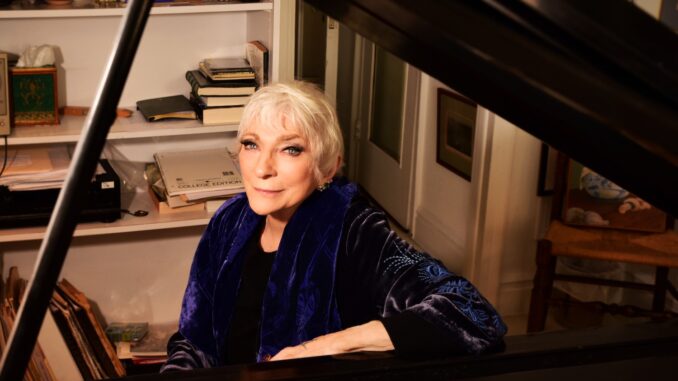
“My home is in New York City, on the Upper West Side,” Judy Collins said, proudly holding up a painting by her sister of cats and dogs that resembles a Monet. When I mentioned travelling up to New York this summer to take a walking tour of Greenwich Village with Willie Nile, she thought that was a wonderful idea. “I knew Willie back in the day, but I haven’t seen him for a long time. I’ll look him up. Maybe I can get on one of his tours. Show him where I lived in the Village.” Collins arrived in New York City around 1961 to immerse herself in the burgeoning folk revival and lived on Sullivan Street during the early to mid-60s. During this time, she did some busking before becoming a fixture in local clubs such as Gerde’s Folk City and The Bitter End. She moved to Manhattan to gain more space and has been indisposed to move ever since.
With a long and successful career in the rear view, at age 86, she will be embarking on a farewell tour, dubbed “Sweet Judy Blue Eyes” after the song (Suite: Judy Blue Eyes) Stephen Stills wrote with her in mind on the first Crosby, Stills and Nash album. The tour is starting this July and continuing into 2027. “Yeah, I’m always on a tour, of course,” she confirmed. “You probably know that, but this will be a little different. We’re adding a lot of interesting artists. Rosanne Cash, Mary Chapin Carpenter, Amanda Shires, Richard Thompson, Elles Bailey, and a few other people are going to join me. It will be fun.”
As for the setlist, it will be far from static, although the old favourites will be worked into her sets. “I move it around because I want to be creating the sequence that I’m going to be doing that day,” she asserted. “So, I always mess around with the lyrics, and I put them hopefully in a different context. You’ll usually hear Someday Soon somewhere and Both Sides Now. You’ll always hear Amazing Grace at the end, well, usually. And I try to put in there Send in the Clowns because people love that one.”
When asked if she would play Spellbound from her 2023 album of the same name, her face and demeanour shimmered like a diamond necklace. “Absolutely. I’m singing that a lot now. It’s the album that has all my own writing on it.”
One of the songs on Spellbound (Arizona) has a history from a difficult time in the singer’s life. She travelled to Arizona in 1962 after opening for Theodore Bikel at Carnegie Hall in New York City. “The next day I had to fly and was sick with some bug,” she recalled. “But I wasn’t going to see a doctor because I didn’t want him to mess around and tell me I couldn’t do things. I sang at a little club called Ash Alley, and the kids that ran the club told me their day job was working for a doctor in Tucson. They said I wasn’t well, so we got in the truck. I made them stop at a liquor store and got a quart of Kahlua and a case of Canadian beer, and said, ‘I’ll be okay for a while.’ The doctor looked me over and said, Honey, you’re not going anywhere. You have tuberculosis.”
She was taken to a sanatorium and had settled in for three months of isolation before being transferred for the second three months of treatment to another one in Denver, where her mother was living. “Then I had real troubles,” she recounted, referring to her first husband, Peter Taylor, and son Clark; “First, he brought my son to stay with my mother, where I could visit him every day because I was at the hospital and wasn’t an outpatient. And then his mother and stepfather came and kidnapped my son, took him back to the East Coast.”
Her husband sued for divorce as well as custody of their son. He couldn’t have waited until after she recovered? She calls Taylor her “starter husband” as if he were someone you could use to make sourdough bread. “No, he was a sonofabitch in a lot of ways,” she said, the long frown of time perhaps erasing some of the bitterness. “The song is very meaningful because it reminds me of the terrible things that happened, but it also reminds me that life goes on.” It took three decades for her to marry again, in 1996, to an industrial designer named Louis Nelson. “Louis died in 2024, so I’m still trying to get through that without losing my mind. He loved the Arizona song.”
TB wasn’t Collins’ first bout with a major illness. The family had moved from L.A. to Colorado in 1949, when she was ten years of age. She contracted polio and spent two months in the hospital. “As soon as I could, I was horseback riding out there. I was always horse crazy. And my brothers were skiing. I was playing the piano, so I had to be practicing all the time. But we loved Colorado from day one. My father wrote a song about Colorado. Girl from Colorado was a big hit for a while, whereupon she began singing it (over Zoom) in that familiar, clear voice as if half a century hadn’t passed. Colorado is the place to be. Hearts are yearning, steps are turning. Since the magic of the hills is calling me.
Years later, with Colorado still on her mind, Collins wrote The Blizzard when she was playing shows at the Wheeler Opera House in Aspen with Kris Kristofferson. She was unaware the song was added as a bonus track to Spellbound, the only time it has appeared on an album. “I had it as a lyric, as a poem for years, but I couldn’t finish it,” she said. “I didn’t know what to do with it, so I asked Ari if he would help me with it, which he did.” Ari Hest and Collins established an intergenerational partnership, collaborating on the 2016 album Silver Skies Blue.
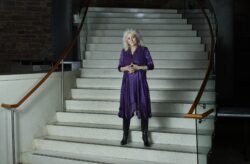
Collins once described songwriting as a mundane task, whether done in hotel rooms or at home, referring to her “toaster muse” as how she found inspiration. “I think that’s an interesting way to put it,” she said, eyebrows arching like stretched cats, “because you’re staring into the toaster, and you don’t know how hot you should get it. You’re never sure about a song, putting it in the toaster. That makes perfect sense. You have to heat it up somehow and give it a surface that’s edible and pleasant. And it takes time because sometimes you have to just sit there watching the coils glow.”
Before singing took over, Collins was trained as a classical pianist, starting at the age of 5. “I played with a symphony when I was 13 and was headed towards that at 16 when I heard a song on the radio.” Once again, she began singing as if it were yesterday: “T’was in the merry month of May, When June buds all were swelling, Sweet William on his deathbed lay, For love of Barbara Allen. That’s what kicked it off. I thought oh my God, I’m going to have to stop playing Rachmaninoff.”
She still plays piano and does her exercises, but her main instrument is an acoustic guitar. There is a special wildflower (columbine) inlaid on her signature Martin 12-string. “I have had a long relationship with Martin. I was already playing a Martin when, in 1964, I got a call from whoever the president was there, and they said, ‘We want you to come to Nazareth (Pennsylvania).’ Tom Paxton and I were both invited to come to the dedication of the new barn, where they were doing all the work. So, we played guitar for that big gathering of the new factory, and we were both given guitars that had our names on it. It was very exciting”.
“My road manager put it in his car,” she continued. “He was a big film producer later on, but he was not a good road manager, I’ll tell you, because he left it in his unlocked car down in the Village and it was stolen. And for years, Martin looked for it. I looked for it. There’s a code on it, but they’ve never located it. So, somebody is carrying around my 1964 Martin six-string. Of course, later on, I started playing the 12-string, and now that’s what I do all the time. I started to finger pick, and I was one hell of a finger picker.”
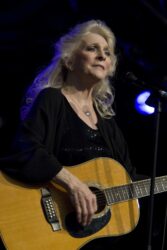
It was Travis-style picking, which turned out to be a strain on her hand, necessitating surgery. But that wasn’t what stopped her. “What stopped me doing the finger picking, the Travis style, was that I heard Pete Seeger’s song,” once again singing in notes that would thaw a frozen tundra in Lapland, “Oh what will you give me, said the sad bells of Rhymney, And I just couldn’t stop listening to the 12-string. I finally said to Pete, ‘I’ve got to get a 12-string, and I’ve got to start playing it.’ It sounded like an orchestra.”
One of Collins’ most famous songs is Send in the Clowns, written by Stephen Sondheim for the 1973 Broadway musical A Little Night Music. Discovering that Leonard Cohen had a hand in her recording it on the 1975 album, Judith had curiosity popping my neurons like buttons on a shirt. “I got a hold of it because of Leonard Cohen’s best friend, Nancy Bacall,” she said, a bit bemused. “I was introduced to her when I met Leonard in 1966, and she and I became very good friends. He also introduced me to his other girlfriends, and I introduced him to my friends. That was how it went then. Anyway, she called me one day and said, ‘I’ve sent you an album, and I want you to put the needle on it and play this song, and then call me.’ So, I put the needle on it and called Hal Prince, because his name was on the LP. He knew me as the Both Sides Now girl.”
“Anyway, I told him he had a great song, and he said he knew it; two hundred people had already recorded it. I didn’t care. I asked who should do the orchestration, and he said the guy who did it for the show, Jonathan Tunick. I had dinner with him not too long ago, and I said the reason the song became a hit was you started out with the English horn, da-da-da-da. Nobody else recorded it like that. But Sondheim always would tell me that Sinatra had the hit. That was insulting.”
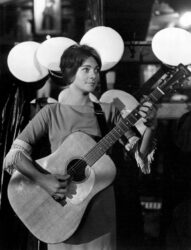
Leonard Cohen was the one who started Collins writing her own songs. “Leonard’s best friend from Canada was Mary Martin, not the one who flew in the movie,” Collins said. “She worked for Albert Grossman with the big record companies in New York. She called me, and we had dinner, hung out with other women and just talked and gossiped about things. One day she said, ‘I grew up with this guy, Leonard, and he’s such a great poet, but he’s not going anywhere.’ Well, that’s too bad. Then a couple years later, she called me, and she said, ‘Well, guess what? Leonard wants to come and sing you his songs.’ I asked if they were obscure, which is what she’d said about his poetry.”
When Cohen came calling to Collins’ door, she thought I don’t care if he can’t write songs. We’ll think of something. Then he came in. “Thank God I didn’t think of anything to do with him because he was a useless ladies’ man. He told me he couldn’t sing, couldn’t play a guitar and didn’t even know if what he had was a song. And then he sang Suzanne to me, and I said, ‘This is a song, and I’m recording it tomorrow,’ which I did, and it became a hit.”
Cohen said she had made him famous, and he wanted Collins to sing all his songs. She told him that he should sing them himself, but Cohen thought he had a terrible voice and would rather not. “I said yours isn’t a terrible voice; it’s a little obscure,” Collins said diplomatically. He also thought she should be writing her own songs. “So I went over to my Steinway piano, and I wrote Since You’ve Asked, and that was the beginning. It was on the Wildflowers album, which came out in 1967, along with Both Sides Now.”
Fans of Collins from the ’60s are going to feel like time has slowed, maybe even reversed, when they hear selections from her back catalogue during the farewell tour. For instance, she’ll sing Maid of Constant Sorrow from her 1961 debut on Elektra, which featured traditional folk songs. “Particularly, I play that when I’m working with my pedal steel player, Thad DeBrock, who is brilliant. He’s coming on board, and so we’ll do it again.” There will be songs through the decades up to Spellbound, relatively a musical whippersnapper of only two years. “I’m doing it with my swing pianist, Will Kjeer, who’s just extraordinary. I’ve worked with Russell Walden for almost 40 years, and it’s always different with another pianist.”
Warm-up dates are scheduled for June, before the tour officially kicks off on July 4, 2026, at the “America Made In Virginia: 250 Years Together” celebration hosted by Virginia’s American Revolution 250 Commission (VA250) in Colonial Williamsburg, the capital city of revolutionary Virginia. Collins will headline the live, star-studded Independence Day event and broadcast. The sagacious concert-goer will understand that these are no mere events that you can catch another time. She has said she would do it until she can’t do it anymore. Well, this is it. When asked what would be her advice to her younger self, the ’60s Judy Collins, looking back? Her answer was simple and succinct: “Don’t look back, look forward.”

