
Sensitive sounds carry poetic lyrics and encourage deeper reflections on meaning.
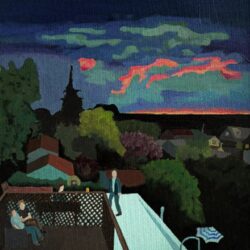 Mildred is a four-piece band from Oakland, CA, with members: Henry Easton Koehler (vocals, guitar), Jack Schrott (vocals, guitar), Matt Palmquist (vocals, bass, woodwinds) or Will Fortna (drums, production), each time. They bring different perspectives to their shared music, hardly surprising considering their day jobs are quite divers: Jack is a PhD student, studying sub-atomic physics, Will is an environmental lawyer, Matt is an architect, a job he took up properly after a year in a Benedictine monastery and Henry works in affordable housing, helps his dad grow beans, and plays a lot of basketball. They have a couple of EPs to their name, Mild and Red, but Fenceline is the debut album.
The opening song, UPS Brown, is a series of vignettes in a one-sided friendship, where easy promises are easily broken, and party invitations lead to being abandoned to the company of a boor. It features a lead vocal and lyrical style very much in the Bill Callahan mode, as does the title album song, where a laid-back accompaniment gently props up a vocal that is perhaps to its own surprise is intent on communicating every action to an absent partner, starting from “I got high again, I just thought I’d let you know.” Fleet Week paints an impressionistic portrait of sailors on shore leave, ready to paint the town red, whilst they are observed with amusement from those already ashore. It’s a time that seems like it could stretch out endlessly, as the words ring out, it is “forever fleet week.”
Whilst the majority of the songs are pitched within a modern folk-rock framing, there are also more experimental songs such as Hardcore of Beauty, which beats time with an electronic cymbal sound, which challenges the listener to accept this as beautiful, and then rams the point home with discordant guitar playing and random noise making as if to ask are you still enjoying the poetry? Mumblecore Melody leans into self-analysing, and not finding much positive in what the analysis reveals, then taking that bedroom folk revelation and marrying it to an expanded soundscape moving from a regular gentle rock accompaniment into a scene of noise and confusion before relating a humdrum life of repetitive form, filling in a spoken word rap.
The thing that lifts Mildred’s album a little higher than most is the quality of the words, with references littered through them there to be discovered, and thereby giving a wider meaning to what might otherwise seem like a very direct lyric. Even the small vignettes have bigger things to say. In that way, it’s somewhat akin to Midlake, although musically very different (although we do find some ethereal flute on Cobwebs), more interested in a melodic folk-rock that gets those occasional rough scrubs as the real, perhaps less pretty, world insists on pushing in.


