
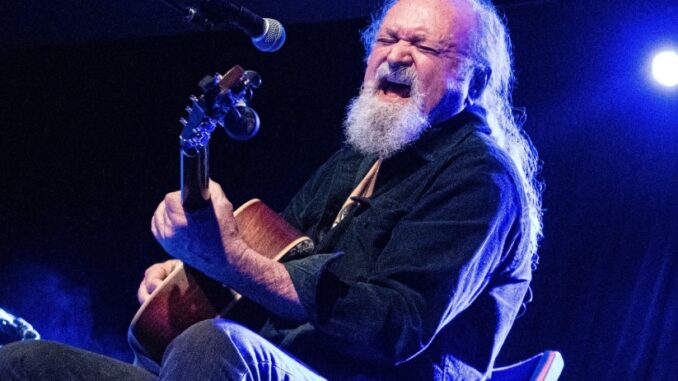
In 2025, Tinsley Ellis returned to the deep roots of the blues after the success of his previous album, Naked Truth (Alligator Records, 2024). There are many different styles of playing wrapped up in his music, from 4-bar blues to boogie, country blues to Delta blues, even some Hill Country. His main influences early on were electric players like B.B. King, Duane Allman, Eric Clapton and especially that of Freddie King. You don’t hear any of the Three Kings (including Albert) in his acoustic playing, but it’s still alive underneath the finger-picking in the way he turns a phrase or bends a string.
Whether acoustic or electric, his sound is as recognisable as his southern drawl, which enriches the tales he spins at a show. He is a student of the game, a history major in college and is determined that people come to know the history of the music he plays. “I feel a sense of obligation to talk about it without being too scholarly or academic,” he said, while displaying a pleased, ruminative expression. He calls shows Tinsley Ellis: Acoustic Songs and Stories. “It’s cause I love to talk. I’ll do some Delta Blues on my old National Steel and other stuff on my Martin D-35. Maybe talkin’ a little bit about how I wrote the songs, then tellin’ some stories, some of them ribald, stories of the road.”
On Labor of Love (2025), Ellis delivers a raw, edgy, catchy set of 13 original compositions, all performed with pure emotional honesty. The album is vulnerable, rootsy and showcases Ellis’ passion and truth fueled by an acoustic setting. The songs spin modern tales of floods, conflagrations, voodoo spirits, personal travails and heaven-sent prayers. From the feral opener Hoodoo Woman done Hill Country style to the John Lee Hooker-groove of Long Time, from the evocative, Skip James-inspired To A Hammer to the Son House-style stomp of Sunnyland, Ellis inhabits his songs in a way that is simply astonishing. There’s a palpable giddiness to this album, an exuberant sense of humor that comes from the ultimate freedom: the cutting loose from all worries and constraints. And coming to a time in his life and career when he “can do whatever the hell I want and play what I want to play.”
It has worked best for him when it combines the working-class fundamentals of the blues with the ambition of refusing all limitations. He has an obvious zest for life of which a good share of it is taken up by driving around the country and playing gigs, a lot of them on a tour he calls “Two Guitars and a Car.” After a few rescheduled dates, happily we found a time for the interview which follows. Just like in his music, Tinsley Ellis is locked in during conversation and never fussy about making a point.
Americana UK: What caused you to switch from electric to acoustic guitar?
Tinsley Ellis: Well, I started on acoustic guitar after seeing the Beatles on the Ed Sullivan Show in 1964, and my parents wouldn’t get me an electric guitar. I guess I would’ve been six or seven at the time, and they rented me an acoustic guitar. I’ve always done acoustic music as a part of my shows. And what I found five, ten years ago is that I was just kind of lying in wait for that part of the show every night, just getting really excited about the middle, which would be two or three acoustic songs. This now is the full extension of that part of the show. And I don’t know if I’ll ever go back to the way I did it before. I am really enjoying the freedom of playing not only acoustic, but playing solo acoustic.
AUK: You’re playing a little mandolin on the album.
TE: It’s on three songs and is part of my shows, just a little something extra.
AUK: What struck me about this latest album is the variety of arrangements and accompaniment for your songs. There are a lot of different blues patterns.
TE: There are six or seven different guitar tunings on the album that some of my favorite acoustic artists tuned in, like Skip James, Muddy Waters, Fred McDowell and Elmore James. At the end of the day, I don’t think there’s any song where I’m using standard guitar tuning, and that’s just the way it worked out for this particular album.
AUK: One of them, Silver Mountain, I couldn’t figure out what you were tuned in. I tried Drop D and a couple other open tunings. Maybe DADGAD, but I didn’t fool with that long enough.
TE: You’ve got a good ear. That one is on the Naked Truth album. That’s a big part of my live show and throwing in a Jimmy Page tease every once in a while.
AUK: Long Time reminded me of a riff Canned Heat played a lot.
TE: Yeah. The endless boogie. It’s definitely a John Lee Hooker type thing, from Clarksdale, Mississippi. And it’s finger-picked, as are all the songs on the new album, with the exception of one song where I used a 12- string and that’s in Drop D tuning. You definitely want to use a pick with the mandolin though.
AUK: Tell us some about your origins. You were born in Atlanta, moved to Florida, then went back to Atlanta.
TE: My parents were college students in Atlanta and then moved to South Florida, which is where my dad’s family was from and stayed there until 1975. I came up to Atlanta to go to college. I really wanted to get in with the Southern rock scene; Macon, Georgia, Capricorn Records. So in the late ’70s, the band I was in was called the Alleycats. We auditioned for Capricorn, and before they even got a chance to reject us, they went out of business. But then I did do an album with Capricorn when it came back as a label in the 1990s.
AUK: How and when did you sign with Alligator Records?
TE: Well, I had been in a band and made four albums with the Heart Fixers here in Atlanta. We started in 1981 and did our final album in 1986. And that brought me to the attention of Bruce Iglauer. He came to Atlanta in 1987 and signed me to Alligator. At the time, they didn’t have any long-hair blues. My first album for Alligator was in 1988. That was definitely the turning point of my career because before that, I would just go up and down the East Coast. And I’d gone over to Europe a couple times to tour. But when I got with Alligator, it became more of a global thing. And at this point, I played all 50 states and all the lower provinces of Canada and overseas in all directions. So, I’m really grateful to have that relationship.
They had mainly artists from Chicago, with the exception of people who were already famous like Roy Buchanan, Johnny Winter, Dr. John, Professor Longhair. But pretty much it was a Chicago blues label. I always met with a lot of scepticism. Lonnie Brooks and his family were the first people to really befriend me in Chicago. Over time, I hopefully won over my critics.
AUK: You call this extensive touring schedule Two Guitars and a Car.
TE: That’s a good description of what I do. Of course, I got changes of clothing and CDs and vinyl in the car. I just did a 40-show tour. Went all over America right when the album first came out.
AUK: How many miles are on that car?
TE: It’s got 130,000 miles now, but I went all the way on that tour from the Northeast to California and all the places in between. And I’ve got another dozen shows coming up. After that, I’ll be anxious to get back to the drawing board and into my songwriter mode.
AUK: What do you like for food on the road? You wrote that song Sweet Ice Tea about soul food.
TE: I look for soul food, which is not the easiest thing to find all around America. I’d like to tell you that I eat healthy on the road, but it’s just really hard to do that. A lot of handheld food is involved in touring.
AUK: I heard there was a story about having a guitar string that B.B. King broke.
TE: I went to see B.B. King when I was a young teenager, and he broke a guitar string. I sat in the front row, and he handed it to me or maybe somebody at my table. That was a real aha moment seeing Mr. King and then meeting him after the show. He greeted us all in the lobby and talked to us for a while. He’s the nicest man. But after I saw him in concert, all of a sudden, I could see where Duane Allman was coming from, Peter Green and Eric Clapton, all my heroes. After that, it became kind of a quest for me to sit at the feet of B.B. King and Howlin’ Wolf, Muddy Waters and Albert King.
At Alligator, I got a chance to actually play with a lot of my heroes, Otis Rush and Albert Collins and Buddy Guy, of course. And it saddens me that they’re all gone now, except for Buddy Guy. But there’s some new people coming out like Kingfish and Jontavious Willis that give me hope. Jontavious is in a little town in west Georgia. We hook up together every once in a while, and it’s almost like a guitar lesson because he’s a force of nature on acoustic guitar.
AUK: Jontavious does a lot of talking in the shows I’ve seen.
TE: I do quite a bit of talking in my shows too, telling stories about the old blues guys. I don’t want people to not know about it. That’s the way I found out about the original blues was word of mouth. So, I feel a sense of obligation to talk about it without being too scholarly or academic.
AUK: Are you enthused by Freddie King’s playing?
TE: Even though he’s probably one of my biggest influences on electric guitar, I never got to see him in concert. I opened shows for BB and knew him, and I knew Albert King and opened shows for him as well. Freddie was gone by the mid-‘70s. I don’t remember him ever playing down in South Florida, but somebody told me he played down there as a part of a tour with Leon Russell, which would make sense because Leon was his producer. I wish I had seen him live, but I’ve got all his recordings and just love his music.
AUK: What was Albert King like?
TE: He was a moody guy. Sometimes he’d be real friendly. Now, B.B. King was always friendly. On any different day, Albert could be ill-tempered, and then other times he’d be really friendly and complimentary. I would try to get a read on him before I would approach him. But he used to come see us play on Beale Street at B.B. King’s club. That’s a pedestrian street during the day, then they shut it down at night. People walk up and down the street, and they don’t allow any cars on there. But Albert King totally ignored that and parked his big Cadillac right in front of B.B. King’s. I guess they bent the rules for him.
AUK: There is a picture online with all your guitars. The one with the Sunburst and a Varitone switch is really pretty.
TE: That’s my Gibson ES345, which would’ve been the kind of thing B.B. King, or definitely Freddie King, would’ve played back in the day. And that and my old Strat are my go-to electric guitars. Currently, my go-to acoustic guitars are a Martin D-35 and my 1937 National Steel. I got so many guitars and amplifiers. I’ve been thinning the herd a little bit, knowing I can’t take them with me when I go. Maybe they will go into the hands of somebody that would use them.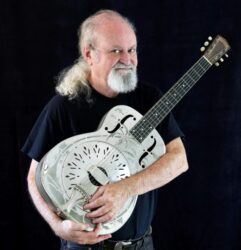
AUK: One of the songs you are well known for is A Quitter Never Wins.
TE: I put that on my Storm Warning album (Alligator, 1994). That was my biggest-selling album ever.
AUK: Wasn’t Chuck Leavell on that album?
TE: Yeah, Chuck Leavell and Oliver Wood and a very young Derek Trucks. I think he was 14 at the time. I recorded that song, and then I was playing a venue up in Minneapolis and a knock came on the dressing room door. I opened the door, and there was a really young kid out there wanting to come in. He wanted me to teach him A Quitter Never Wins. He didn’t seem dangerous, so I let him in. It turned out to be highly dangerous because his name was Jonny Lang, and he put A Quitter Never Wins on his first album, and it’s sold over two million copies of my song. That definitely got my attention. Now, there are couple dozen others who have recorded it. Melvin Taylor probably did my favorite version. And then a few years back, John Mayall put it on his final album. So that’s definitely a song I feature every night.
AUK: Getting back to the new album, Hoodoo Woman sounds a little like Hill Country blues.
TE: Exactly. That’s coming from the R.L. Burnside thing, which is one of my favorites. I first found out about R.L. Burnside in the early 1980s. The guy that produced the very first Heart Fixtures album, George Mitchell, had discovered and was the first one to record RL. We used to do festivals together. I’d open for him, and I’d always soak in that groove and that sound that he had. RL was kind of the last of the Mississippi superstars, him and Junior Kimbrough. I love that Hill Country stuff.
AUK: Once on a trip, I went down to Lafayette County in Mississippi and saw R.L. play at Junior Kimbrough’s place. That was a couple years before he died, and he wasn’t in great health. I am told the Black Keys got their start there.
TE: I never got a chance to go to play there, and I had every opportunity to back in the day. But I did recently go to Jimmy “Duck” Holmes’ place there in Bentonia (Miss.), the Blue Front Cafe. And that’s a juke joint; there is no stage or anything, just got a bar and a refrigerator. They sell some cold beer and maybe some food from time to time. Like I said, no stage, just a bunch of old guitars and amplifiers. And “Duck” Holmes gets up there and wears it out. He’s definitely the keeper of the flame of the Bentonia sound that was most popularized by Skip James.
AUK: He has that one chord, drone groove thing going on.
TE: Unique. Open D minor, that’s the Bentonia tuning. And I used that a lot on the new album.
AUK: On I’d Rather Be Saved?
TE: Exactly. And on To A Hammer, Everything’s A Nail and Fountain of Love.
AUK: Too Broke is pretty funny. No worries if you’re too broke. I like how you have the bank truck with all the money pulling up to the funeral.
TE: Yeah. “If you want to stay happy, stay broke all the time.” “I’ve seen a lot of weird stuff in my day, but I’ve never seen a bank truck in a funeral parade,” which means you can’t take it with you when you go.
AUK: I guess if I had a truck in my funeral procession, it should be one filled with faith, not money.
TE: That’s an old saying, by the way, kind of a dad or granddad saying. Those things have really stuck with me and stood the test of time. Another good one is, “If work was fun, they’d call it going to ‘fun’ in the morning.” There’s a song in that, I believe.
AUK: I’d wager you go to fun in the morning or night.
TE: I definitely do. I’m more excited about performing these acoustic shows than anything I’ve done probably since I made the live album in 2005. That was an exciting time. Then I kind of ran out of ideas for a while. When COVID was over, everybody went back on tour, and I just decided to do it this way, acoustic. It was my escape plan.
AUK: In Grown Ass Man, you’re take on ageing.
TE: It talks about a woman that just can’t stand serious love from a grown-ass man. That’s something a lot of people can relate to. I mean, I wish I looked out there and saw a bunch of college kids at my shows, but that’s the way it was in the 1980s. It would be nice if we got some young fans. I think it would take another Stevie Ray Vaughan to make that happen.
AUK: You are spending time on the road more than most musicians. There must be a story worth telling our readers.
TE: Gosh, so many. My favorite times performing was when I’d get a chance to open for somebody, then they call me up on stage to play with them. I haven’t had that happen in a while, but jamming with Duane in the Allman Brothers Band, Derek and Susan Tedeschi and Warren Haynes. I remember one time I got a chance to open for Buddy Guy and John Lee Hooker at the Beacon Theater in New York City. Sold-out show, thousands of people there right on Broadway. Then next night, I played this little place in Lancaster, Pennsylvania that only held 80 people. You’re just trying to find a way to bloom where you’ve been planted.
Even before there was an expression called americana, there were bands that did that like the Allmans or the Band. There were people doing roots American music. Blues is the true roots of americana, where it meets folk and country. Taj Mahal is a good example of that kind of blend. I met him at a bar in Atlanta and have done quite a few shows with him over the years.
AUK: I believe we’ve done it. Thank you for the conversation, Tinsley.
TE: You’re welcome. Had a good time. Now, you come see one of my shows, you hear.
I’ll be certain to do that. And if anyone reading this wants to know where to hear Tinsley Ellis play, check his website.

