
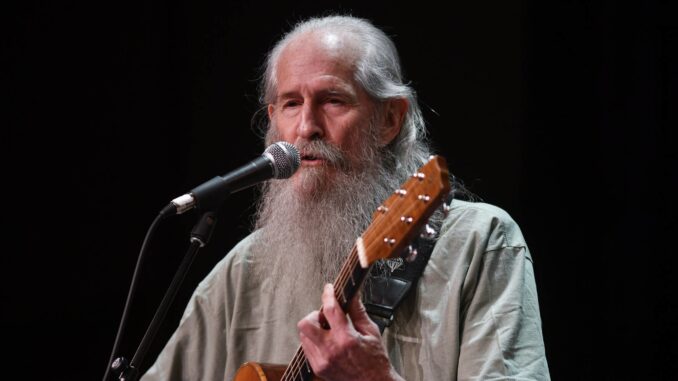
Like the old sailors of yore, Hank Alrich sure knows how to spin a yarn, though I doubt his are made up or heavily stretched. They keep your attention. I would contentedly sit in an armchair holding a ball of yarn while he crocheted a handmade afghan as long as the stories kept coming. Alrich is also a helluva songwriter and holds his own as a musician.
I don’t know much about songwriting, at least not in the technical sense, but I’m pretty sure I can tell a good one from a bad one. Alrich is a strong lyricist, maybe one of the best I’ve heard this year. I listened to an old record of his with Andrew Hardin recently and will hold onto it tightly. Alrich’s characters are compelling and familiarly flawed. They’re human portrayals of human people, though the particulars on his new album, Broken River, land closer to social issues than one might expect. He has emerged from a decade-long hiatus older but healthy and full of memories he’s asked us to step into alongside him. Broken River isn’t just a declaration, but an earned reputation.
The songs are warm, affable and intimate as always, as is the man. They are rich in sentiment and nostalgia and the intricacies of a daily life built from small moments. It’s not without a bit of sonic exploration, but Alrich knows what works for him, and sticks to it well: easygoing vocals singing poetics over artful, complex guitar lines from Hardin. His effortless charisma bleeds through every word, every riff, welcoming listeners into his world and inviting us to make ourselves comfortable. To our delight, Alrich said he’s not been treating the record like it’s his last at an advanced age, but even if it is, it’s one you can sit inside for the long haul.
Alrich is an unabashed nostalgist, a genteel romantic; the kind of presence you might expect from an eighty-two-year-old entertainer with an impossibly rich backstory and a knack for pointed commentary. He has an earthy spirit that animates everything from the absurdist Blue Guru to the folk curiosity Don’t You Listen to That Man. The songs will make you think; the stories will make you laugh, or vice versa. You’ll likely do both reading this interview.
Americana UK: Good morning, Hank. Are you in Texas this morning or home in California?
Hank Alrich: I’m actually at a friend’s house in Quincy, California. I live in Plumas County, three miles outside the town of Greenville, which is in northeastern California, about two hours from Reno, Nevada. My house was incinerated by the Dixie Fire in 2021, and a lot of infrastructure was destroyed, so I don’t have good internet at my house.
AUK: I know California isn’t called the Golden State for the wildfires, but it sure has a lot of them.
HA: We are on the cutting edge of climate change. There were a couple of little tornadoes outside of Chester two days ago, and that’s pretty much unheard of. The other thing is, after leaving Austin in 1985, I wound up living right on the cusp of a meadow and the forest. When you’re outside the urban environment, the thermal mass around you is natural. It’s the trees and the meadows and the dirt instead of asphalt and concrete. You can’t miss the change in vegetation. You can’t miss the insects and birds that you didn’t see before. You can’t overlook that the poison oak has climbed about 800 feet.
AUK: I read the term “sonic explorer” among your materials. How would you describe that?
HA: Well, I have an interest in everything from Lightning Hopkins to Hank Williams, Ornette Coleman and beyond. I play a lot of different kinds of music. I’ve spent time improvising what would be called free jazz with a friend who’s fantastic at that. Out of thin air, somebody plays something, and you respond and develop, sometimes for an hour or more, a continuous piece. I’ve played blues and country music, folk, bluegrass and jug band music. I’ve played standards. I’ve been the bass player in a fabulous acoustic swing quintet. I have an interest in sound and spent a lot of time in audio engineering, recording, and production. I’ve built studios. Exploration is a matter of curiosity: you always wonder how do you get better tone out of your guitar? Do you blame it on the pick? Is it the strings? Your fingers? I’m fascinated by sound in that way.
AUK: I play some guitar, and for me the arthritis gets the blame.
HA: The guy I played with for 38 years has pretty much quit playing for that same reason. Ten years ago, I realized that if I didn’t stop wrapping my thumb around the fretboard when I was making the D-major chord, my left thumb was going to give up. So, I trained myself to make that chord differently, and in the process, that led to a lot of new chord shapes. Same thing was happening on my right thumb. Eventually, I found that a certain vitamin regimen put it in abeyance. Before, I was joking that the thing I liked about arthritis was giving it the finger in the morning. At my age, I didn’t expect to be alive, let alone playing and productive. Still, I don’t write songs on purpose, but they won’t leave me alone. They keep showing up and demanding that I either finish them or go nuts.
AUK: You have a daughter who plays with you sometimes. In a picture, she had a fiddle.
HA: Her name is Shaidri. I’ve had a duet with her since she was three. I tell people her name rhymes with shade tree because she’s cool. She’s a pretty good fiddler and a great songwriter. She doesn’t realize what a good rhythm guitarist she is. We made a lovely folk album in 2009, and she assumed that the fellow who was the producer was going to play the part she played, and he laughed and said, “I wish I could play like you. I can play all kinds of things that you can’t. Only you can get that feel, and that’s the music that you and your dad make.”

AUK: It appears you are not the most prolific musician when it comes to recording, making an album every decade.
HA: Isn’t that wild? It sounds ridiculous, but I have the next album lined up and the one after that, all the material. I have hundreds of songs. I have a swing album I want to do, and I easily have enough tunes for a bluegrass album and another kind of older rural finger-picking folk style that I would probably make with a bass player and my friend Andrew Hardin. I’m hoping to accelerate that curve. I’ll be 82 in November and like I said, amazed to still be walking around and playing music. And I still play my set standing up.
AUK: You just accumulate songs through the years.
HA: Well, I don’t write an album. All of the songs in a personal library span a wider stylistic spectrum than is on the Broken River album, which is fairly wide compared to what a lot of people might offer. I don’t consider myself a songwriter. I write songs when I have to. And by that, I mean that I’ll be doing some mundane tasks, splitting firewood, sweeping the floor, washing dishes, and a line will come to me. I’ve learned if that engages me, I need to write it down because in ten minutes I won’t remember it.
Then I’ll dry my hands and go back to the dishes, and the next line will come. It takes forever to get the dishes done. But I write when a song won’t leave me alone. Otherwise, I just work to become a better musician for when the next song comes along. I believe it was 2010; we went to our first Southwestern Regional Folk Alliance conference in Austin. The guy who produced the album I made with my daughter said, “People are going to hear your songs, Hank, and they’re going to ask you about your process.” And I’m going, “Well, what the hell is that?” And sure enough, one Sunday at the end of the thing, a very earnest, sincere young lady came up to me in the middle of hundreds of people who were about to go eat, cafeteria style. I told her I used the lightning bolt method. She had a puzzled expression. And I said, “I’m walking along minding my own business, and I get struck by lightning, and the lightning turns into a horse, and I jump on the back of the horse, and the horse starts running, and I hold on for dear life until I either get thrown off or there’s a song.” She looked at me and went, “Oh.” And I thought, well, that works because she didn’t ask any more questions. I’ve gotten better at talking with young writers or people who look curious.
AUK: I’ve only listened to Broken River so could you describe how that relates to your two previous albums?
HA: Well, parenthetically, prior to making this, I played on a lot of people’s albums in Austin. I built a studio inside Armadillo World Headquarters before I became the manager of that place. And I also put on mandolin, guitar, banjo and sometimes bass tracks for people along the way. My singing daughter, Shaidri, moved back to Austin, her hometown, in May of 2008, and coincidentally, I was working down there helping her older sister with the relocation of the major social dance instruction studio in Austin. It’s called Go Dance. I asked Shaidri if I could get us a gig because I was good friends with Eddie Wilson who owned Threadgill’s. We started in May, one night a month. And then my friend Fletcher Clark, with whom I worked since 1972, approached the proprietor of the Armadillo Christmas Bazaar, which had started at the world headquarters to get us through a Christmas season and had carried on to see if he’d get us a booking there.
He asked if we had an album or product, and Fletcher said, “No, but we will.” In the first week of November 2009, we went in the studio for three days, and a week before we were supposed to play in December, we had product. We had an accumulation of material that we’d been playing. It’s a dozen songs, four of them are mine, and others were like The Death of Ellenton, Peter Rowan’s Before the Streets Were Paved, The Great Baltimore Fire. I was attracted to that by virtue of the 1960’s “folk scare,” as it came to be called. She played guitar or fiddle, me guitar and mandolin, and Doug Harmon played cello and bass. Fred Remnert mixed it, Jerry Tubb mastered it and Bill Narum did the package design. We were going to make another, but my daughter got deeply involved in the dance studio.
AUK: The next was called!AH-HA¡ by you and Andrew Hardin – nothing to do with the Norwegian synth-pop band.
HA: I met Andrew Hardin out of the blue at the 2008 Folk Alliance International Conference in Memphis. I was there on a fluke. There’s a fabulous Australian Tasmanian singer, Audrey Auld, who passed away. I dearly miss her. Well, Eddie Wilson had met her and unbeknownst to me, she had rehearsed with Andrew, who had been with Tom Russell for 25 years, played on 500 albums and produced a couple hundred. He’s a legendary figure on the guitar, rightly so. And so anyway, a friend and I drove overnight in Eddie’s big black SUV hauling barbecue from Texas to Memphis – talk about chutzpah, take barbecue to Memphis.
We got there late at night and immediately met a gal, Laura McGee from Dundee, Scotland, and she didn’t have an accompanist. Odom told her, “Don’t worry about that. We have a guy who will accompany you.” It’s late at night and she’s traveled 42 hours. She has a Scottish manager who I can barely understand; his brogue is so thick. He asked, “Am I speakin’ too fast for ya?” then goes into this Mississippi drawl. Turns out he can do that colloquial ventriloquism. Laura played American country music, Scottish fiddle tunes and American fiddle tunes, and I understood the difference in accompaniment for all three of those. So anyway, phone rings in the morning a little too early, and it’s Eddie and he says, “Come on down here, Audrey Auld wants to meet you. Bring your guitar.” I go down and Audrey says, “Well, I’m pleased to meet you. Would you come play a few songs with me?”
Boom, just like that! We found a little side room that wasn’t being used, and she started playing a song and I was playing along with it. She did three songs and asked me if I wrote anything, so I played three songs. And she goes, “Oh, that sounds lovely, Hank. Would you join Andrew Hardin and myself for my showcase the next day?” And I was thinking, “What the hell would I be doing on stage with Andrew Hardin?” But before I could say that, another part of my brain had already said, “Sure.” Well, from the first notes we played together, it was like we had been brothers that grew up together playing. We have a similar approach to improvisational freedom and spontaneity, and so we took to each other and became guitar buddies.
AUK: I get the album title. It’s both of your initials and also an “ah-ha moment.”
HA: There is a song on Broken River, The Perfect Hat. It was early November 2017, and I needed to load the van and drive to Austin to oversee stage production at the Armadillo Christmas Bazaar. I’d been doing that for nine years. This will be my 10th year. And I had been writing nonstop. I said, “Damn it, I need to stop writing because I need to get the band loaded, get my act together and get out of here.” And of course, I started loading the van and those lyrics start coming to me. I live in the middle of a very parochial area. There are plenty of us who view humanity compassionately and plenty of others who consider the land that we stole from the natives their land.
By the time I got the van loaded, I had all the lyrics but didn’t have any music. Andrew had already made a list of songs of mine that he thought we should record. I played the new song, and he goes, “Wow! Well, I’m scratching one off the list and putting that one on.” We hadn’t really committed to recording yet. One day I was staying with a friend, and Andrew burst in the door for a jam session. He was very intense and said we needed to record these songs. So, we went to Merel Bregante’s lovely studio in Liberty Hill and made an album. It took us a week. I didn’t have the resources to promote it. I also had a lot of stuff going on in my personal life, and so did he, that we weren’t really going to be able to get that album the exposure it deserved. But it’s a good album.
AUK: Well, Perfect Hat appears as if it could have been written today. It sounds contemporary.
HA: That’s the thing; a good song is a good song. And if it’s not explicitly tied thematically to specific immediate issues, then it turns out to be timeless. Fast Money was written a long time ago as a potential theme song I submitted for a movie that was being made in Austin. The movie turned into a farce, and fortunately the song did not get accepted. Three or four years ago Shaidri said, “Dad, you know that song, Fast Money, you need to start playing that again because it just won’t go out of style.”
AUK: Don’t Listen to the Man seems to thematically follow The Perfect Hat.
HA: Yeah, it does. Now, I often don’t know exactly what I’m writing about, but in that song I did, and it came pretty quickly. Getting the melody exactly the way I wanted it was the hardest part and yet not a big struggle. I found my recording band. I’ve known these guys for years, but this is the first time we’d played together. They were pleasantly startled by the quality of the material and really took to it. Now these guys, they don’t take themselves seriously. They’re monster musicians, and they don’t have any ego wrapped up in it.
Anyway, I’ve gone off to use the bathroom and get a cup of coffee. I come back in and say the next song we’re going to cut is a cheerful little ditty about 10,000 years of patriarchy and religious oppression. They all started laughing. The outliers on the record are the three that relate to breakup of relationships: She Had Whiskey for Dinner, Where You Been and Locomotive Wind, which came out of those folk alliance conferences. We were playing a showcase for two people; one guy was listening very intently. Turned out his name was Brian Kalinek from Houston. He’s a fabulous composer, performer, arranger, with unusual chord changes and themes. The next showcase is in Ken Gaines’ room and has a different format. It’s Ken and two other artists doing a song swap. There was a woman there named Susan Herndon. She was born in Oklahoma from Woody Guthrie’s hometown, and is a very good musician, writes very interesting songs.
After I accompanied Ken Gaines, Susan said, “Play along with me too.” Well, we formed a fast friendship, and the next year she said, “If I could book us a little tour up through North Texas into Southern Oklahoma, would you join me?” That got us into the All Good Cafe in Dallas and the Blue Door in Oklahoma City, which is a very famous venue. We make friends, not necessarily musicians. The kind of people that you spend a few days with them and you’re going to be friends for life. You’ve connected.
Well, a few weeks after that, the tornado came through Oklahoma City and went right down the freeway. The radio announcer warned people, but it was too late to get out of town. Houses were destroyed, and dead people were in fields; trucks were being thrown in the air. And when you’ve just made personal connections there, people you care about and who care about you, that kind of news hits you differently. And that’s where Locomotive Wind came from.
AUK: You are quite the storyteller. “Consummate” is the word I’m looking for. I read your piece about robots on Facebook. Bass players must have loved that. “Who needs robots when you’ve got bassists?”
HA: One of my friends has got a PhD in physics, and he’s a bass player, and he loved it. The kind of people I get along with …. well, take their music seriously; they do not take themselves seriously. In fact, sometimes to get a measure of who they are, I’ll say to a musician, “You’d be good if you’d practice.” And I’m always saying that to someone who’s really good. I walked into Antone’s and the incredible Texas fiddler, Jason Roberts, was inside the back door sawing away, just playing fabulous stuff. We had met a few days before that and had a lot of mutual respect and appreciation. He was playing with Asleep at the Wheel at the time. “Hi, Jason,” I said. “You’d be good if you practiced.” And he goes, “Hank, all I do is practice.” And we both laughed. I said that to Redd Volkaert after he’d given a show. He’s fabulous. He goes, “Damn it, Hank. I wish somebody had told me that sooner.” I said it to another guy whose name I won’t mention, and he kind of took umbrage. This is a guy I never booked for a session.
AUK: Your songs often speak to issues of our time as large problems. But what gives you hope for the world?
HA: The resilience of humans, a refusal to capitulate. It isn’t clear good always triumphs over evil. There’s not really any evidence of that. We see surges of what many of us would consider as an appropriate direction. It’s definitely possible though and that’s the thing to keep in mind. I don’t know if you’re familiar with George Lakoff. He’s a neurophysiologist, a brain scientist and a professor of politics. He writes about how the functioning of the human brain relates to how our politics work. Just in cold terms, I don’t think it’s appropriate to think of issues as left or right, but it’s either or. One is a strict father lineage throughout history, and one is the nurturing mother image. You get uptight patriarchy with very strict rules for everybody else, or you get maternal nurturing of people who are concerned about each other.
AUK: There doesn’t seem to be a really solid centre anymore.
HA: Lakoff lays out methods of dialogue and approach that can be very helpful, and that gives me hope for understanding at that level. I have a random curiosity; I mean, it just takes me everywhere. It’s, in a way, kind of a productive ADHD, if you will. I get curious about something, and yes, I’m distracted, but I will learn something about it. The hope is expressed through resilience and the need for humor when you can muster it.


NICE INTERVIEW! A new discovery for me at the end of the day. Very enjoyable.
Thank you!